Showing posts with label Butterflies. Show all posts

Wednesday, September 3, 2014

A Nature Hike at The Ridges

This past Monday I co-led a trip to The Ridges with the Ohio University Wildlife Club, of which I am the secretary. This trip was a nature hike that was aimed at finding herps, finding insects, doing some birding, and basically looking at whatever else caught our attention as we made our way through The Ridges, which is on the outskirts of Athens. We had a much, much larger group than we expected (we had about 15 members show up but were honestly only expecting 5 or so), most of which were freshmen.

The Ridges
While up on the Radar Hill Trail earlier last week, I noticed a lot of Common Milkweed individuals. I thought it would be fun to fan out and search the plants for any caterpillars (especially Monarchs) that might have been chowing down.

Common Milkweed
Common Milkweed, Asclepias syriaca, is probably the most common milkweed species here in Ohio. The photo above (Taken at Rhododendron Cove SNP in Fairfield County) shows what they look like earlier in the Summer as they are flowering. I've previously covered Common Milkweed, and other milkweed species, in a post that you can read here. At the time of the trip up to The Ridges, the flowers were long gone and the plants each contained a few "seed pods," better known as follicles. These follicles contain many silk-like hairs that are attached to seeds. These silky hairs are known as pappus, which help scatter the seeds when they are caught by the wind. 682 acres of the land at The Ridges is actually set aside as a land lab where Ohio University faculty and students teach and conduct research. As a result, I'm pretty sure all these Common Milkweed plants have been planted there and did not just occur naturally. That is actually a very good thing, as I will get into here in a moment...

Monarch Butterfly Caterpillar
The main goal I had in mind, as I stated before, was finding Monarch Butterfly, Danaus plexippus, caterpillars. We fanned out and began searching the milkweed individuals for the caterpillars. A few minutes in, a voice called out exclaiming they found one. We all closed in to get a closer look at the nicely-sized green-white-and-yellow caterpillar. Monarchs are completely dependent on milkweed species for survival. Eggs are laid on milkweed, the caterpillars hatch and eat the milkweed, they metamorphose, then the adults mate and lay more eggs onto more milkweed and the cycle begins again. In fact, there are 4 generations of Monarchs a year. The overwintering adults migrate from Mexico up to the US each Spring and lay eggs; this is the first generation. Then, those of the first generation lay the second generation, and those lay the third. The interesting ones are the fourth generation. Unlike the first three generations, which die after laying their eggs, the fourth generation actually migrates over a thousand miles to Mexico. This migration happens in October. As for our individual, I'm pretty sure he (or she) is part of the 4th generation, which means after he metamorphoses in his chrysalis, he will begin his very long journey to Mexico to overwinter!

Monarch Butterfly Caterpillar
The milkweed the caterpillars consume isn't just important as a food source, however. Milkweed species contain a type of toxin known as cardenolide glycosides. Cardenolide glycosides in the plant are consumed by the caterpillars and stored, rendering the individual toxic to predators. After metamorphosis, they still retain the toxin, but they move much of it to the wings as some predators will attack the wings first. This toxin makes the wings taste very bad, and will also make the predators, namely birds, sick. Other species simply tear off the wings of butterflies and eat the body right away. As a result, Monarchs store the most potent toxin in their abdomen, which upon ingestion will make a predator quite sick. Although the Monarch individual might be killed, this will most likely ensure that predator will never again eat a Monarch, thus overall improving the chance of Monarch survival. The bright coloration of the adults warns predators of such a fate that might come from eating them. Monarchs aren't the only species to capitalize on this toxin; many other insect species which feed on milkweed are also toxic and brightly colored to warn predators of that toxicity.

Monarch Butterfly
An adult Monarch Butterfly from Pickaway County a few years ago.
Now, many people on the trip were surprised when I told them Monarchs are badly in trouble. As in "their population has declined by 90% over the last 15 years" badly. Yes, 90%. Their population, which had a high of over 1 billion overwintering individuals in 1996, was only 33.5 million in 2013. The average is about 350 million overwintering individuals a year. This decline is so bad that many are pushing to list Monarchs as threatened, a move I am for as well. So why the dramatic decline from 2012 on? Well, there are many factors. One is the 2012 drought which killed many. Another factor was the cold temperatures of the Spring of 2013, which slowed the growth of the first generation and messed up that year's schedule. Monarchs are also facing a severe loss of habitat in their overwintering grounds in Mexico, which is hurting overwintering survival. However, they are hurting for breeding habitat too. Monarchs require milkweed, and milkweed population has declined by about 60% in the last decade. This is due to many factors such as drought, new agricultural methods, and the mowing of roadsides (a favorite place for milkweeds to grow). As an aside, please consider growing milkweed on your property. Any bit helps. Anyway, all these factors have come together to decimate the population. You might have noticed that you haven't seen many, if any, Monarchs this Summer. That's not because you're missing them, that's simply because their population is that low right now. It's horribly sad, and if this trend continues their future looks very, very grim.


We also were able to relocate a deer skeleton that I stumbled across last Spring semester. I found a semi-decayed carcass in probably March or so, and the months following that had gotten rid of everything remaining but the bones. I led the group back along a small creek and had them look for any remains of the White-Tailed Deer, Odocoileus virginianus, among the tall boneset flowers. We scanned the area once and found nothing. We gave up and turned back to the main trail. A few seconds later someone called out they saw bones. I parted the 2-foot tall plants covering the area and saw a rib and some assorted bones. A quick search of the immediate area found much of the skeleton, including the skull and both jawbones. We decided to take those back with us to show others during the next club meeting. The photo above shows the skull with the jawbones in the place they would normally be.

As Alayna, the president of Wildlife Club, pointed out, the skull was quite small. She suggested it was a fawn. I looked at one of the jaw bones and sure enough it was a fawn. How can you tell quickly? Take a look at the photo above. Deer are just like humans; new teeth form and erupt as they grow through childhood. The photo above, which has one of the molars removed, shows another molar buried in the bone. A thin piece of bone partially covers the molar. Eventually, this bone would shrink back and the molar would erupt through the gum. You had the same exact process happen as your molars formed when you were young.

So just how young is this fawn? Well, the teeth give can help us find that out. I put the above photo together quickly to help explain. So, we know it is young, but is it a yearling (1.5 years+) or a fawn? Well, a yearling has 6 fully erupted teeth. This individual only has 5, so that means it is a fawn. So, how old of a fawn? Well, the first two permanent molars, M4 and M5, have erupted completely. This places the fawn in the 6 month to 14 month range at least. We can close this gap even farther by examining how far along the third molar, M6, is. In this individual, it has not begun to erupt yet, so that closes the range down to 6-11 months. The M6 molar is, however, close to beginning to erupt, so that puts it a little bit ahead of 6 months. As a result, I would age this individual at 9-10 months, +/- 1 month.

Overall, the nature hike was really fun and really productive. I will definitely do a few more this school year hopefully. Thanks for reading! I know this was a wordy post, but there's just so many interesting things to talk about. I could have gone on much longer, but I tried to keep it somewhat sane! Thanks again!

Thursday, May 29, 2014

Some Butterflies

Over the past month or two I've been trying to get some photos of butterflies for a post, and let me tell you it is not easy to get a good, close photo of these guys. If you get anywhere near them they generally fly away leaving a frustrated blogger. However, I've had some luck and here we are.

Sleepy Duskywing, Erynnis brizo
First off is the Sleepy Duskywing, Erynnis brizo. This is a Spring butterfly that flies from April to July, but mostly in May. This species and the Dreamy Duskywing, E. icelus, are very similar, but upon consulting some others it was agreed this was a Sleepy Duskywing. This individual was found in Vinton County. Duskywings belong to the family Hesperiidae, better known as the skippers. Skippers are known for their fast, darting flight.

Juvenal's Duskywing, Erynnis juvenalis
Next is another duskywing. This one is Juvenal's Duskywing, Erynnis juvenalis. This is another Spring butterfly that has only one brood here in Ohio. They are closely associated with oak woods as oak trees are what the caterpillars feed on. This one was found in Vinton County also, in Raccoon Ecological Management Area.

Little Wood Satyr, Megisto cymela
Next we have a Little Wood Satyr, Megisto cymela. As the name suggests, you can find these in the woods (and shrubby areas) throughout Ohio from May to July or August. Notice the eyespots on the wings. Most people think butterflies have these eyespots to scare off predators, but that is not always the case. The exact reasoning behind eyespots in butterflies is not known, but it is most likely more than simple mimicry to scare off predators. Eyespots may be used in sexual selection, like the eyes on a peacock's tail, or may be byproducts of other evolutionary adaptations. Eyespots might also be helpful in drawing a predator's attention away from the body of the butterfly, which a butterfly would obviously want to protect a little bit better than a tip of the wings.

Falcate Orangetip, Anthocharis midea
And finally we have the Falcate Orangetip, Anthocharis midea. This butterfly is found in the eastern US, including the southern half of Ohio. The Falcate Orangetip is yet another Spring butterfly, flying from April to May. In fact, this individual is feeding on a Spring Beauty, an early Spring wildflower. Interestingly, the caterpillars of this species are actually cannibalistic and may eat smaller individuals nearby.

female Falcate Orangetip
This is a female Falcate Orangetip. Notice the two black dots; both the male and female have these. However, the male has those two orange tips on its wings as shown in the previous photo.

I hope to be able to get more butterfly photos throughout the summer. I would love to do a swallowtail post, so hopefully I'll be lucky enough to get photos. As of right now, there are about four more posts I am currently working on, so stay tuned for some insects, spiders, more flowers, and a turtle!

Friday, June 28, 2013

Glen Helen Nature Preserve

Monday, June 17, my grandpa and I traveled to a few different parks. We first hit Batelle Darby Metropark and then Prairie Oaks Metropark near Columbus. Both parks were great, but this post is on another park.

Around lunch we decided to head down to Yellow Springs, outside of Dayton. Our goal was Glen Helen Nature Preserve. After a nice lunch at Peach's Bar and Grill, we headed, quite literally, right across the street to "The Glen."

Glen Helen Nature Preserve is an area owned by the Antioch College in Yellow Springs. Glen Helen is about 1000 acres and was designated as a National Natural Landmark in 1965.

My intent with this visit was more photography based versus nature based, fair warning.

So why is the town of Yellow Springs called Yellow Springs? Well, it's this thing right here. This spring within Glen Helen is the namesake of the town. As you can see, in person it's more of an orange than a yellow from the high iron content. From what I've read, this place was well known to the Shawnees. They believed the spring water held healing properties, a notion carried on by the early white settlers. It is said that even Tecumseh frequented the spring.

Another shot of the spring. This spring is located off a Native American path known as the Bullskin Trace, an ancient pathway that led from Lake Erie to the Ohio River. This path was created by migrating bison and other animals before being used by the Native Americans. It was then used by explorers such as Daniel Boone and then the following pioneers, but it soon became a part of the Underground Railroad (of which the Antioch College of Yellow Springs, with its abolitionist president Horace Mann, was a major stop). Other Native American chiefs are said to have visited the spring for its "powers," including Blue Jacket, Blackhoof, Blackfish, and Little Turtle.


The spring water slides down the hill, cascading over a rocky area making a small waterfall, and finally into Yellow Springs Creek. However, this waterfall right here is located along a tributary to that Yellow Springs Creek. This creek has always interested me. Before this waterfall, the creek has a rock bottom. Hundreds and hundreds of years of erosion has sculpted the rock into many interesting features. As the water goes from that part to this waterfall, a whole new interesting geography takes place. This waterfall starts "the cascades" which is a series of falls and pools that is incredibly beautiful. I don't have any photos of the lower cascades because there were people swimming and I didn't want to come off as "creepy," but let me say you are not allowed to swim in this creek. The rules say so, so please follow them to protect the Glen.

We came across this guy enjoying some sunlight. This is a Hackberry Emperor, Asterocampa celtis. A tip on IDing these subtly beautiful guys can be found on the tips of their antenna. Their white tips help eliminate many other butterflies and point to Hackberry or Tawny Emperors in the Eastern region of America. They are an active butterfly often times with erratic flying. Many times they are curious and will fly over to intrusions, which include humans hiking through the forest. They are attracted to white objects, including white shirts, and may land on you if you so happen to be wearing one when a Hackberry Emperor sees you!

And last, but not least, Glen Helen Nature Preserve is the site of the Raptor Center. The Raptor Center is an education center, but first and foremost its duty is to rehabilitate injured raptors, which include hawks, eagles, owls, and so on. The lighting was bad, but I was able to take this photo of a sleepy Barred Owl as he woke only enough to see what the intrusion was. The Raptor Center is definitely worth checking out if you like birds; it allows amazing views of amazing birds of prey, a complete win win situation.


Glen Helen Nature Preserve is definitely worth the visit. Easy access, many miles of hiking trails, and beautiful natural features make this park a great gem in Western Ohio.

Monday, October 1, 2012

Monarchs, Bees, and Aster

So another post about A.W. Marion State Park critters. I know so far this blog has been insects and arachnids, but give it time. I'll be getting more things here soon. 

Anyway, on to some more colorful creatures and plants.

This is a female Monarch butterfly. You can tell it is a female by the dark lines on the wings. This one was very cooperative with my camera and I. They're quite common, but still so beautiful. The colors, the contrast, the size, everything about Monarchs is awesome. They're on their way south right now. In fact, a few days ago, I counted 20 Monarchs moving through my yard in half an hour. Since then, I've seen none. Monarchs have four generations a year. Of those four, three generations live and die up here, and then the fourth migrates down to Mexico to hibernate through the winter. Monarch caterpillars require only the Milkweed plant for food, but adults can drink the nectar of any flowering plant. Milkweed is declining in some areas, for example along roads due to human intervention, and this has led to a recent decline in Monarch populations. Sometimes we need to let nature be...well, nature. 

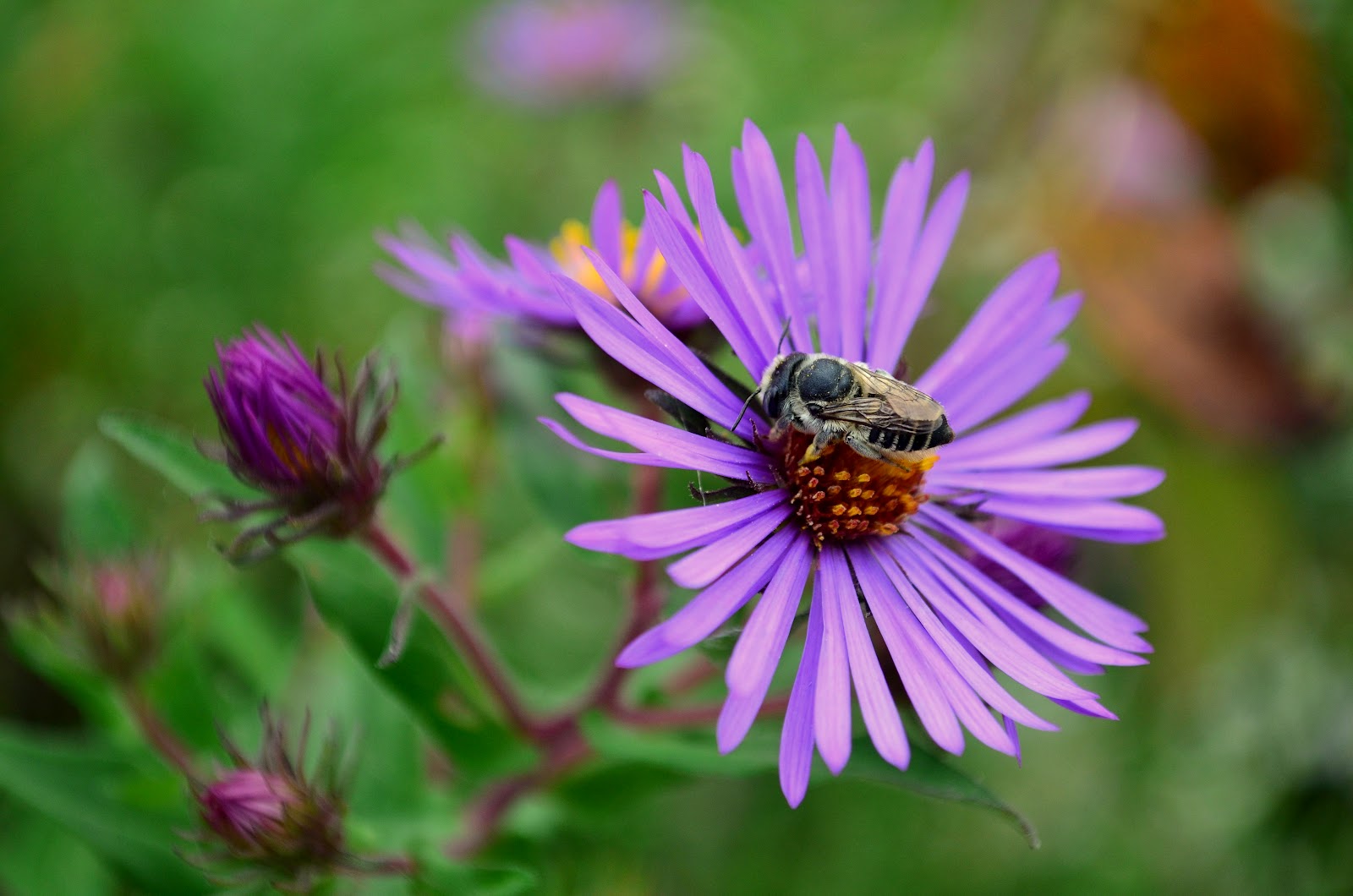
This is a female Leafcutter Bee on an Aster flower. I am not sure which Aster it is; it could be New England or New York Aster (or another species. If you can ID it correctly, please comment). Leafcutter Bees are native bees that get their name from their habit of cutting the leaves of plants for their nest cells. They are important for pollination, as this one is currently partaking in. They aren't aggressive like other bees in Ohio. They will sting, but only if you handle it and make it feel in danger. 


A wildflower, most likely some type of Aster. I am not a good flower person as of yet.

Sunday, September 30, 2012

Butterflies at Hargus Lake

The other day I was at A.W. Marion State Park in Pickaway County. Known as Hargus Lake by the locals because of the man-made lake that is the center of the park, the park offers a 5 mile lake perimeter trail, a half mile trail through a second growth forest, and a few other smaller trails and paths.

I came for the butterflies.


Subject number 1, and the prize of the day. A minuscule Dainty Sulphur. A butterfly that's generally rare in Ohio, this guy was just barely noticeable among the pebbles of the dog beach area. This year has been an invasion year for Dainty's in Ohio. There have been large numbers reported in many counties all across Ohio. This Dainty, like them all, was incredibly tiny, and I almost overlooked it.

These guys, Common Buckeyes, were definitely among the most common. There were dozens flying around. They aren't residents in Ohio, but instead migrate northward during the summer. This year I've seen a lot, and other years Buckeyes have been known to be absent from Ohio.

These two mating butterflies are Eastern Tailed Blues. They are another very tiny butterfly. Very beautiful in a subtle way. They are one of Ohio's most common butterflies, but tend to be overlooked by people who aren't looking for butterflies because of their size and non-in-your-face colors, like a Zebra Swallowtail. These two were flitting about and it was really hard to get a shot. Eastern Tailed Blues are found in Ohio from April to October, so they're on their last leg at the moment. If you look closely, you can see where they get the name "Tailed." They have tiny projections on each of their hindwings.  

There were a few others present at the park on the day I went. These included many Silver Spotted Skippers, Monarchs, Pearl Crescents, and a Red-Spotted Blue.