Showing posts with label Maine. Show all posts

Monday, January 21, 2019

Maine's Great Black Hawk Saga Comes to an End

For the past several months, a tropical bird of prey has been unexpectedly living in southern Maine. The mega-rarity—a juvenile Great Black Hawk—sent shock waves throughout the birding community, and thousands of birders made the journey to Maine to see a glimpse of the hawk. But the story is more complex than the hawk just showing up in one place and staying there for a period of time. Instead, it was a saga that began months ago in Texas, went silent, jumped to Biddeford Pool in Maine, went silent again, and then continued in a city park in downtown Portland, Maine. And yesterday the saga came to an end as the Great Black Hawk was entered into a wildlife rehab center after being found on the ground, injured.

ABA First Great Black Hawk
I was lucky enough to see Maine's famous visitor on December 30, 2018. I had traveled up to southern Maine for a short, unrelated trip, but I was only 20 minutes away from Portland, so of course I couldn't pass up the opportunity to see it! After a first attempted failed on December 29, I—along with my birding friends and about 30 other birders—finally saw the hawk on December 30 at Deering Oaks Park in downtown Portland. It was an easy find on that day; we simply pulled up to the park, parked the car, and walked up to the mass of people with binoculars and cameras who were all staring quietly at the hawk, who was perched in a spruce tree by the park's entrance.

Range map courtesy of Avibirds and NatureServe.
Why all the hubbub for this specific hawk though? The Great Black Hawk is a tropical species of raptor, found throughout central and northern South America, as well as throughout Central America up to southern Chihuahua and Tamaulipas in Mexico. Up until the specific Great Black Hawk in question showed up in Texas, there was no accepted record of this species from the United States. Simply put, a Great Black Hawk shouldn't be in the US, let alone in Maine of all places.

Several Great Black Hawks had been observed over the past few decades in a small area of southern Florida, but those records were never accepted by the rare bird committee of the state. To "count" in the official records, it has to be nearly certain that the rare bird in question is a wild individual that showed up into the area on its own volition. Great Black Hawks are known to be kept in captivity, and it could never be pinned down whether the Florida one(s) were wild vagrants or released/escaped captive individuals. To dive into that quagmire of a story—which spans decades—check out this detailed write up on the Tropical Audubon Society's page.

The Timeline

ABA First Record of a Great Black Hawk
The location of South Padre Island, Texas. Map courtesy of Google Maps.


The saga of the Texas/Maine Great Black Hawk began back on April 24, 2018, when a birder photographed a juvenile black hawk species on South Padre Island, Texas. It was initially uncertain whether it was a Common Black Hawk (a species whose range extends into southern Arizona and New Mexico, but have been recorded from southern Texas as well) or a Great Black Hawk. The ID was quickly confirmed as a Great Black Hawk as the photos were circulated on Facebook and elsewhere. A few other birders saw it within the hour or so it was discovered, but the bird quickly disappeared. Despite birders searching the island, it couldn't be relocated later that day, nor in the upcoming days. It appeared it was a one day wonder, something that often happens with rare birds.

The Great Black Hawk was a species that had been long predicted to show up in the southern US. Although it is a sedentary species across its normal range, the very northern tip of its range is only a mere 200 miles from the US border. So tantalizing close that many birders assumed one would eventually show up in Texas. When this one showed up near the Texas/Mexico border (near the famous birding hotspot of Brownsville, at that), it made logical sense. But what was about to happen made absolutely no sense.

Great Black Hawk Visits Maine
The location of Biddeford Pool, Maine, where the Great Black Hawk first showed up in Maine. Map courtesy of Google Maps.
Several months later, on August 6th, 2018, another birder found a juvenile Great Black Hawk in Biddeford Pool, Maine. Of course, this was an absolutely mind blowing observation of what would be a MEGA mega rarity; so mind blowing that the report was initially met with skepticism by some birders. Not only had the first apparently wild Great Black Hawk in the US shown up in Texas only earlier that year, which had been expected for some time, but now one had shown up in Maine? MAINE? It just seemed implausible. A completely hilarious debate ensued in the ABA Rare Bird Alert Facebook page post, where people began trying to identify the plants in the background of the photo posted to see whether those plants were plants native to Maine, or whether the photo had been taken in the tropics and passed as "Maine." People were also trying to match up the photos with Google Maps Street View.

In the end, it was confirmed that a Great Black Hawk was indeed in the Biddeford Pool area of Maine. Then the discussion moved to the next logical question: Was this juvenile Great Black Hawk the same juvenile Great Black Hawk that had shown up in Texas back in April? It simultaneously seemed both a ridiculous idea and a totally believable idea. 

Then, a close inspection of the markings on the undersides of the wings confirmed that the Texas and Maine individuals were, in fact, the same juvenile Great Black Hawk! Not only had this Great Black Hawk shown up 200 miles north of the northern tip of this species' range, but it then showed up around 1,970 miles further north in Maine over 3 months later. Of course, this raised the question of just where it had been during those 3 months. It had escaped detection that entire time, and no one knewand no one still knows nor will ever knowwhether it had booked it straight to Maine, or whether it had meandered to Maine and hung around in various other states for days, if not weeks, at a time. Despite the question of the time in between, it was in Biddeford Pool now. Well, it was there for a few days at least. It disappeared on August 9, where it had, seemingly, disappeared for good.

Great Black Hawk Deering Oaks Park
The location of Deering Oaks Park in Portland, Maine. This is where the Great Black Hawk was based for several months. Map courtesy of Google Maps.
And just when the story couldn't get any stranger, the Great Black Hawk appeared 81 days later in downtown Portland, Maine, only 18 miles to the north of where it had last been seen in Biddeford Pool. The initial report came from the Eastern Promenade, but the Great Black Hawk soon began making its home in Deering Oaks Park. Deering Oaks Park is a city park, complete with a large pond, baseball fields, tennis courts, some trees, and—perhaps most importantly—a large population of very fat Eastern Gray Squirrels.

The Great Black Hawk hung around Deering Oaks Park for the next several months, proving that a tropical bird of prey could apparently make it in through the Maine autumn and the first parts of a Maine winter. But then a large snowstorm hit New England on January 19th and 20th. During the early hours of Sunday, January 20th, a birder found the Great Black Hawk on the ground, apparently injured. It was quickly captured and brought to the home of a concerned Portland resident, who made some calls. That's when Avian Haven, a wild bird rehabilitation center, came in. Volunteers made the treacherous trip in the poor weather conditions to pick up the injured hawk and transport it to the Avian Haven. Initial inspections found that the Great Black Hawk had frostbite on its feet, along with some other minor problems. The hawk is now in stable condition
—as Avian Haven just reported on their Facebook page—and it will begin its (hopefully successful) journey toward recovery. What will ultimately become of the bird if it successfully recovers is still unknown, butas the Avian Haven pointed out—that question will get answered if, and when, the time comes.

UPDATE: On January 31st, 2019, Avian Haven reported that the decision had been made to euthanize the Great Black Hawk. The frostbite damage was just too bad; the feet had begun to decompose, and the behavior of the hawk had changed from lively to listless. Kudos to Avian Haven for trying all that could be done, and for ultimately making the hard, yet appropriate, decision to euthanize such a well-known individual.

Chasers, Listers, and Rare Birds

Birders Chasing the Great Black Hawk
The crowd of birders on December 30, 2018, when I saw the hawk.
The Great Black Hawk was seen regularly in Portland from October 29, 2018, to January 20, 2019. Because of how rare it was, and because of how consistently it could be found, thousands of birders ventured to Deering Oaks Park in Portland (a fantastic city, by the way). The Great Black Hawk became quite a celebrity, with it receiving both local and regional news coverage. On the day that I visited, over 30 birders were watching the hawk, and that was on a cold day in December.

If you're not in the birding community, you might be thinking how crazy all this is. And you would be right; birders can be crazy. While not all birders are like this, many take listing—or keeping track of all the species you seeseriously. It's the drive to see as many birds as possible that underpins this listing hobby. Some of that drive can be due to competitive reasons, or even simply due to an urge to see the biodiversity of birds as best as one can, or a combination of both. A subset of listers can be considered chasers, which are birders who will go out of their way to see a rare bird that shows up somewhere. Chasing can be as much as chasing a rare bird that shows up in your home county (as I did when a Black-Legged Kittiwake showed up in Pickaway County, Ohio), to getting on a plane and flying across the country. Several chasers I know in Ohio made the drive all the way to Portland (a 13 hour drive) just for the chance to see the Great Black Hawk in person. 

One of the interesting side effects of birders chasing a rare bird is the economic impact they bring to the local communities. Birders came from as far away as Arizona, and each person undoubtedly spent at least $1 in the Portland area. People would have bought hotel or AirBnB rooms, got lunch or dinner at local restaurants, spent time at local shops, and the likes. Birding tourism can have huge impacts on local communities. The Biggest Week in American Birding, held in northwestern Ohio, had a $40 million dollar economic impact in the local community last year. One study looking at the economic impact of birders chasing a rare bird—in this case a Black-Backed Oriole which showed up in Pennsylvania in 2017—found that the nearly 2,000 birders who went to see the rare bird brought in an extra $223,000 to the community over the course of 67 days. The Portland Great Black Hawk will, no doubt, have a similar impact, if not greater!

Why Was it There?

Great Black Hawk Portland Maine
Why did this juvenile Great Black Hawk do what it did? Why did it leave its normal range and venture not only to Texas, but 2,000 miles north to Maine? There are several possible explanations, but we will never know the answer for certain.

Birds regularly show up in places outside of their normal range. Some species do so more than others, due to both biological and meteorological circumstances. Sometimes weather events like hurricanes, strong winds, or storm fronts will push birds into new places. Sometimes young birds will disperse outside of their range either due to naivety or an attempt to find a new place to live (such as pioneering or colonizing attempts). Sometimes the internal navigational system of birds will be messed up, making a bird migrate north instead of south, or vice versa. Sometimes birds accidentally go a little too far when migrating, and end up further north or south of where they should be. Recent data suggests that insecticides might even be disrupting the ability of birds to navigate, which might be causing some birds to show up in unusual places on accident. There's a lot of reasons that can cause birds to show up in unusual places, and oftentimes it's very hard to pinpoint exactly which factor was at play.

It's especially difficult regarding the Great Black Hawk. The Great Black Hawk is a species that doesn't migrate, so migratory overshooting and misdirection don't make sense. The Maine individual is a juvenile, and so it dispersing 200 miles north to Texas makes some sense, but at the same time it doesn't make sense for a juvenile to disperse 2,000 miles north to Maine. Maine also has a history of southern species showing up, so this suggests some kind of weather-related events possibly at play, but there's no specific storm or front we can attribute to its arrival. From what I've seen, there's no obvious conclusion to be made about why this Great Black Hawk ventured this far north.

Leah Mould, Kyle Brooks, and Olivia Brooks Birding
Leah Mould (left), your blogger Kyle Brooks (center), and Olivia Brooks (right) in Deering Oaks Park, Portland, after seeing the Great Black Hawk. You can actually see the Great Black Hawk in this photo; it's the brown blob in the spruce tree above the person in the purple coat that's facing away. Photo Credit: Miranda Wheeler
Although the Great Black Hawk saga has come to a sad end, this crazy traveling hawk has impacted thousands of people around the US, and the local community as well. It's not the first time something like this has happened, as birders know all too well, and it won't be the last. What species will be the next big star, and where will it show up? Only time will tell!

Monday, June 11, 2018

Hiking The Beehive in Acadia National Park

Called by some as the "crown jewel of the North Atlantic Coast," Acadia National Park in Maine is the only national park that can be found in New England. It's a relatively small park by national park standardscoming in at "only" 49,000 acres—but it protects much of Mount Desert Island, the 6th largest island in the lower 48 states. Back in May, a few of the educators from The Ecology School—myself includeddrove the 3.5 hours from Saco, Maine, to Acadia National Park for a weekend filled with hiking and exploring. While there, one of the other educators and I decided to climb the  famous Beehive.

The Beehive Acadia National Park
The Beehive is a granite knob that rises 520 feet above the Atlantic Ocean on the southeastern corner of Mount Desert Island. You can access the summit via The Beehive Trail, whose trailhead is found just near the Sand Beach parking lot. This trail is challenging and offers beautiful views, but it also comes with a much higher risk factor than your average trail. To give you an idea of just what you're climbing up when you hike this trail, take a look at the photo above. The knob pictured is The Beehive. If you look at the zoomed in portion (remember you can always click on a photo to enlarge it), you'll notice a red circle. In that circle is a person, and that person is on The Beehive Trail.

Original figure made by Martin D. Adamiker [CC BY-SA 3.0 (link) or GFDL (link)], via Wikimedia Commons. Figure modified (addition of arrows and text) by Kyle Brooks.
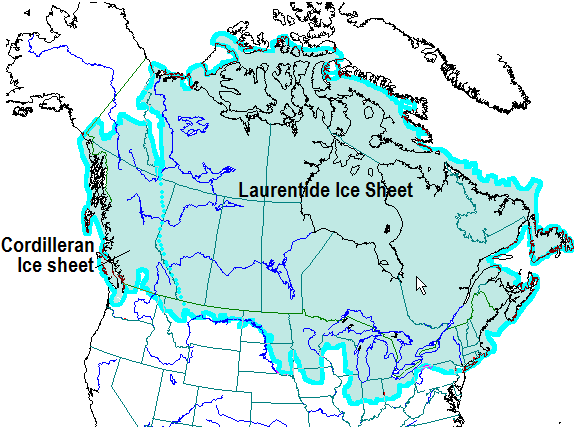
Before we get to what the actual hike is like, I want to spend some time talking about the geology of Mount Desert Island, and especially The Beehive itself. As with many places in the northern portions of the United States, Mount Desert Island was heavily shaped and modified by various glacial periods during the last Ice Age. The last glacial periodthe Wisconsin Glacial Episode—began around 70,000 years ago and finished up around 12,000 years ago. At its greatest extent, this giant sheet of ice completely covered Maine, including Mount Desert Island. In this part of the world, the glacier moved from the northwest toward the southeast. As it moved over Mount Desert Island, it eroded the mountains that were present on the island into long, yet narrow, formations that were separated by U-shaped valleys. 

The Beehive Geology Plucking and Abrasion
Left: A smooth granite face resulting from glacial abrasion.
Right: A jagged, steep granite face resulting from glacial plucking.
As the glacier eroded the mountains on the island, it did so in two different ways, all dependent on which direction the side of the mountain was facing. Take, for example, The Beehive. Parts of The Beehive experienced glacial abrasion, while other parts experienced glacial plucking. Glacial abrasion and plucking are both examples of how a glacier can erode bedrock, but these two types of erosion are a result of different factors and forces. Subsequently, they end up leaving behind different geological features after the glacier retreats. The northwest side of The Beehive was eroded by glacial abrasion. In this case, the glacier smashed directly into the northwest side of the knob. This force of pressure, coupled with the rocks embedded in the bottom of the glacier, smoothed and polished the bedrock like sandpaper on a piece of rough wood. This left behind a large face of smooth, rounded granite.

The southeastern side of The Beehive, however, experienced erosion via glacial plucking. As the glacier polished the northwest side of the knob, it moved over the knob and slid down the southeastern side. As the ice slid down this side, frictional forces caused some of the ice at the very bottom to melt. This liquid water then entered into cracks and joints that were already present in the bedrock, were the water consequently refroze. Since water expands when it freezes, this resulted in large boulders cracking and breaking free of the knob. These boulders were then "plucked" up by the bottom of the glacier, where they were transported and dropped into the ocean or elsewhere. The resulting rock face was not highly smooth and polished, but was instead a steep cliff side with a jagged face. It's on this plucked side of The Beehive that the trail ascends.

Photos of The Beehive Trail Maine
The trail up to the summit starts out easy enough. The trailhead is at the bottom of a gully lined with granite boulders of various sizes—many of which were dropped there after being plucked off the knob by the glacier. This part is straightforward; one just has to watch their footing as they walk from rock to rock and keep an eye out for the blue blazes marking the trail.

The Beehive Trail Mount Desert Island Maine
The boulder field eventually ends at the base of the plucked side of the knob. This is where the scrambling begins. Scrambling is the type of hiking that is in between walking and technical rock climbing. Basically, it's walking up or down a rocky area that requires you to use your hands relatively often, but it still doesn't require technical gear like rope and carabiners.

Metal Rungs The Beehive Trail
This is also the first part of the trail in which you encounter the metal rungs, which you will soon come to rely on. As with many of the steep, rocky trails in the national park system, metal rungs were added at some point along the trail for hikers to more safely navigate. In the case above, metal rungs were added so hikers could safely cross a gap in the rock face.

Sand Beach Acadia National Park
Rather quickly, you are rewarded with grand views of the southeastern side of Acadia National Park. Features like the Sand Beach come into view. Although sandy beaches are not rare in the world by any means, the Sand Beach in Acadia National Park is significant. Maine is not known for sandy beaches; in fact, of the 3,478 miles of shoreline found in Maine, there's only about 40 miles of sand-based shorelines (~1.15% of the total). The Sand Beach in Acadia National Park represents about 290 yards of that 40 or so miles, and the only sand-based beach you'll find on Mount Desert Island.

Climbing The Beehive Trail
While the trail gets higher and higher, and the views get better and better, the trail also becomes increasingly more climbing-based. The trail also becomes smaller, and gaps become more prevalent. At one point a short wooden bridge is required to cross a gap.

Views from The Beehive Trail
Your blogger embracing his inner mountain goat.
Some sections of the trail are very narrow, like the one pictured above. Sure-footing, grippy shoes, and patience are a must.

The Beehive Trail Maine
About halfway up the trail, you reach an "Oh boy" section—at least it was for me. There is a relatively long, and steep, section of the trail that requires lots of climbing up metal rung after metal rung. And to make things more interesting, decades of use by hikers have worn smooth the parts of the granite along the trail, making them slippery. This last half of the trail is extremely reminiscent of the Angels Landing Trail in Utah's Zion National Park. I hiked up Angels Landing in the summer of 2016, and that trail is another example of scrambling up a steep rock face with the use of metal rungs and chains. (Check out my "Hiking Angels Landing" post to see just what I'm talking about.)

Hiking The Beehive Acadia National Park
Leah ascends part of the more steep sections of The Beehive Trail.
Is the trail dangerous and hard to do? Yes and no. All hiking comes with risks. Although The Beehive Trail does have more risks involved than your average stroll through a city metro park, deaths and serious injuries are rare (but they do happen.) The trail itself isn't that strenuous for an average hiker that is at least somewhat in shape and has full control over their extremities. Hiking up the trail and returning via the Bowl Trail (it is not recommended that you descend the way you came up) is only 2 miles, and there's only about a 450 foot elevation gain in total. That's not much at all in the hiking world. The biggest challenge hikers face is the fear factor. Afraid of heights? Well, this trail might not be for you. I've heard stories about hikers getting halfway up the trail, only to become frozen in fear. The only way out is up, though.

The Beehive Summit Marker
If you don't mind heights and cliff sides, and you're willing to do a bit of non-technical climbing and scrambling, then you'll love this trail. It's absolutely beautiful, and it's been one of my favorite hikes that I've done east of the Mississippi River.

Kyle Brooks Nature Writer
Even though the summit is only at 520 feet above sea level, The Beehive sits on the edge of the Atlantic Ocean, so the views are fantastic. You can see miles and miles of the ocean, Mount Desert Island, and the mainland. If you ever find yourself in Downeast Maine, head over to Acadia National Park and hike The Beehive; you won't regret it!