Saturday, April 25, 2015

The Red-Backed Salamander, Plethodon cinereus

I've been wanting to do a big post on a species of amphibian that is near and dear to my heart for awhile now. With the semester coming to an end, I've finally gotten the chance to write it. This post is all about the Red-Backed Salamander, Plethodon cinereus. My aim is to give a general overview, with some interesting detailed bits, of this incredibly common species. Why is it so special to me? P. cinereus is the first species I've ever had the chance to do real research on. Starting back in the fall of 2014, I began a job as an undergrad research assistant at Ohio University. I work in Dr. Shawn Kuchta's lab under Maggie Hantak, one of Dr. Kuchta's Ph.D students. It's been an incredibly fun, and incredibly educational, experience so far. I'll talk more about her research and what I do at the end of this post.

That aside, let's move on to some basics! Be warned, this is going to be a really long post.

Red-Backed Salamander, Plethodon cinereus
The Red-Backed Salamander, Plethodon cinereus, is a terrestrial species of Plethodontid salamander. As with all other salamanders in the family Plethodontidae, the Red-Backed is lungless. Since they lack lungs, respiration instead occurs across the skin and the lining of the mouth. For these salamanders to breathe correctly, they must remain moist so gas can be exchanged freely across the cells in the skin. As a result, desiccation (drying out) is a constant threat to this salamander. In order to remain moist, they must inhabit areas that meet a certain threshold for moisture. These salamanders can be found in deciduous forests, mainly under rocks and logs where moisture is retained. When it is wet enough, they will travel throughout the leaf litter on the forest floor in search of food. During the summer months, when the heat dries out the top layers of the forest floor, P. cinereus will move into the ground, using old worm burrows or possibly making burrows itself.

P. cinereus
is an incredibly abundant species in the forests of the Northeast part of the US, and it can be found in nearly every county here in Ohio. In fact, P. cinereus is thought to be the most abundant vertebrate species in the Northeast quarter of the US. They can reach densities of 2.8 individuals per square meter in good habitats, making this species more abundant than birds and mammals combined. In addition, there is some compelling evidence that the 2.8 individuals per square meter number is actually an underestimate; it might be double that number (See Semlitsch et al., 2014)! It is important to note that the bulk of a given population of Red-Backed Salamanders lives below the surface, so trying to accurately estimate a population is difficult when you can only find those individuals who are on the surface (See Taub 1961). When Maggie and I travel to a good location in Northern Ohio, we can normally find at least one individual under every rock or log you flip. It's amazing to think that all those individuals we readily find under cover objects represent only a fraction of the individuals actually living in that location.

Red-Backed Salamander morphs
The two common morphs of the Red-Backed Salamander, with the red-stripe morph on the right, and the lead morph on the left.
One of the really interesting characteristics about this salamander is its color polymorphism. Polymorphism is where there are two or more clearly different phenotypes (an individual's set of physical traits) in a species. Generally speaking, P. cinereus exhibits three color morphs. First is the red-stripe morph (pictured above on the right). This is by far the most common morph. The second most common morph is the lead (or lead-backed) morph (pictured above on the left). The third morph is the erythristic morph, which is very rare. The erythristic morph is essentially all red with a creamy white stomach. In addition to these three morphs, there are several other rare color anomalies: iridistic, albino, leucistic, amelanistic, and melanistic. You can read more about the different color phenotypes in J.D. Moore's paper here.

As stated previously, the red-stripe morph is by far the most common, especially in Ohio. There are, however, many polymorphic populations. Northern Ohio has a relatively high density of polymorphic populations, where one can find both the lead and red-stripe morph (and occasionally the erythristic morph) all living together in the same location. The ratios between the morphs vary according to each site. Interestingly, there are a few all-lead populations in Ohio, such as the population on South Bass Island. This is not a common occurrence by any means.

Iridistic Red-Backed Salamander
There is an extreme amount of color variation not only between color morphs, but also within the morphs and anomalies. At some locations we visit, the red-stripe morphs have a very bright and well defined red stripe. At other locations, the red stripe is very mottled and dull with high amounts of black across the body. On the other side of the coin, the leads at some locations are a very dull and subdued black, while other locations have very iridescent and beautiful leads, like the one pictured above.

Red-Backed Salamander juvenile
Unlike many salamander species, P. cinereus does not have an aquatic larval stage. The entire life cycle is terrestrial, and that means we run into many juvenile individuals when in the field. And the juveniles are cute. Extremely cute. Pictured above is a small (yes, small) adult red-stripe individual next to a juvenile lead individual. Many of the juveniles we find could easily fit on a penny.

Red-Backed Salamander eggs
Most, but not all, salamanders lay eggs, and this includes the Red-Backed Salamander. When we measure the salamanders, we are able to see the eggs of any pregnant females. These eggs can be very pronounced, as the photo above shows. If you count carefully, you can see a total of 8 eggs (the white blobby things in the abdomen) in the individual above. As mentioned earlier, while many salamanders have an aquatic larval stage, the Red-Backed is completely terrestrial. The eggs are laid in a protected area, mainly in rotten logs. There is a larval stage, but this stage happens completely in the egg. Upon hatching, the juveniles are fully developed and essentially a smaller version of the adult.
Red-Backed Salamander male and female
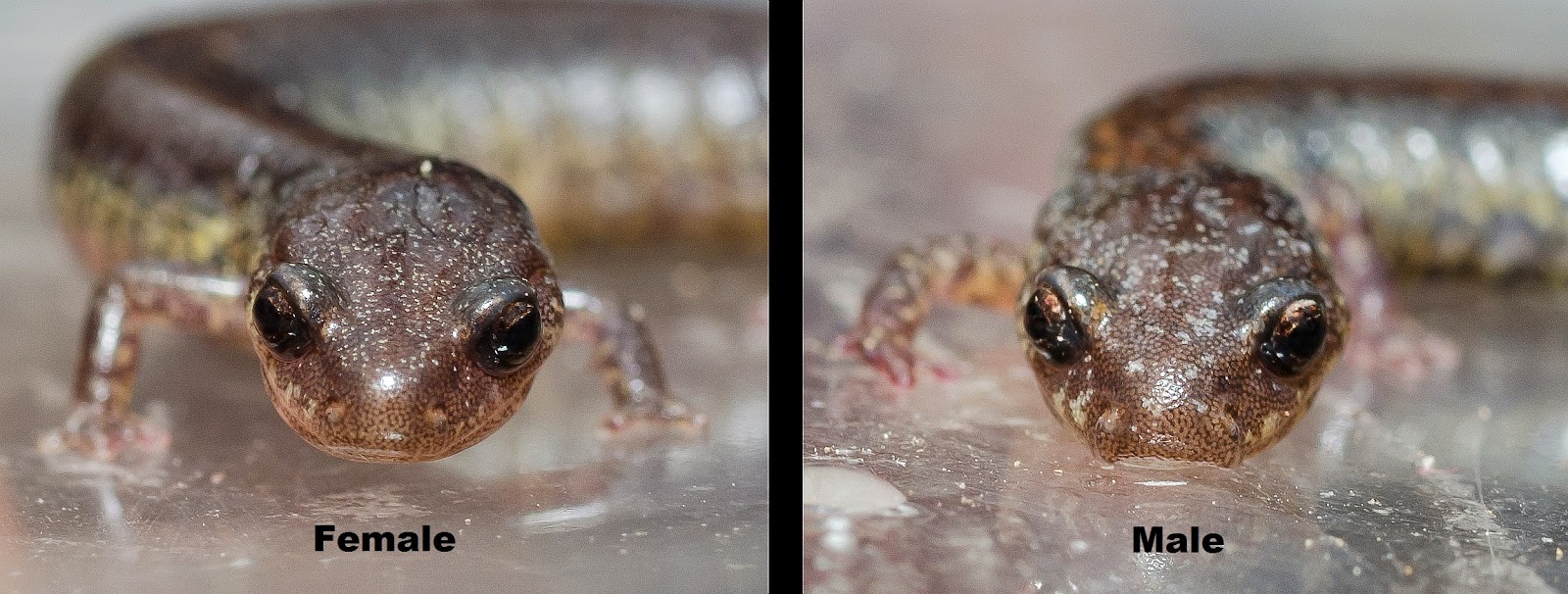
How do you tell the sex of a Red-Backed Salamander? There are a few differences between the two sexes, but the easiest way is to look at their heads. Females have a very round snout. Males, on the other hand, have a very broad, square-like snout, which you can see above. Another feature to look for is the presence of cirri. Cirri (singular cirrus) are a fleshy downward extension of the upper lip. Cirri function as chemoreceptors, and the males use these for a multitude of reasons, most commonly to sense out a potential mate's pheromones. You can see the cirri on the male above; they are the two tiny, mustache-like extensions hanging down on either side of the snout. As always, you can click on a photo to view a larger version of it.

Red-Backed Salamander missing tail
One of the incredibly interesting characteristics of salamanders is their ability to regenerate whole limbs and parts of major organs. It's a tough world out there, and salamanders can lose parts of their body due to predators, but also due to fights with larger salamanders. Red-Backed Salamanders are known for being fiercely territorial, and they will defend their territories against many different intruders like the Northern Ravine Salamander, Spotted Salamanders, or centipedes, occasionally resulting in the loss of limbs. The tail is the part that is most often lost, like in the individual above. When it comes to tails, salamanders are like lizards. When in a situation with a predator, the Red-Backed Salamander will wave its tail in an attempt to get the predator to go after that part instead of elsewhere. As soon as the predator latches onto the tail, the tail pops off giving the salamander time to escape. The tail wiggles violently for a short bit to confuse the predator even further in order to hopefully allow a safe escape for the salamander. Salamanders can regrow legs in only 7-10 weeks, but tails take a little long due to their size and how much actually comes off. The individual above (who was found in the Fall) probably has a fully regrown tail by now.

Red-Backed Salamander diet
While the Red-Backed Salamander is a prey item for many other animals, it is still a ferocious predator itself. I'm currently in the middle of a dietary study that aims to find out if there is a difference in the type of food the red-stripe and lead morphs eat. The Red-Backed Salamander eats a large variety of arthropods, although I did find a weird one who ate a mushroom. The photos above give you an idea of some of their usual prey items. On the far right is their favorite type of food, mites. There's an incredible diversity of mite species on the forest flood, and the salamanders will eat many of them. In the center are Springtails, another favorite. On the far left is a pseudoscorpion, one of the more awesome-looking arthropods they eat. In addition, they also consume ants, beetles, assorted tiny wasps, spiders, and more.

Partially erythristic Red-Backed Salamander
One of more interesting individuals we've come across so far this Spring is the one pictured above. We had traveled to a location where around 15% of the population was erythristic (an unusual reddish or orange coloration). While we didn't find any completely erythristic individuals, Maggie did find the one above which exhibits partial erythrism. Note how most of the body is a red-orange, while the stomach is a creamy white. There's too much black on the individual for it to be considered completely erythristic, but you can tell it is definitely not a normal red-stripe individual. If you're interested in learning more, partial erythrism and erythrism in general is covered in the J.D. Moore paper that I linked to earlier in the post.

Silver-Striped Red-Backed Salamander
Several weeks after I wrote this initial post, we came across another interesting individual, pictured above. This is what has been called the "Silver-Striped" or "Silver-Backed" variant of the Red-Backed Salamander. As you can see, the stripe running down the back in this individual is a silvery-grey color instead of the normal red color. Sadly there's not much information I can find on this color abnormality other than assorted photos of similar individuals. Vincent Farallo, an Ohio University graduate student, did tell me that he has seen a lot of individuals like this at Strouds Run State Park in Athens County.

Maggie Hantak
Maggie Hantak measuring a Red-Backed Salamander using a method termed "Mander-Mashing." Seriously. (No salamanders are harmed in this process.)
As I mentioned earlier, I currently have a job as an undergrad research assistant. My job is essentially to help Maggie Hantak, a Ph.D student at Ohio University, collect data at her field sites in Northern Ohio, as well as working independently on a dietary study for her. In a nutshell, Maggie is exploring multiple facets of the evolutionary ecology of the Red-Backed Salamander with regard to the differences between the red-stripe and lead morphs. She's been a wonderful mentor to me and has helped me get involved in real research. I'll be spending the first half of this summer in Northern Ohio as her field assistant, with the last half spent down in Athens to try and finish the dietary study. I'll also hopefully have the opportunity to begin my own research on Plethodon electromorphus, the Northern Ravine Salamander, this summer.  As of October, 2016, I am beginning my own independent project on the Northern Ravine Salamander. Stay tuned for more information in the upcoming months!

I've got several more salamander posts in the works that I'll hopefully be finishing up sometime during Summer, so if you're a herpetology person, stay tuned! Otherwise, I'll be covering the usual interesting things I come across this summer, including flowers, birds, insects, parks and more. Thanks for reading!

Saturday, March 28, 2015

Two Rare Geese on the Hocking!

Okay, so this is horribly overdue, but here it is nonetheless. The Sunday of February 8th, I decided to head up to The Ridges, an Ohio University owned hiking complex on the edge of Athens in Athens County, to do some birding. It was a good trip for mid winter, but the real surprises of the day were found when I was walking back to Ohio University. As I was crossing the Hocking River, I decided to scope out the larger and ever-present resident population of Canada Geese. A local birder had found two Greater White-Fronted Geese a few days prior, and although I didn't think they would still be hanging around, why not look?

Greater White-Fronted Goose Ohio
I relocated them within 30 seconds, much to my surprise. After a few obligatory seconds of freaking-out-over-a-lifer, I crossed the bridge and decided to get a better view. So why all this hoopla over a goose? Well, the Greater White-Fronted Goose is a pretty rare visitor to Ohio. When they do show up here, it's mainly in the glaciated portions of western Ohio and along Lake Erie; to have not one, but two, show up in southeastern Ohio, in a pretty urban area, was really unexpected.

Greater White-Fronted Goose
The Greater White-Fronted Goose, Anser albifrons, is a goose of the west. The North American populations (they are also found in Eurasia) breed on the tundra of Alaska and northern Canada. They overwinter in disjunct regions in the southern US and Mexico, including the Central Valley of California along with southeastern Texas and Louisiana. They migrate mainly along the Pacific and Central Flyways. The Central Flyway goes up and down the Great Plains region.  If you haven't noticed yet, they're a little out of place here in Athens, Ohio. Although they are a bird found mainly west of the Mississippi River, a few individuals do stray east into Ohio every year.

Greater White-Fronted Goose Ohio
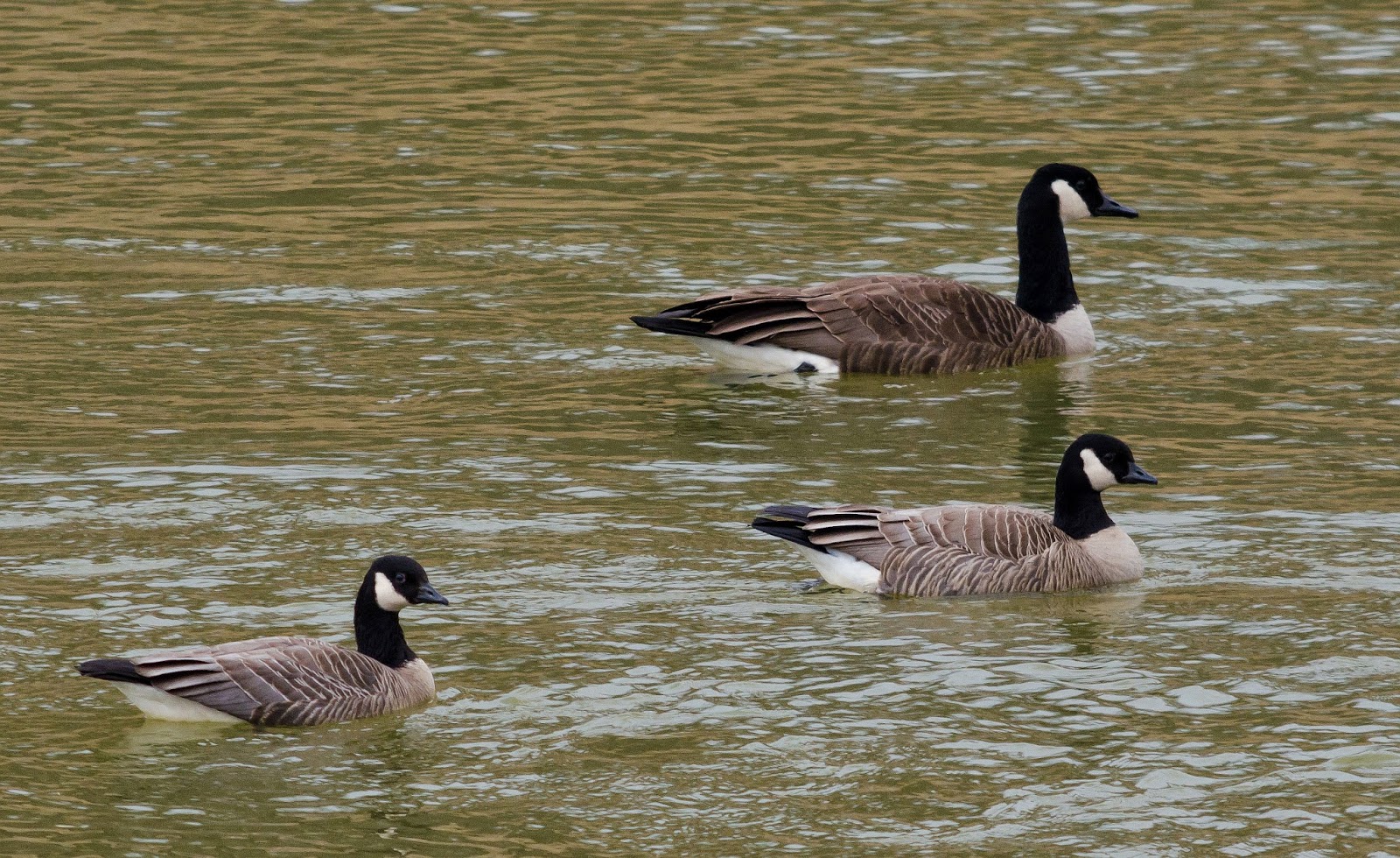
The Greater White-Fronted Goose is a relatively small goose. Compare the size of the Canada Geese with the White-Fronted in the photo above to get an idea of the size. I knew they were smaller, but their size honestly surprised me when I saw them. They were just so dainty!

Greater White-Fronted Goose Athens Ohio
These geese are sometimes nicknamed "Specklebellies" here in the US. The dark bands and speckles going across the breast, as seen above, give rise to this name. You might also be wondering about the "Greater" in their common name as well. If there is a Greater White-Fronted Goose, is there a Lesser? There is indeed a Lesser White-Fronted Goose, but they are not found here in North America. Greater White-Fronted's are circumpolar breeders, meaning they breed all around the northern half of the world, including Canada, Alaska, Greenland, and Siberia. Lesser White-Fronted Geese are restricted to Eurasia, breeding primarily in northern Asia. They are superficially similar to the Greater White-Fronted, with the biggest difference being their smaller size. For some reason in the geese, "dwarf species" have arose several times. For example, the Greater and Lesser White-Fronted Geese, Snow and Ross's Geese, and Canada Geese and Cackling Geese.

Greater White-Fronted Goose Flying
Interestingly, these two individuals stuck around Athens for awhile. I assumed they would try to move on relatively quickly, but they were repeatedly found for about 3 or so weeks total.

Cackling Goose Athens Ohio
After watching the Greater White-Fronted Geese for awhile, I decided to scan the rest of the river to see if there were any ducks hanging around. Of the near 100 Canada Geese hanging around, two immediately made me stop scanning. My mind started racing; could those two small geese be what I thought they were? Could it really be that the Hocking River not only held one rare species that day, but two? Could they really be Cackling Geese, yet another lifer for me?

Cackling Goose Ohio
I looked over their field marks: Tiny, Mallard-like size? Check. Short, stubby neck? Check. Squarish forehead with a very short beak? Check. Yes! It was a Cackling Goose, Branta hutchinsii! I was completely amazed; not only was I lucky enough to relocate the rare Greater White-Fronted Geese, but I also found two Cackling Geese to boot! Cackling Geese are another species of western geese that occasionally visit Ohio each winter. They breed along the Arctic tundra and migrate primarily through the Great Plains and down the Pacific coast, overwintering in both Texas/New Mexico and California/Oregon/Washington, respectively. Most of the individuals that move through Ohio are found in the western half of the state, especially near Lake Erie. Finding two in Athens County was yet another unexpected treat.

Cackling Geese Ohio
The Cackling Goose is a "newer" species. Up until 2004, the Cackling Goose was considered one of the many subspecies of the Canada Goose. Some research concluded that it was indeed a different species, a relatively common occurrence. Many subspecies get elevated to the species level, and sometimes two or more species are lumped together into one species. The act of lumping and splitting species has especially increased with the rise of genetic studies in the past decade. More genetic research has found that there are a number of highly distinct subspecies of the Cackling Goose, so future studies might even result in a further split.

The semester is winding down for me, with only about a month to go! This semester has been crazy, making it really hard to find time to blog. Hopefully this summer brings me more time to write. I will be spending the first half of my summer in northern Ohio doing more salamander research, and I am very excited for that. The second half of my summer will be spent in either New Mexico for an internship, or back in Athens for snake research. I'm hoping that I'll come across some awesome stuff to write about since most of my summer will be spent outside! Thanks for reading!

Monday, February 2, 2015

Spiders, Spiders, and More Spiders

So it's been awhile since I've lasted posted, more than a month actually. I've found myself in sort of a writing rut, and school has been a busy whirlwind of things to do so far this semester. I haven't been able to get to writing like I've wanted too. Excuses aside, I'm back.

Jumping Spider eating fly
A jumping spider (possibly Paraphidippus aurantius) chows down on a fly.
So here I am, writing a new post. This one is about a group of much feared, much hated, much maligned animals. Spiders. Why dislike spiders? I think most of that is societal. Most children are taught to dislike and fear spiders. "They're dangerous," or "They're scary." They keep that mindset as they grow up and end up passing that mindset onto their own children, perpetuating the completely-unnecessary and inane spider hate we have in our culture.

Are spiders really dangerous? A few species are dangerous. But dogs are dangerous, and horses, and most other pets. Yet people love dogs, horses, cats, and the like. We acknowledge those animals can hurt us, but we respect them in such a way that we minimize the risk of getting hurt. This is exactly how we should treat dangerous spiders, or any animal really. You don't go up and hit a stranger's dog, or any dog; that is asking to be bit. No one blames a dog that bites a person when it feels like its well-being is threatened and it must defend itself; and just like the dog, we should not hate spiders simply because we might force an individual into a predicament where that individual fears for its well-being and bites us. That is our fault, not the spider's.

Wolf Spider Schizocosa
A large, but completely harmless, wolf spider of the genus Schizocosa.
Almost all spiders are venomous, but that venom is almost always too weak to hurt a human. There are a few species of spiders with venom that can harm a human. In Ohio, we have up to three species of truly dangerous spiders. The first two are black widows, specifically the Southern Black Widow (Latrodectus mactans, photos here) and the Northern Black Widow (L. variolus, photos here). Both species are highly uncommon, but can be found throughout Ohio. They are shy, rarely encountered spiders (I've only seen one, and I've been looking for them), and a bite from them, while painful and often requiring medical attention, will almost never end in death for a healthy adult.

The last dangerous spider species is the Brown Recluse (Loxosceles reclusa, photos here), depending on who you talk to and what range maps you look at. It is unsure if we have native Brown Recluses in Ohio; ODNR says there have been no verified specimens from outdoors, but that doesn't necessarily mean they aren't there. The very few that have been recorded in Ohio have been found indoors, most likely brought in by humans from elsewhere in their range, as they like to catch rides on furniture and the likes. Regardless, Brown Recluses in Ohio are very, very rare and highly restricted to the area around Cincinnati. It is important to add a note about their bite. Brown Recluses get a bad rep for their bite, which supposedly causes necrosis around the bite area. If you're seen photos of supposed bites, you know what I'm talking about. However, studies have found that only about 37% of Brown Recluse bites actually result in necrosis (the death of tissues). On top of that, studies have also estimated that nearly 80% of all "Brown Recluse bites" have actually been misdiagnoses. Most of the time it's actually MRSA, but can also be a host of other infections. The point is, Brown Recluse bites are incredibly rare due to their shyness, and even when they do bite it will most likely be harmless. If you ever see a supposed photo of a "Brown Recluse" bite, always be wary; it's more than likely something else. Another important thing to add is that doctors are not entomologists. Unless you watch a spider biting you, you can never be sure a wound was caused by a spider. On top of that, a doctor can never positively identify a spider species from a possible bite unless they have the actual spider.

Spiders do bite, there is no denying that. And in Ohio, unless they're one of the three listed here, you will be fine. Many spiders rarely bite, and it takes a lot to make them want to bite you. You have a better chance of being stung by a bee than bit by a spider. Most spiders bite when a human accidentally begins crushing one, like if you're putting on a shoe with a spider in it, or with other cases of making the spider feel in danger. Regardless, treat all spiders with respect and obviously be aware if the spider starts acting defensively, in which case they are probably to the point of biting.

Dark Fishing Spider dolomedes tenebrosus
The spider above is one that many people completely freak out about when they see one. Meet the Dark Fishing Spider, Dolomedes tenebrosus. Dark-Fishing Spiders are some of the largest spiders in Ohio, reaching up to a total size of 4 inches across (basically the size of your palm). While massive, these guys are totally harmless. They are really shy and will many times run away upon seeing a human. Occasionally they will wander into buildings and homes, often resulting in terror-stricken inhabitants. There's no need to worry; simply try and carefully put it in a plastic container in order to release it outside! Dark Fishing Spiders are forest spiders. They do not build a web, and instead actively hunt down prey. Look for them low on tree trunks at night, or near rocky areas with water (which is where I find most of mine).

Six-Spotted Fishing Spider, Dolomedes triton
Next up we have another fishing spider, the Six-Spotted Fishing Spider, Dolomedes triton. Spiders in the genus Dolomedes are known as Fishing Spiders as most of them are at least semi-aquatic. The previous Dark Fishing Spider is not always that aquatic and can be found very far from water. The Six-Spotted Fishing Spider, on the other hand, is the most aquatic fishing spider in Ohio. These guys are really cool. This species can actually walk on water, as shown above. They will often wait on the surface of water for prey to come by, or actively hunt prey down. Water Striders are a favorite, as are terrestrial insects that fall helplessly into water, but the Six-Spotted Fishing Spider will also hunt prey in the water. They are capable of diving up to 7 inches under the water to catch aquatic invertebrates, tadpoles, and even small fish! Pretty awesome, eh?

White-Banded Crab Spider, Misumenoides formosipes
This tiny spider sitting on a flower is a White-Banded Crab Spider, Misumenoides formosipes. It's small, but note the characteristic white-band that runs across the face underneath the eyes. If you want a larger version of the photo, just click on it! This species, as the name suggests, is a species of crab spider, family Thomisidae. The crab spiders are so-named for their crab-like appearance. Most, but not all, crab spiders in the family Thomisidae are sit-and-wait ambush predators, as the White-Banded Crab Spider is. Basically, they sit on a plant like the one above and wait for an unlucky pollinator to come by. If the pollinator is the right size, the spider will lunge and grab it for a meal. The individual above is a male White-Banded Crab Spider. The males of this species have a golden abdomen with their four front legs being dark brown/black. The females of this species can range from gold to white. Interestingly, the females can actually change color to match the flower they are sitting on. For example, if a female picks a white flower to hunt from, she will become white, and if it's a yellow flower, she will become yellow. The males, like the one above, are locked in with their colors, however. Most of the time people are taught that the females change color in order to be camouflaged so they can be undetected by potential prey until it's too late. A relatively recent study (Brechbühl et all, 2006) has found that this is not the case; color-matching individuals had the same success rate as mismatched-colored individuals. The actual meaning behind changing colors is still up for debate, but it most likely isn't for better hunting success.

Pisaurina mira
And last we have one of my favorites, Pisaurina mira, also known as the Nursery Web Spider. This species loves to hang out on the edges of forests, especially when there's bushes, tall grass, and other similar herbaceous plants. I always find many at A.W. Marion State Park in Pickaway County where a medium sized marsh/grassland area transitions into an established forest. These are large spiders, with some individuals I've seen approaching 2.5 inches wide (that is including the legs). They come in a range of colors, from very light yellow-brown to a dark brown. The markings are somewhat variable as well; BugGuide has a nice layout of the different variations, which you can see here. Why are these known as the Nursery Web Spider? Like the others I went over in this post, this species does not build a web to capture prey; instead it actively hunts down prey. The females of this species (and the others in the family Pisauridae) will, however, carry around an egg sac (photo here). Upon the spiderlings nearing hatching, the female will construct a "nursery" made out of web and place the egg sac inside. After the spiderlings hatch, the female will defend this nursery in order to keep her hundreds of offspring alive.

So I ended up writing a lot more than I thought I would, but I just love spiders. I love how misunderstood they are, and they're just so amazing once you can get past the whole "ew a spider" issue so many people have. If you don't like spiders, I strongly urge you to give them a chance!

Wednesday, December 24, 2014

The Downy Woodpecker

Several days ago I bought a new 300mm telephoto lens. I've been eager to try it out, and December 21st was just the day to do so. I traveled out to a few local parks, including the newer Mary Virginia Crites-Hannan Park right outside of Circleville in Pickaway County. Although a smaller park, there's a decent patch of second-growth forest and a nice prairie they planted about four or five years ago. It's a really birdy park too, which brings me to the subject of this post. There were at least two Downy Woodpeckers in the small area I explored and I was able to get a few photos of them.

Downy Woodpecker
Downy Woodpeckers, Picoides pubescens, are probably the most common woodpecker species in the United States. They can essentially be found from coast to coast and everywhere in between, aside from some desert regions like western Texas, Arizona, and smaller parts of southern California and Nevada. They inhabit a range of forest types and even open areas where they will feed upon insects found on small herbaceous plants. Downy Woodpeckers are nearly identical to the Hairy Woodpecker, but there are a few differences to look for in the field. A big one is the size; Downy's are only about 2/3 of the size of a Hairy. Another is beak length; a Hairy Woodpecker's beak is about the same length as its head, but a Downy's beak is much smaller (as you can see above). You can read about some of the other differences here. In Ohio, when you come across a Downy/Hairy woodpecker, it's much more likely to be a Downy. Hairy's are not rare by any means though.

Downy Woodpecker Ohio

Woodpeckers are well-adapted to their bark-clinging lifestyles. If you look at the photo above, you can see a Downy's large feet with large, curved claws; this helps with clinging to bark. Woodpeckers are also a bit different from other terrestrial birds. Most terrestrial birds have feet with three toes facing forward and one toe facing backward; this arrangement is known as anisodactyl feet. Essentially all woodpeckers have zygodactyl feet, which is where two toes face forward and two face backward. This arrangement also helps woodpeckers cling to bark better. Woodpeckers also use their tail to brace themselves as they cling to bark. If you look at the previous photo, you can see this in use; the tail is pushed down against the branch in order to help stabilize the woodpecker. A woodpecker's tail is made up of very stiff feathers, and these feathers are attached to large muscles which allow for a range of fine muscle control. If you've ever seen a woodpecker climb up a tree, you've probably noticed that it climbs in short, jerky bursts instead of one fluid motion. Woodpeckers actually climb by using their feet and tail. A woodpecker will lean close to the bark, which takes pressure off the tail, and then push straight up with their legs. They will then swing their legs up quickly and grab the bark once more before bringing their tail down to stabilize everything. They will repeat this method to ascend a tree, which gives them their jerky climbing appearance.

Downy Woodpecker Ohio
While on the trail, I found another Downy on a large, dead tree. I quickly noticed it was a female Downy Woodpecker since it lacked the red found on the males' heads (which can be seen on the two previous photos). She was standing in one place and excavating a cavity. I first thought that she was excavating a nesting cavity (all woodpeckers are cavity nesters), but it seemed a little early for that. I looked around on the internet and my suspicions were confirmed; Downy Woodpeckers begin excavating their nest cavities in mid April and May. So what was this one doing?

Downy Woodpecker Excavating
It turns out that Downy Woodpeckers not only nest in cavities, but they also roost in cavities. While they mainly excavate roost cavities in the Fall, they will also do it whenever they need to. I'm assuming that this is the case for this individual. A Downy's roost cavity is built a bit differently from their nest cavity. The main difference is the depth of the cavity; a nest cavity is deeper than a simple roosting cavity. Roost cavities are also built to hold a single individual, instead of a bunch of hatchlings.

Downy Woodpecker Excavating
I stood around for awhile and watched as she worked on the cavity. Eventually she took off, probably to forage for some food.

I haven't had many bird-related posts on this blog, but that has started to change in the past month. I'm a bird-guy first and foremost, but I haven't been able to get any decent photos with the lenses that I had. With my new 300mm lens, I should have more opportunities to get some photos, and hopefully that means more bird posts, so keep on the lookout!

Monday, December 1, 2014

Black-Legged Kittiwake in Central Ohio!

I'm sorry for the short absence. I've been preparing for finals week, and then, more importantly, getting it over with. But now that finals week is finally over, I finally have a chance to breathe, relax, and blog!

During the week of Thanksgiving, Robert Royse found and reported a juvenile Black-Legged Kittiwake at Deer Creek State Park, specifically the section that lies in Fayette County. Black-Legged Kittiwakes, a species of gull, are a rare visitor to Ohio. Most of the ones that do end up in Ohio show up along Lake Erie, but occasionally you'll get one that shows up in an inland reservoir. This individual was one of those few that showed up inland. To make it even better, it showed up at a park only 30 minutes away from my hometown, and luckily I was there on break. Before returning to Ohio University on Sunday morning (Nov. 30), I ventured out in search of the then-continuing Black-Legged Kittiwake. As with many rarities, dozens of other birders had already made the trip to "chase" the bird, and dozens more would chase it on the day I went.

Deer Creek State Park
The kittiwake was said to be hanging around the upper part of Deer Creek State Park, right where Long Branch (a creek) feeds into the man-made reservoir. As I pulled over to park, the site above greeted me. You might ask where's the lake, and that's a good question. Every winter they lower the reservoir by about 14 feet. Since this part of the reservoir is where it begins, draining the lake by that much is enough to reduce the water to a small stream and leave expansive mudflats behind. The lake still remains if you head to the beach or other parts of the reservoir though.

There were already three birders present by the time I arrived there around 8:40 AM. They were scanning as I was getting my gear out, but they hadn't relocated it yet. It's always a gamble when it comes to chasing continuing rare birds, especially when you go early in the morning; it might have been there for a week straight but decided to leave the night before you went. Anxiously, I joined in and scanned the horizon, only to find a handful of Bonaparte's Gulls. Suddenly, we saw a small gull flying in from down the reservoir. Holding our breaths, we turned to the gull...

Black-Legged Kittiwake Flying
And lucky for us it was the kittiwake! I quickly tried to snap at least an identifiable photo, which is pictured above. So why are Black-Legged Kittiwakes, Rissa tridactyla, so rare in Ohio?

Range map created by Terry Sohl at South Dakota Birds and Birding. Go check out his wonderful photography!

A quick look at a range map should give you a pretty good idea as to why Black-Legged Kittiwakes are rare in Ohio. Black-Legged Kittiwakes are a true "sea gull." They nest on sea cliffs in northern Canada and all around Alaska before heading out to sea to spend the winter. Occasionally a young bird, like the one at Deer Creek, will wander inland during the winter. Adult visitors to Ohio are much, much rarer (but have still been recorded).

Black-Legged Kittiwake Ohio
After some hunting, the kittiwake decided to rest and preen on the rock above, which was its favorite roosting place (as evident from the white-wash on the rock). It really is a gorgeous gull, which are birds that many people pass by. A day or two after I visited it, it decided to head out and hasn't been relocated since. Hopefully it ventures back out to sea.