Thursday, June 4, 2015

Northern Parula

This year's Spring migration is all but a memory now, and most species are currently focusing on raising a successful brood. I, however, want to revisit a day during migration for this post. On May 19th I had the chance to visit the famous boardwalk at Magee Marsh along Lake Erie. Sadly, I was a few days late for the Biggest Week in Birding, but Spring migration was still hopping. I saw many warblers and assorted other migrants, but one Northern Parula gave me and a few other birders quite the show. I was fascinated by this Parula and decided to write up a post about the species, so here we go!


The Northern Parula, Setophaga americana, is a small migratory warbler. You might be wondering where in the world the name "Parula" came from. When this species was first classified by Carl Linnaeus in 1758, Linnaeus considered it to be related to the tits of the Old World. The name for this genus was Parus, and that was slightly changed to Parula for the common name of this species. However, the Northern Parula isn't a tit, and is instead a new world warbler. Like other neotropical warblers, the Parula spends half the year in more southerly climes and the other half in more northerly climes to breed. During Spring (April-May in Ohio), this species migrates from parts of Central America and the West Indies to the Eastern United States and Eastern Canada. It then spends the next few months trying to find a mate and raising a new generation before migrating back south to overwinter.

Northern Parula Magee Marsh
Where can you find this species in Ohio? Well, it depends on when you're looking. They can essentially be found anywhere across Ohio during migration, especially in the southern portion of Ohio and along the Lake Erie coast. It's a little harder to find this species during the Summer. They breed in the Allegheny Plateau region of Southern and Eastern Ohio, becoming scarcer the farther North you travel. The Northern Parula breeds in well-established forests here in Ohio. The older forests of Southern Ohio typically hold a good number of individuals. You can always find some in the Hocking Hills region, as well as Adams County. If you're looking for one though, good luck! The Northern Parula is a tree-top gleaner, meaning it feeds on insects that live on the branches in the canopy. Parulas are also roughly the same size as a chickadee. Spotting this tiny bird when it's 80 feet up in the leaves is definitely a frustratingly hard thing to accomplish. To help know when there's a Northern Parula near you, learn their song! It's a fairly easy song to learn, and you will find ten times more individuals this way than you would by just scanning the trees in hope for one. To listen to some examples of their songs, go to this link and look on the bottom right for "Songs and Calls."

Northern Parula Ohio
At Magee Marsh during Spring migration, things are a little different. Tree-top gleaners, such as the Northern Parula, might be only 5 feet off the ground. On top of that, the warblers are so focused on getting enough food to make it across Lake Erie that they essentially ignore all the people around. That means there might be a warbler only an arm's length away and right at eye level. Regardless of how cheesy it sounds, I can only describe Magee Marsh as a magical place, and birders who have made the trip know exactly what I'm talking about. This Northern Parula was no exception, foraging right at eye level only about 5 feet away. In the photo above you can see him checking out a leaf for a possible tasty arthropod morsel.

Northern Parula
And turns out there was indeed a tasty arthropod about! He quickly pulled a tiny green caterpillar off the leaf, which you can see in his beak above. As always, you can click on the photo to get a bigger version. While the Northern Parula eats a wide variety of arthropods, their favorites are caterpillars and spiders.

Northern Parula Eating
Another caterpillar victory!
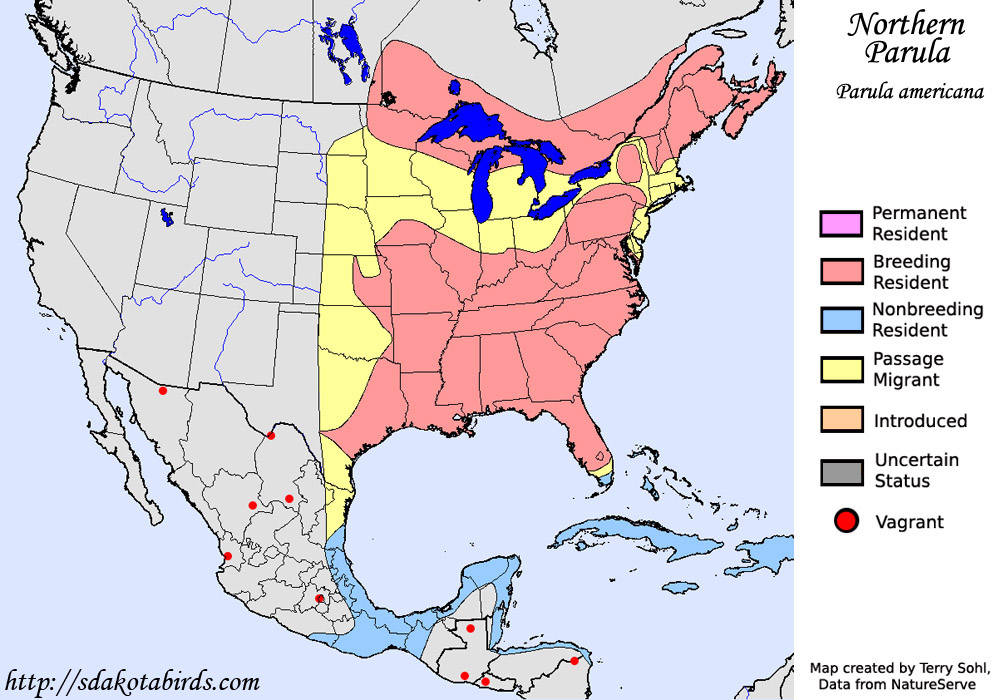
If you look at a range map, like this one here, you might notice something strange. The Northern Parula nests in southeast Canada and the southeast US, but there's a noticeable gap where they don't breed. This gap separates the species into a northern and a southern breeding population. The gap is probably due to a combination of two main factors that I'll discuss below.

Northern Parula
The Northern Parula loves to make nests out of tree lichen. In the south they use Spanish Moss, which is actually a lichen, while in the north they utilize Usnea sp. lichens, commonly known as the Beard Lichens. Is there abundant tree lichen in the gap? Turns out there isn't, but that wasn't always the case. Lichen is very sensitive to air quality, and if you look at the gap you can see that it matches up nicely with big metropolitan areas where air pollution was, and still is, an issue. The Parula more than likely nested in the gap in the past before industrialization, but the air pollution the cities brought killed off the tree lichen species they would utilize. With the disappearance of appropriate nesting material, the Parulas were simply forced to leave that area; however, there is another factor to consider. Parulas favor complex forests where there is a variety in tree height, plant species, and so on. The area that the gap is in was a victim of deforestation, and as a result there is now a very homogenous forest instead of a complex heterogeneous forest. The homogenous, young forests of the area coupled with the lack of tree lichens is probably the true cause of the gap, not just one or the other. Once again, this is another example of human-caused problems. Hopefully the air quality will get better in the gap over the upcoming decades and the Northern Parula will once again return to the area to nest.

Friday, May 29, 2015

Cecropia Moth

A few days ago I visited Carlisle Reservation, a park in the Lorain County Metroparks district. Just a few minutes down the trail, a flash of red in some low herbaceous plants caught my eye. As I moved in closer, I was astounded to see an incredible Cecropia Moth taking refuge from the strong winds of the day.

Cecropia Moth hyalophora cecropia
The Cecropia Moth (pronounced "say-crow-peeah"), Hyalophora cecropia, is a member of the moth family Saturniidae, also known as the giant silk moths. I was absolutely ecstatic that I had found this species, a lifer for me, only two weeks after finding yet another giant silk moth lifer, the Luna Moth. Interestingly, both the Cecropia Moth and the Luna Moths were found hanging on small herbaceous plants on very windy days. This could possibly be explained as a simple coincidence, but I hypothesize that these large moths were simply taking refuge in low-lying parts of the forest, as they would be most protected from the wind in those locations.

Cecropia Moth Size
The Cecropia Moth is an incredibly massive moth. In fact, this is the largest regularly-occurring moth species in Ohio! They can reach wingspans of 6 to 8 inches, but are typically between 4 and 6 inches. This individual was pushing the upper limits, and probably had around a 6 inch wingspan. The Cecropia can be found all throughout Ohio, typically in places where a forest meets a large open space such as an old field or meadow. Like the Luna Moth (as well as all other giant silk moths), the adult Cecropia Moth lacks any sort of mouth, rendering it incapable of eating. As a result, the adult moth only lives for about a week; its sole goal during that extremely short period is to find a mate and reproduce. This species has only one generation in Ohio, and you can find them from May to July.

Cecropia Moth Body
Very fuzzy, isn't he? And yes, this individual is a male. Cecropia Moths can be easily sexed by paying attention to their antennae. Males, such as this one, have very feathery antennae, while the antennae of a female are much less feathery and bushy. The male's feathery antennae are incredibly sensitive and are used for sensing out a prospective female's pheromones. During mating time, which is between 3 and 4 AM, the females will release pheromones into the air. Males can pick up these pheromones with their antennae from up to a mile away, but many males will travel up 7 miles in order to find a female.

In a few weeks I'll be moving back down to Athens County. I hope to get a mothing setup and begin mothing somewhat regularly. If you like moths, stay tuned for more!

Tuesday, May 19, 2015

Melanistic Garter Snake

For half of this summer, I'll be living up in Northern Ohio helping with some salamander research as a field assistant. It's only been 2 weeks so far, but we've found so many interesting and wonderful things. The best find of last week came from one of the field sites on South Bass Island in Lake Erie.

Melanistic Eastern Garter Snake
Olivia Brooks, who is the one behind the nature-oriented Twitter account Wild Earth, is the other field assistant. We're always on the lookout for snakes, and while in the middle of trying to find salamanders, Olivia yelled "snake!" We ran toward Olivia and were met by a very young Eastern Garter Snake. I've covered Eastern Garter Snakes before, and you might notice that this one doesn't really look like a garter at all. The coloration is all wrong, right? Garter snakes aren't black?!

Melanistic Eastern Garter Snake Ohio
This is indeed an Eastern Garter Snake, Thamnophis sirtalis sirtalis, but it is an individual with melanism. Melanism is essentially the opposite of albinism. While albinism is the absence of melanin (a dark colored pigment found in skin), melanism is the overabundance of melanin, leading to an individual with an abnormal amount of black coloration. Melanistic Eastern Garter Snakes can be found along the Western Basin of Lake Erie and on some of the Lake Erie Islands. Some populations can be up to 50% melanistic in this area, meaning there will be a mixture of normal-looking and melanistic individuals within one area.

Eastern Garter Snake Ohio
The photo above shows what a normal Eastern Garter Snake looks like. This normal-colored individual was found at the same exact location on South Bass Island as the melanistic individual we found. I have no clue as to what the exact ratio between the two types is, but it would be very interesting to do a survey and get an estimate!

Melanistic Eastern Garter Snake
So why is there such a high concentration of melanistic garters in Northwest Ohio? Mutations that lead to melanism can arise randomly in any animal that has melanin; however, mutations that cause melanism and albinism are very rare. This leads to sporadic occurrences of the color abnormality that randomly occur across multiple populations. For a trait like melanism to "build up" in a population, there must be something else going on. More specifically, being melanistic must benefit the individual in some way. If the trait was bad for the individual, it would quickly be selected out of the population. If it had a neutral effect, individuals with the trait would only exist in very small numbers. Adaptive melanism can be adaptive for many different reasons. For example, in Black Panthers, which are actually just melanistic Jaguars, melanism leads to better camouflage as these predators hunt in the dark of night. In the Eastern Garter Snake, being melanistic makes it easier for an individual to warm up when basking in the Sun. The color black absorbs all the wavelengths of the white light of the Sun, resulting in the black individual gaining relatively more heat energy than the predominantly brown individuals. Snakes are ectotherms ("cold-blooded"). This means that they do not hold a constant internal temperature like we do, but instead rely on the ambient heat of the environment to regulate their internal temperature. For a snake to be able to hunt successfully, their body temperature must reach a certain threshold. By being able to reach that threshold quicker and easier, melanistic garter snakes have an advantage in being able to find and eat more food than the normal individuals, who have to wait longer for their temperature to reach that threshold.

Sunday, May 17, 2015

Luna Moth

Last week I was walking along a path at Old Woman Creek National Estuarine Research Reserve in Erie County, Ohio. Suddenly, something on a Mayapple caught my eye...

Luna Moth camouflage
Can you find both Luna Moths?
I quickly stopped and took a closer look. Much to my surprise, the object that caught my eye was a Luna Moth, a lifer for me! I then noticed that not only was there one Luna Moth, but a few inches away there was also a second one. I have been wanting to see this beautiful species for years, and I was ecstatic that I finally had the chance!

Luna Moth Actias luna
The Luna Moth, Actias luna, is a very large moth. In fact, this species is one of the largest moths in North America. Its wingspan is 4.5 inches on average, making this species an incredibly impressive sight. The Luna Moth is found in the deciduous forests east of the Great Plains, and in Ohio they can generally be found from May through October. The Luna Moth can have 1, 2, or 3 generations a year depending on where you are within their range. Ohio falls in the 2 generation range, which means these individuals are part of the first generation for the year. While the Luna Moth can be found in every county in Ohio, they are hard to find and sadly on the decline. If a Luna Moth is hanging from a leaf, their camouflage makes them very hard to spot. Most people see Luna Moths when they are perched on a wall or other surface that makes their bright green coloration stand out. It's been even harder to find them recently due to a decline over the past several years. This decline is especially pronounced near cities and large towns, but the exact cause, or causes, remain unknown.

Luna Moth on Plant
The adult Luna Moth has a very short life. The only goal for an adult is to find a mate and reproduce. While this is the same goal across all species, the Luna Moth life cycle is missing essentially anything it doesn't need to achieve that goal. Upon metamorphosing, the adult moths lack a way to feed. As a result, they only live for about seven days before starving to death. That single week is spent looking for a mate, and then waiting for death. Since they cannot eat, the moths need a large storage of fat to live off of. If you look at the photo above, you can see how large the abdomen (about the size of a big thumb). This is due to all the fat the individual accumulated in the caterpillar stage in order to last through the adult stage.

Luna Moth Face
Who can't love a cute face like this?
Luna Moths are hard to find since they are so short-lived, but even if you've never seen one in person, you probably recognize them. They're a commonly represented moth in our lives. Commercials, cartoons, magazines, and more all utilize Luna Moths for advertisement or plot devices. Moths, in general, are an overlooked group of animals, but it is impossibly hard to overlook a Luna Moth, and so they pop up a lot in pop-culture. There's nothing quite like seeing one in person though, so keep an eye out the next time you take a hike through a forest. You never know what you might find.

Saturday, April 25, 2015

The Red-Backed Salamander, Plethodon cinereus

I've been wanting to do a big post on a species of amphibian that is near and dear to my heart for awhile now. With the semester coming to an end, I've finally gotten the chance to write it. This post is all about the Red-Backed Salamander, Plethodon cinereus. My aim is to give a general overview, with some interesting detailed bits, of this incredibly common species. Why is it so special to me? P. cinereus is the first species I've ever had the chance to do real research on. Starting back in the fall of 2014, I began a job as an undergrad research assistant at Ohio University. I work in Dr. Shawn Kuchta's lab under Maggie Hantak, one of Dr. Kuchta's Ph.D students. It's been an incredibly fun, and incredibly educational, experience so far. I'll talk more about her research and what I do at the end of this post.

That aside, let's move on to some basics! Be warned, this is going to be a really long post.

Red-Backed Salamander, Plethodon cinereus
The Red-Backed Salamander, Plethodon cinereus, is a terrestrial species of Plethodontid salamander. As with all other salamanders in the family Plethodontidae, the Red-Backed is lungless. Since they lack lungs, respiration instead occurs across the skin and the lining of the mouth. For these salamanders to breathe correctly, they must remain moist so gas can be exchanged freely across the cells in the skin. As a result, desiccation (drying out) is a constant threat to this salamander. In order to remain moist, they must inhabit areas that meet a certain threshold for moisture. These salamanders can be found in deciduous forests, mainly under rocks and logs where moisture is retained. When it is wet enough, they will travel throughout the leaf litter on the forest floor in search of food. During the summer months, when the heat dries out the top layers of the forest floor, P. cinereus will move into the ground, using old worm burrows or possibly making burrows itself.

P. cinereus
is an incredibly abundant species in the forests of the Northeast part of the US, and it can be found in nearly every county here in Ohio. In fact, P. cinereus is thought to be the most abundant vertebrate species in the Northeast quarter of the US. They can reach densities of 2.8 individuals per square meter in good habitats, making this species more abundant than birds and mammals combined. In addition, there is some compelling evidence that the 2.8 individuals per square meter number is actually an underestimate; it might be double that number (See Semlitsch et al., 2014)! It is important to note that the bulk of a given population of Red-Backed Salamanders lives below the surface, so trying to accurately estimate a population is difficult when you can only find those individuals who are on the surface (See Taub 1961). When Maggie and I travel to a good location in Northern Ohio, we can normally find at least one individual under every rock or log you flip. It's amazing to think that all those individuals we readily find under cover objects represent only a fraction of the individuals actually living in that location.

Red-Backed Salamander morphs
The two common morphs of the Red-Backed Salamander, with the red-stripe morph on the right, and the lead morph on the left.
One of the really interesting characteristics about this salamander is its color polymorphism. Polymorphism is where there are two or more clearly different phenotypes (an individual's set of physical traits) in a species. Generally speaking, P. cinereus exhibits three color morphs. First is the red-stripe morph (pictured above on the right). This is by far the most common morph. The second most common morph is the lead (or lead-backed) morph (pictured above on the left). The third morph is the erythristic morph, which is very rare. The erythristic morph is essentially all red with a creamy white stomach. In addition to these three morphs, there are several other rare color anomalies: iridistic, albino, leucistic, amelanistic, and melanistic. You can read more about the different color phenotypes in J.D. Moore's paper here.

As stated previously, the red-stripe morph is by far the most common, especially in Ohio. There are, however, many polymorphic populations. Northern Ohio has a relatively high density of polymorphic populations, where one can find both the lead and red-stripe morph (and occasionally the erythristic morph) all living together in the same location. The ratios between the morphs vary according to each site. Interestingly, there are a few all-lead populations in Ohio, such as the population on South Bass Island. This is not a common occurrence by any means.

Iridistic Red-Backed Salamander
There is an extreme amount of color variation not only between color morphs, but also within the morphs and anomalies. At some locations we visit, the red-stripe morphs have a very bright and well defined red stripe. At other locations, the red stripe is very mottled and dull with high amounts of black across the body. On the other side of the coin, the leads at some locations are a very dull and subdued black, while other locations have very iridescent and beautiful leads, like the one pictured above.

Red-Backed Salamander juvenile
Unlike many salamander species, P. cinereus does not have an aquatic larval stage. The entire life cycle is terrestrial, and that means we run into many juvenile individuals when in the field. And the juveniles are cute. Extremely cute. Pictured above is a small (yes, small) adult red-stripe individual next to a juvenile lead individual. Many of the juveniles we find could easily fit on a penny.

Red-Backed Salamander eggs
Most, but not all, salamanders lay eggs, and this includes the Red-Backed Salamander. When we measure the salamanders, we are able to see the eggs of any pregnant females. These eggs can be very pronounced, as the photo above shows. If you count carefully, you can see a total of 8 eggs (the white blobby things in the abdomen) in the individual above. As mentioned earlier, while many salamanders have an aquatic larval stage, the Red-Backed is completely terrestrial. The eggs are laid in a protected area, mainly in rotten logs. There is a larval stage, but this stage happens completely in the egg. Upon hatching, the juveniles are fully developed and essentially a smaller version of the adult.
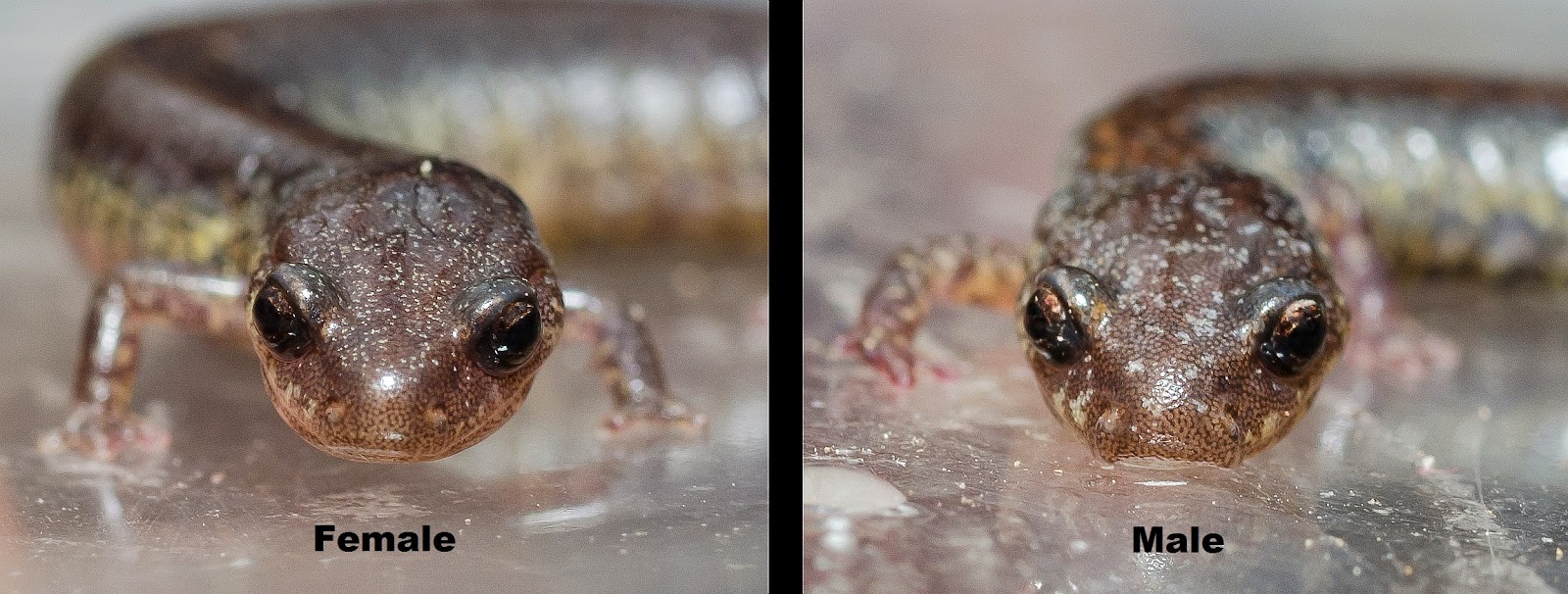
Red-Backed Salamander male and female
How do you tell the sex of a Red-Backed Salamander? There are a few differences between the two sexes, but the easiest way is to look at their heads. Females have a very round snout. Males, on the other hand, have a very broad, square-like snout, which you can see above. Another feature to look for is the presence of cirri. Cirri (singular cirrus) are a fleshy downward extension of the upper lip. Cirri function as chemoreceptors, and the males use these for a multitude of reasons, most commonly to sense out a potential mate's pheromones. You can see the cirri on the male above; they are the two tiny, mustache-like extensions hanging down on either side of the snout. As always, you can click on a photo to view a larger version of it.

Red-Backed Salamander missing tail
One of the incredibly interesting characteristics of salamanders is their ability to regenerate whole limbs and parts of major organs. It's a tough world out there, and salamanders can lose parts of their body due to predators, but also due to fights with larger salamanders. Red-Backed Salamanders are known for being fiercely territorial, and they will defend their territories against many different intruders like the Northern Ravine Salamander, Spotted Salamanders, or centipedes, occasionally resulting in the loss of limbs. The tail is the part that is most often lost, like in the individual above. When it comes to tails, salamanders are like lizards. When in a situation with a predator, the Red-Backed Salamander will wave its tail in an attempt to get the predator to go after that part instead of elsewhere. As soon as the predator latches onto the tail, the tail pops off giving the salamander time to escape. The tail wiggles violently for a short bit to confuse the predator even further in order to hopefully allow a safe escape for the salamander. Salamanders can regrow legs in only 7-10 weeks, but tails take a little long due to their size and how much actually comes off. The individual above (who was found in the Fall) probably has a fully regrown tail by now.

Red-Backed Salamander diet
While the Red-Backed Salamander is a prey item for many other animals, it is still a ferocious predator itself. I'm currently in the middle of a dietary study that aims to find out if there is a difference in the type of food the red-stripe and lead morphs eat. The Red-Backed Salamander eats a large variety of arthropods, although I did find a weird one who ate a mushroom. The photos above give you an idea of some of their usual prey items. On the far right is their favorite type of food, mites. There's an incredible diversity of mite species on the forest flood, and the salamanders will eat many of them. In the center are Springtails, another favorite. On the far left is a pseudoscorpion, one of the more awesome-looking arthropods they eat. In addition, they also consume ants, beetles, assorted tiny wasps, spiders, and more.

Partially erythristic Red-Backed Salamander
One of more interesting individuals we've come across so far this Spring is the one pictured above. We had traveled to a location where around 15% of the population was erythristic (an unusual reddish or orange coloration). While we didn't find any completely erythristic individuals, Maggie did find the one above which exhibits partial erythrism. Note how most of the body is a red-orange, while the stomach is a creamy white. There's too much black on the individual for it to be considered completely erythristic, but you can tell it is definitely not a normal red-stripe individual. If you're interested in learning more, partial erythrism and erythrism in general is covered in the J.D. Moore paper that I linked to earlier in the post.

Silver-Striped Red-Backed Salamander
Several weeks after I wrote this initial post, we came across another interesting individual, pictured above. This is what has been called the "Silver-Striped" or "Silver-Backed" variant of the Red-Backed Salamander. As you can see, the stripe running down the back in this individual is a silvery-grey color instead of the normal red color. Sadly there's not much information I can find on this color abnormality other than assorted photos of similar individuals. Vincent Farallo, an Ohio University graduate student, did tell me that he has seen a lot of individuals like this at Strouds Run State Park in Athens County.

Maggie Hantak
Maggie Hantak measuring a Red-Backed Salamander using a method termed "Mander-Mashing." Seriously. (No salamanders are harmed in this process.)
As I mentioned earlier, I currently have a job as an undergrad research assistant. My job is essentially to help Maggie Hantak, a Ph.D student at Ohio University, collect data at her field sites in Northern Ohio, as well as working independently on a dietary study for her. In a nutshell, Maggie is exploring multiple facets of the evolutionary ecology of the Red-Backed Salamander with regard to the differences between the red-stripe and lead morphs. She's been a wonderful mentor to me and has helped me get involved in real research. I'll be spending the first half of this summer in Northern Ohio as her field assistant, with the last half spent down in Athens to try and finish the dietary study. I'll also hopefully have the opportunity to begin my own research on Plethodon electromorphus, the Northern Ravine Salamander, this summer.  As of October, 2016, I am beginning my own independent project on the Northern Ravine Salamander. Stay tuned for more information in the upcoming months!

I've got several more salamander posts in the works that I'll hopefully be finishing up sometime during Summer, so if you're a herpetology person, stay tuned! Otherwise, I'll be covering the usual interesting things I come across this summer, including flowers, birds, insects, parks and more. Thanks for reading!