Friday, July 24, 2015

Crested Coralroot

This past Wednesday I made the trip out to Adams County in southern Ohio. Now, those of you who know me probably know I have a slight obsession with Adams County, but it's for good reason! This place is a biological hotspot of diversity, rarities, prairies, and more.

Lynx Prairie Ohio
My main reason for going was to see the ever-amazing Lynx Prairie, which I've previously wrote about here. Late July/Early August is prime time in the prairies of Ohio; many of the wildflower species bloom in this part of the summer, making for incredible displays of color among the green grasses. For some examples of the flowers blooming right now in the Adams Co. prairies, check out my previous post here. When it comes to Ohio prairies, Lynx is by far my favorite. It is an incredible system of pocket prairies that is definitely worth exploring!

Crested Coralroot Ohio
I arrived at Lynx Prairie at a perfect time. In the second prairie opening I saw two people looking down at a plant. We had our greetings and I asked them if they had seen anything interesting while there. They pointed me to the plant they were looking at: a beautiful specimen of Crested Coralroot, a species of orchid. (Imagine that, more orchids!) This is an orchid that I've been wanting to see for a long time, and I was beyond ecstatic to finally get the chance to see one. The couple told me that there were more scattered about the preserve and to keep an eye out for them. As I later found out, it turns out the people that showed me the orchid were none other than Deb Marsh and her husband. You might know Deb Marsh as the blogger at Around the Bend, another nature-based Ohio blog, which I've been following for the past couple of years. It's always great to meet another blogger out in the field!

Crested Coralroot Flowers
Crested Coralroot, Hexalectris spicata, is a unique plant. It lacks chlorophyll, giving it a haunting pale color that stands out against the vibrant greens of the prairie and forest edge. As you might know, chlorophyll is necessary for a plant to produce food. If it lacks chlorophyll, then how does it get food? The answer lies in the roots. Crested Coralroots (as well as all orchids at some point during their life cycle) are myco-heterotrophs. Myco-heterotrophy is a symbiotic relationship between a plant and fungus. It's a complex system of energy exchange, with the Crested Coralroot ultimately being a parasite. I'll explain the process below!

Crested Coralroot Flower
Many plants form a relationship with fungus. For the vast majority, this relationship is mutualistic, meaning both the plant and fungus benefit. What happens is that a fungus will colonize the roots of a plant. The plant will then give the fungus carbohydrates for the fungus to live and prosper. This causes the fungus to grow in size, creating more surface area. The plant benefits from this increase in surface area, as its fungus-colonized root system can now absorb more water and nutrients. This creates what is called a mycorrhizal network. Now, in comes the Crested Coralroot. This orchid "cheats" the system. The orchid will essentially send its roots to tap into the mycorrhizal network. From there, it actually steals the carbohydrates from the fungus. Essentially, the Crested Coralroot steals food from another plant, while using the mycorrhizal fungus as a middle-man. It's pretty amazing to think about all of the complex craziness that occurs down in the soil. We're taught from a young age a very simplistic way of how plants grow, get nutrients, and make food. The reality is much, much more complex than how most of us view it.

Crested Coralroot
The foot-tall Crested Coralroot stands out against the greenery, creating a striking scene.
Crested Coralroot is a rare plant in Ohio. In fact, it is state-listed as Potentially Threatened. There's only three counties that it can currently be found in here in Ohio (Adams, Scioto, and Lawrence). Crested Coralroot only comes above ground to flower and produce seeds; however, an individual does not do this every year. They will only send up a flowering stalk every few years. As a result, during some years a location might not have any flowering individuals, while other years might have dozens. Crested Coralroot tends to bloom in large numbers during wet summers. The extremely wet summer we're currently in has made for an amazing year when it comes to fungi and many plant species, and Crested Coralroot is no exception. In fact, we counted 10 individuals easily at the site, and we probably missed many more. If you want to see one, I highly suggest going this year. From what I've read, Lynx Prairie and parts of Shawnee State Forest are the two easiest places to find this orchid.

I'm also proud to announce that my blog recently surpassed 50,000 views! I just want to thank everyone for their support, and for reading!

Sunday, July 19, 2015

Purple Fringeless Orchid

Earlier this week I received a message from Andrew Gibson asking if I was interested in going to see an orchid species that was in bloom in Vinton County. You might recognize that name; Andrew Gibson is a field botanist for ODNR and the blogger of the exceptional Buckeye Botanist blog (which I strongly suggest you check out if you haven't already). Of course, when anyone ever asks you a question like that, the only rational answer is yes.

Purple Fringeless Orchid, Platanthera peramoena
The target species was the Purple Fringeless Orchid, Platanthera peramoena. This species was a lifer for me, making it the 9th Ohio orchid species I've seen (out of 46 native species). I'm a relatively late-comer to the world of plants and can only say I've really been "into" them for about a year and a half now. Of the 9 orchid species I've seen so far, 8 of them have been during this summer. Orchids, of the family Orchidaceae, are a very diverse and well-known group of plants. Most people I've met are surprised to learn that Ohio does indeed have native orchids, and I can't overly blame them; the majority of the ~26,000 orchid species are found in the tropics, but a few are found in more temperate regions. 

Purple Fringeless Orchid Ohio
Purple Fringeless Orchid is a large species, with most of the individuals we saw being over 2 feet tall. Their bright, bubblegum-purple flowers were enough to capture anyone's attention. This species is mainly home to Southern Ohio. It likes moist areas, such as open areas in swamps, roadside ditches (which is where we found the ones pictured), open areas in floodplain forests, and so on. 

Small Purple Fringed Orchid (left) and Purple Fringeless Orchid (right).
There's three very similarly-looking "purple something orchids" species in this region of the US. First, there's the Small Purple Fringed Orchid and the Large Purple Fringed Orchid. In Ohio we only have the Small Purple Fringed Orchid, as the Large is extirpated (extirpation is "regional" extinction). As you might guess from the names, there's an easy way to tell the difference between the Small Purple Fringed Orchid and the Purple Fringeless Orchid. The edges of the Small Purple Fringed Orchid flowers are, you guessed it, fringed. The edges of the Purple Fringeless Orchid flowers are not fringed, although there is still a somewhat "rough" looking edge.

Purple Fringeless Orchid Pollinator
While investigating one stand of the orchid, a Hummingbird Clearwing paid us a visit. Zipping from flower to flower, and orchid to orchid, the moth buried its head in the flowers in order to reach the nectar hidden deep inside. To learn more about the Hummingbird Clearwing, check out my previous blog post on this species.

Thanks for reading!

Monday, July 13, 2015

Hummingbird Clearwings!

I was recently shown a very interesting road in Wayne National Forest. Big Bailey Run Road is a gravel road that winds through the Athens County section of Wayne National Forest. Just outside of Chauncey, this road has wetlands, forests, young scrubby bushland, and much more. It's easy to get 60 bird species here during the summer, see Box Turtles, and find tons of colorful wildflowers. It is in a stretch of roadside wildflowers along Big Bailey Run Road that this post takes place.

Wild Bergamot Ohio
This roadside was what I could only describe as a Lepidopteran paradise. The Lepidopterans are the moths and butterflies. This roadside, as you can see, has a huge population of wildflowers. By far the majority was Wild Bergamot, Monarda fistulosa. Tall Bellflower, Campanula americana, was also present in smaller numbers. Silver-Spotted Skippers, Spicebush Swallowtails, Pearl Crescents, and other Lepidopterans abounded. This finally brings us to the main subject.

Hummingbird Clearwing, Hemaris thysbe
Meet the Hummingbird Clearwing, Hemaris thysbe. The moths in the genus Hemaris are also known as the Hummingbird Moths, and if you ever see one you will know why. Zipping erratically from flower to flower, this good-sized moth is often mistake for the similarly-sized and similarly-acting Ruby-Throated Hummingbird. They even hum like a hummingbird! It isn't surprising to learn that this species is actually a hummingbird mimic. Why mimic a hummingbird though? It's all in avoiding predation! Birds prey heavily on moths, and a day-flying moth is a big target for lunch. However, insectivorous birds aren't going to feed on another bird species. By mimicking a hummingbird, the Hemaris sp. hummingbird moths can avoid predation by the birds seeking to eat moths.

Take notice of the pale-creamy legs that are characteristic of this species. You can also see that the wings are blurred in this photo. This photo was taken at 1/400 of a second, which means that those wings are moving very quickly.

Hummingbird Clearwing Ohio
This patch of flowers had dozens of Hummingbird Clearwings present. I had only seen this species once before (it is by no means rare though), and I was thoroughly excited, to put it mildly. These moths are just so wonderful. The Hummingbird Clearwing is in the family Sphingidae, better known as the Sphinx Moths. Unlike most moths, which are nocturnal, this species is diurnal, meaning it is out and about during the day. It likes clear, sunny days and can be found in open areas such as meadows, forest clearings, gardens, and the likes. 

Hummingbird Clearwing
Hummingbird Clearwings have a long proboscis (the black tube mouthpart pictured above) that they use to reach into long-necked flowers. Long-necked flowers make it hard for normal pollinators to reach the nectar, but pollinators with a proboscis can easily reach the nectar. The individual pictured above is in the middle of accessing the nectar in a Bergamot flower. Hummingbirds can also reach deep flowers due to their long beaks and even longer tongues. (You can see a photo of a Ruby-Throated Hummingbird's long tongue here.)

As I mentioned before, it was very hard to get a somewhat decent photo of these guys as they quickly flew around flowers which were already blowing in the wind. Most of the photos turned out like the one above. When I and other bloggers put photos up online, you're only seeing a small percentage of the ones we actually took out in the field. In this case, I took 45 photos of the Hummingbird Clearwings, but only 3 turned out okay. That's about a 7% success rate. For every "good" photo you see from people, there's at least 10 bad ones that just don't cut it and that the public will never see.

Friday, June 19, 2015

Five-Lined Skink!

Last week was the end of the salamander field season in Northern Ohio; the high temperatures had driven most of the Plethodontid salamanders completely underground, rendering them nearly impossible to find. With the field season over, the lab-based part of my summer job is about to begin. I have a few days off before I have to head back down to Athens, and I've spent many of those days exploring (surprise surprise). One of the locations I've visited so far is Cedar Bog Nature Preserve in Champaign County, Ohio.

Cedar Bog Ohio
Cedar Bog is indescribable; it is by far one of the most amazing, and unique, places I've been to in Ohio. There are several different types of ecosystems located there, but this post takes place in the scene above. This is a White Cedar swamp. Swamps are essentially a forested wetland, and in this case the dominant tree is the White Cedar, a rare tree in Ohio.

Five-Lined Skink male
I was walking quietly down the boardwalk when a tiny scurrying noise caught my attention. I assumed it was probably a snake so I began searching intently for it. After a few seconds, I noticed a tiny head staring at me. It was a skink! I froze and hoped that he would possibly come out for a better view...

Five-Lined Skink, Plestiodon fasciatus
Sure enough, he did. This is a Five-Lined Skink, Plestiodon fasciatus. This specific individual, with his bright orange head, is a male in breeding colors. You might have heard of this skink by another common name, the Blue-Tailed Skink, which refers to the bright blue tail that the juveniles have. The Five-Lined Skink is the most common of the 5 lizard species we have in Ohio. I've previously covered another Ohio lizard on this blog, the Eastern Fence Lizard, which you can read about here. Although this species is the most common in Ohio, it isn't an easy find by any means. Skinks are incredibly fast (they're some of the fastest lizards out there), and any that might be in the area will simply run quickly away from you if you're not quiet and paying close attention. I would have never seen this guy had I not been looking and listening for anything that might be in the area.

Male Five-Lined Skink
Eventually the curious little skink wandered out onto the boardwalk only a few feet away from me. This was the start of a 10 to 15 minute game of hide-and-seek-with-a-skink. The skink would wander out into the open for a few seconds, then run away and hide. A few seconds later he would reemerge from a new location somewhere within 5 feet of me. This cycle repeated over and over. A ground-dwelling species, this skink knew all the ins-and-outs of his territory and could have easily slipped away never to be seen if he wanted to. It was an interesting encounter to watch unfold; he was obviously interested enough in me to check me out, and also seemed to know that I wasn't an immediate threat to him. He would have been gone had he seen me as a real threat, but instead he kept coming back and watching me.

Five-Lined Skink Cedar Bog
The Five-Lined Skink probably lives in most, if not all, of the counties in Ohio; however, only about half the counties have official records of this species, which can often be hard to find. Records of this species are conspicuously missing from the central part of Eastern Ohio. This is a common theme with many reptile and amphibian species of Ohio. Counties such as Belmont, Harrison, Jefferson, and others in that immediate area are missing records of many species that are almost certainly there. These counties must not be heavily explored by surveyors. Southern Ohio is still your best bet to see this species, as well as Cedar Bog NP in Western Ohio.

Thursday, June 4, 2015

Northern Parula

This year's Spring migration is all but a memory now, and most species are currently focusing on raising a successful brood. I, however, want to revisit a day during migration for this post. On May 19th I had the chance to visit the famous boardwalk at Magee Marsh along Lake Erie. Sadly, I was a few days late for the Biggest Week in Birding, but Spring migration was still hopping. I saw many warblers and assorted other migrants, but one Northern Parula gave me and a few other birders quite the show. I was fascinated by this Parula and decided to write up a post about the species, so here we go!


The Northern Parula, Setophaga americana, is a small migratory warbler. You might be wondering where in the world the name "Parula" came from. When this species was first classified by Carl Linnaeus in 1758, Linnaeus considered it to be related to the tits of the Old World. The name for this genus was Parus, and that was slightly changed to Parula for the common name of this species. However, the Northern Parula isn't a tit, and is instead a new world warbler. Like other neotropical warblers, the Parula spends half the year in more southerly climes and the other half in more northerly climes to breed. During Spring (April-May in Ohio), this species migrates from parts of Central America and the West Indies to the Eastern United States and Eastern Canada. It then spends the next few months trying to find a mate and raising a new generation before migrating back south to overwinter.

Northern Parula Magee Marsh
Where can you find this species in Ohio? Well, it depends on when you're looking. They can essentially be found anywhere across Ohio during migration, especially in the southern portion of Ohio and along the Lake Erie coast. It's a little harder to find this species during the Summer. They breed in the Allegheny Plateau region of Southern and Eastern Ohio, becoming scarcer the farther North you travel. The Northern Parula breeds in well-established forests here in Ohio. The older forests of Southern Ohio typically hold a good number of individuals. You can always find some in the Hocking Hills region, as well as Adams County. If you're looking for one though, good luck! The Northern Parula is a tree-top gleaner, meaning it feeds on insects that live on the branches in the canopy. Parulas are also roughly the same size as a chickadee. Spotting this tiny bird when it's 80 feet up in the leaves is definitely a frustratingly hard thing to accomplish. To help know when there's a Northern Parula near you, learn their song! It's a fairly easy song to learn, and you will find ten times more individuals this way than you would by just scanning the trees in hope for one. To listen to some examples of their songs, go to this link and look on the bottom right for "Songs and Calls."

Northern Parula Ohio
At Magee Marsh during Spring migration, things are a little different. Tree-top gleaners, such as the Northern Parula, might be only 5 feet off the ground. On top of that, the warblers are so focused on getting enough food to make it across Lake Erie that they essentially ignore all the people around. That means there might be a warbler only an arm's length away and right at eye level. Regardless of how cheesy it sounds, I can only describe Magee Marsh as a magical place, and birders who have made the trip know exactly what I'm talking about. This Northern Parula was no exception, foraging right at eye level only about 5 feet away. In the photo above you can see him checking out a leaf for a possible tasty arthropod morsel.

Northern Parula
And turns out there was indeed a tasty arthropod about! He quickly pulled a tiny green caterpillar off the leaf, which you can see in his beak above. As always, you can click on the photo to get a bigger version. While the Northern Parula eats a wide variety of arthropods, their favorites are caterpillars and spiders.

Northern Parula Eating
Another caterpillar victory!
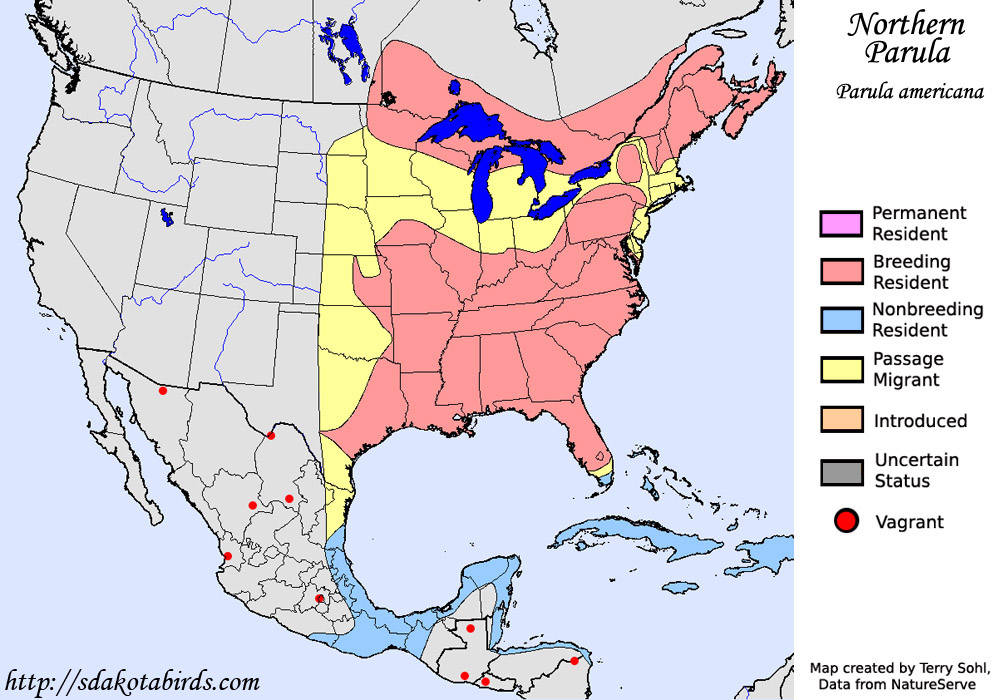
If you look at a range map, like this one here, you might notice something strange. The Northern Parula nests in southeast Canada and the southeast US, but there's a noticeable gap where they don't breed. This gap separates the species into a northern and a southern breeding population. The gap is probably due to a combination of two main factors that I'll discuss below.

Northern Parula
The Northern Parula loves to make nests out of tree lichen. In the south they use Spanish Moss, which is actually a lichen, while in the north they utilize Usnea sp. lichens, commonly known as the Beard Lichens. Is there abundant tree lichen in the gap? Turns out there isn't, but that wasn't always the case. Lichen is very sensitive to air quality, and if you look at the gap you can see that it matches up nicely with big metropolitan areas where air pollution was, and still is, an issue. The Parula more than likely nested in the gap in the past before industrialization, but the air pollution the cities brought killed off the tree lichen species they would utilize. With the disappearance of appropriate nesting material, the Parulas were simply forced to leave that area; however, there is another factor to consider. Parulas favor complex forests where there is a variety in tree height, plant species, and so on. The area that the gap is in was a victim of deforestation, and as a result there is now a very homogenous forest instead of a complex heterogeneous forest. The homogenous, young forests of the area coupled with the lack of tree lichens is probably the true cause of the gap, not just one or the other. Once again, this is another example of human-caused problems. Hopefully the air quality will get better in the gap over the upcoming decades and the Northern Parula will once again return to the area to nest.