Thursday, September 3, 2015

Ornithology Lab, September 2

Hey everyone! This is the first installment in a series of weekly posts for my Ornithology Class at Ohio University. We go out in the field every Wednesday (weather permitting) to do some birding and bird banding. One of our assignments is to write a blog post about each of these field trips, which is what this series will be about. A note to my regular readers: these posts will most likely be very different from my usual posts. I try to have a photo for every individual thing I talk about, but I won't be able to bring my camera on these field trips. As a result, these posts will be more like a journal than anything. I'll try to post any relevant photos I have from my library, but no guarantees! I'm hoping to intersperse "normal" posts with these posts as well. This series will run until early December. Alright, back information aside, let's get started!

~ ~ ~

The morning started early. I would say bright and early, but it's quite dark outside at 5:30 AM. I got ready, grabbed my field guide, binoculars, field notebook, and a pen, and left my dorm room at 6:30 AM. We packed up the banding equipment and drove up to The Ridges, arriving at about 7:10 AM. The Ridges lies on the edge of the city of Athens in Athens County. It's an interesting place, and I honestly spend way more time there than I probably should. Most people know it as the site of the old Athens Lunatic Asylum, but it's much more than that. The land is now owned by Ohio University, and behind the old asylum building is dozens and dozens of acres of land with a smorgasbord of different habitats. Miles of trails, utilized by the students of Ohio University and the "townies" of Athens, crisscross the landscape, cutting through mature deciduous forest, grassland, abandoned orchards, shrubby overgrowth, young forest, and more. I've previously given a quick of The Ridges, which you can read here

The view of Radar Hill, one of the main attractions at The Ridges. Field Sparrows nest all throughout the grassy areas you see, while more "deep forest" birds like Pileated Woodpeckers call the forests you can partially see on the sides of the photo home.

As you might expect from a place with a variety of habitats, it's a good place for birds. I mean, it's a really good place for birds. I would definitely say it's one of the best places in Athens County to go birding. To give you an idea, 224 species have been recorded in Athens County on eBird. Of those 224 species, 155 of them have been seen one time or another at The Ridges. That's about 70%. I personally have a list of around 90 species here at The Ridges, including 21 species of warblers. 

The first bird we heard this morning was a White-Eyed Vireo. This is a common species along the beginning of the Nature Trail by the Challenge Course. The White-Eyed Vireo pictured here is from April 2015 along the Nature Trail.
Now that you have some background information on the area, let's get into today. As I mentioned, we arrived at around 7:10 AM, so all of the sightings I'll mention here happened between then and when we left at 11:40 AM. The morning started off relatively warm at around 65 degrees. It was incredibly humid and only got worse throughout the morning. Light fog hung in some of the low lying areas, while a hazy sky with some cirrus clouds soared overhead. The fog and haze left between 9:30 and 10:00 AM. We were hoping for a lot of good Fall migrants, but this week was a bad week for migration. Southerly winds prevented large movements of many of the northern-breeding songbirds. 

One of the main goals of our class is to get better acquainted with bird banding, specifically with the use of mist nets. Essentially, a mist net is a thin, hard to see net that birds will fly into before getting stuck in a tiny pocket. Once caught, a bird can be removed from the net, inspected for various things such as age, sex, and weight, and then banded. When banded, a bird is given a unique number code that is printed on a tiny aluminum ring. This ring is attached to the leg of the bird. If recaptured at any other banding station, or by any other bander, the code can be looked up and they will have access to all of the previous information gathered on that specific bird. This helps ornithologists gain a better idea of the basic morphology of a species, migration routes used and timing of those routes, what species utilize certain habitats, and much more.

We set up mist nets at 5 different locations. These locations were in a power-line right-of-way with a deciduous forest on each side, by a small pond, by a shrubby area next to an area of semi-developed land, and in a young deciduous forest. Upon setting up these nets, you wait for 10-30 minutes (depends on the conditions of that day) away from the nets, and then make a round checking all the nets. You hope there's at least one bird at one of the nets, but sometimes you come up empty. On a good day and at a good location, some banding stations can get hundreds and hundreds of birds. This day was not a good day. We ended up banding 5 birds total. However, 2 of these birds were really "good" birds.

The first was a surprise. By the tiny pond we caught a waterthrush, a species of warbler. Now, the first thought by me and most others was "Oh, it's a Louisiana Waterthrush." This is by far the most commonly seen waterthrush around Athens, and the only one that breeds here. However, the yellowish wash on its flanks, streaks on the throat, and yellow supercillium (eyebrow stripe) actually meant this was the Northern Waterthrush. This was a lifer for me and a few of the other birders in the class (although I don't really "count" birds that have been caught with a net). A great start to the semester. 

The second bird that was netted was a female Northern Cardinal. This individual was caught along a slight slope in a scruffy secondary growth woods next some lawn, a normal type of habitat that you would expect a cardinal in. Right now in the year, nesting is essentially over. As a result, we have an influx of juvenile birds going through their awkward teenage years. A young male Northern Cardinal superficially looks like an adult female; however, there are a few differences. The most obvious is the bill color; adult females will have a bright orange bill, while young males will have a dull gray bill. Another feature, which you won't see unless you have the bird in hand, is a brood patch, which this female had. Essentially, a brood patch is an area of featherless skin on the stomach of a female. A female's skin is much more efficient at directly transmitting heat to her eggs than adding the feathers as a "middle man." 

The third bird we banded was a Chipping Sparrow that had hatched this past season. As a result, he had juvenile plumage and was missing that species' characteristic rufus crown.

The fourth bird was the second "good" bird of the day. In a young and scrubby deciduous forest patch by an ephemeral creek we caught a Swainson's Thrush, another migrant species. Looking similar to a Wood Thrush or a Hermit Thrush, the Swainson's Thrush is a bird of Canada. They only pass through Ohio during Spring and Fall migrations, typically in April/May and September/October, respectively. A reserved skulker of a bird, this is a species most people don't see unless they're looking for one. It was great to see one so upclose!

Hey, I actually have a picture for this species! This is a Carolina Chickadee from Pickaway County, Ohio.
Last, but not least, was a Carolina Chickadee. A very common species at The Ridges, we heard several this day but only netted one, a young juvenile. The Carolina Chickadees should be, if they haven't already, starting to form mixed foraging flocks for the winter months. These typically consist of species like the Tufted Titmouse, Brown Creeper, and others. If you hear a chickadee starting from September on through the winter, it's best to look around and see what other birds are in the area!

There were plenty of other birds that we saw and heard during our time this morning. Here's my personal list of birds that I saw or heard (also including the species banded) during the field time, in taxonomic order. Note, species with an * means "heard only."

1. Turkey Vulture
2. Red-Bellied Woodpecker
3. Pileated Woodpecker*
4. Eastern Wood-Pewee*
5. Yellow-Throated Vireo*
6. White-Eyed Vireo*
7. Red-Eyed Vireo
8. Blue Jay
9. American Crow
10. Carolina Chickadee
11. Tufted Titmouse
12. White-Breasted Nuthatch
13. Carolina Wren*
14. American Robin
15. Swainson's Thrush
16. Cedar Waxwing
17. Northern Waterthrush
18. Chipping Sparrow
19. Eastern Towhee
20. Northern Cardinal
21. American Goldfinch

Some of the other species that I did not personally see, but others in the class did include:

1.Yellow-Billed Cuckoo
2. Ruby-Throated Hummingbird
3. Northern Mockingbird 

A flock of Cedar Waxwings came through at one point over the pond along the Nature Trail. The Cedar Waxwing pictured was an individual from earlier in the year taken along the Radar Hill Trail at The Ridges.
Overall, it was a really good first week out. I'm hoping that next week will bring northerly winds, and more migrants with it. I'm eagerly awaiting the return of Golden-Crowned Kinglets, Yellow-Bellied Sapsuckers, and White-Throated Sparrows as well, which should be around mid to late September.

Wednesday, September 2, 2015

Spiranthes Orchids at Blue Jay Barrens

Nearly a month ago, I had the pleasure of visiting Blue Jay Barrens. Some of you surely recognize that name. Blue Jay Barrens is a large tract of land in Adams County that's owned and managed by Steve Willson. If you've heard of this place, chances are you've read about it on Steve's wonderful blog entitled Blue Jay Barrens. If you haven't checked out his blog, I highly suggest you do. I've been meaning to make a post on some of the amazing things I saw there, but the past few weeks have been crazy for me. I've had to finish up my summer lab work, as well as move back in to Ohio University and deal with the insanity that is the start of a new semester. Anyway, I now have a little bit of time to write, so better late than never!

Blue Jay Barrens
As I said before, Blue Jay Barrens is a privately owned tract of land that resides in the northern part of Adams County. I've been an avid reader of Steve's blog for a few years now, and he recently reached out to me and asked if I wanted a tour. The answer to a question like that is always yes. I came down on August 13th and Steve gave me a wonderful tour that lasted about 6 hours. He has just over 100 acres, and we saw only about half of it that day. The number of interesting plants and other goodies that I saw that day was simply astounding. Blue Jay Barrens lies in the incredible and unique Adams County, my personal favorite county in Ohio. Adams County is perhaps best known for its globally rare cedar glades (also called cedar barrens) that contain many dozens of rare plant species for Ohio. An example of an Adams County cedar barren is Lynx Prairie. Blue Jay Barrens is a little different though; before Steve bought it in 1985, it was actually farmland. Decades of farming and bad land use practices had eroded essentially all of the topsoil, leaving the land desolate. Slowly but surely, native plants began to come back and soil is slowly being replaced. Adams County, luckily, has many native plant species that can thrive on thin, rocky, and dry soils, most of which are prairie species. Seeds of these hardy species naturally made their way from neighboring areas and began to recolonize the area. Fast forward to the present and you have a beautiful prairie environment with Red Cedars (which are managed by Steve) that dot the landscape.

Spiranthes Orchids Ohio
I was able to visit at a great time in the year. Several Spiranthes orchid species were in bloom, and Spiranthes also happens to be my absolute favorite genus of orchids. Lucky me! Spiranthes is a genus (the classification category right before species) of orchids that mainly calls open areas such as prairies home. There are 9 species that can be found in Ohio, with 3 of those species being state-listed as either Potentially Threatened or Threatened. They're generally small plants, with their white inflorescence (the flowering part of the plant) often being overlooked among the tall grasses they tend to grow in. To give you an idea, look at the photo above. There's a single Spiranthes individual growing on the right side. The good news is, once you intitially find one, your eyes get a "search image" and you start seeing them pretty often. Steve and I saw a few dozen blooming individuals that day, and each one was a treat. 

Spiranthes vernalis
One of the main reasons I adore these orchids is their shape. Spiranthes orchids flower in either a single or double spiral. This individual shows a single spiral really well. This is a Spring Ladies'-Tresses, Spiranthes vernalis. First, a note about the common name of the Spiranthes. I will be using "Ladies'-Tresses" which is what the Ohio Department of Natural Resources uses. You will also see some places using "Lady's Tresses," "Ladies-Tresses," or some other similar name. A tress is a long lock of a woman's hair, and these flowers take on the name Ladies'-Tresses as they resemble a braided lock of hair. As common names are wont to do, the Spring Ladies'-Tresses does not bloom in the Spring, except when they do. The issue here is that in the southern states (where the common name stems from), this species actually does bloom in the Spring. However, the farther north you travel, the later this species blooms. So although the common name is due to its blooming habits in southern states, this species actually blooms in late Summer or early Fall here in Ohio. It blooms as late as October once you get into New England! 

Spiranthes vernalis
A closeup of the flowers on the Spring Ladies'-Tresses, with a beetle guest.
The identification of ladies'-tresses can be difficult. In Ohio, you can often narrow it down to 2 or 3 species depending on your location and time of year, and then you have to start getting into the tiny details to separate them. I am relatively new to plants, so I always like to double check my ID's with the more knowledgeable members of the Facebook group Ohio's Wildflowers and Flora, which is a really wonderful group. Often the flowers, and specifically the labellum (or lip), have some characteristic feature to help nail the identification. In the Spring Ladies'-Tresses, the labellum often has a yellowish-tinge, as you can see in the photo above. An uncommon plant here in Ohio, the Spring Ladies'-Tresses is confined to only 8 counties in the southern tip of Ohio.

Spiranthes tuberosa
Next we have a much smaller species. This is the Little Ladies'-Tresses, Spiranthes tuberosa. This dainty species is also an inhabitant of dry prairies and meadows like the previous Spring Ladies'-Tresses (although they can be found in other habitats as well), but this species is generally much smaller in height. This individual was probably less than a foot high, while the Spring Ladies'-Tresses we saw were about 2 feet or so tall.

Spiranthes tuberosa
As I previously mentioned, the labellum of many Spiranthes orchids holds a clue as to what species it is. In this case, the labellum is pure white, while the previous Spring Ladies'-Tresses had a labellum with a yellow tinge. This pure white labellum is an easy way to quickly identify Spiranthes tuberosa. The Little Ladies'-Tresses has a decently wide range in Ohio. In fact, it pretty much has a straight distribution line from Adams County in Southern Ohio up to Ashtabula County in extreme Northeastern Ohio that's about two or three counties wide. You can see a range map here.

Spiranthes lacera var. gracilis
This is the Slender Ladies'-Tresses, Spiranthes lacera var. gracilis, which was last Spiranthes species we saw that day. I should note that ladies'-tresses are often a hard genus of flowers to photograph. They're generally short and very thin. This gives your camera's autofocus quite a challenge many times. The main issue is that they are often set among similarly-sized grasses and assorted other flowers. As a result, a camera's autofocus has a hard time deciding what exactly you're trying to focus on. If you add a breeze, good luck. Luckily this day was quite still, for the most part at least. There was one instance where I was trying to focus on an individual while there was an intermittent breeze. As soon as my camera would focus on the Spiranthes, a breeze would come and move the flower out of focus, and my camera would then decide to focus on a random piece of grass. Cue the process of trying to refocus on the flower, only to have the process repeat again a few seconds later.

Spiranthes lacera var. gracilis
The defining characteristic of the Slender Ladies'-Tresses is the green spot on the labellum, which you can see above. If you noticed in the previous paragraph, I said this was Spiranthes lacera var. gracilis. You might notice that this isn't the "normal" type of scientific name with only a genus and species part; there's also a "var. gracilis." This means that it is the gracilis variety of Spiranthes lacera. A variety is essentially a distinct type within a species. S. lacera var. gracilis is also known as the Southern Slender Ladies'-Tresses. The other variety is S. lacera var. lacera, also called the Northern Slender Ladies'-Tresses. Andrew Gibson, the blogger at The Buckeye Botanist, helped me on the variety part. He said "The best way to differentiate the two [varieties] is by the presence of basal leaves at anthesis. Variety gracilis' basal leaves are gone while var. lacera's are still there during flowering. Additionally, var. gracilis is a single rank of flowers in a tight spiral around the stem; var. lacera's flowers are more or less secund and all to one side of the stem and hardly spiraled." He also pointed out that var. lacera hasn't been found in Ohio so far, although he believes it is probably somewhere in extreme northern Ohio.

My trip to Blue Jay Barrens was jam-packed with exciting species, and hopefully I'll have some more time to make at least another post on it. These three orchids, which were all lifers for me, bring me up to 14 orchid species for my life list out of the 47 species in Ohio.

Sunday, August 16, 2015

Eastern Prickly Pear Cactus

If someone says the word "cactus," what do you think of? Deserts? Heat? Stark, sandy landscapes? Ohio probably never crossed your mind, and why should it? There's no cacti in Ohio...right? If you thought that, you'll probably be very surprised to learn that Ohio does indeed have a species of native cactus.

Sandy Spring Cemetery
I was down in Adams County last week to do some exploring, and I decided to visit the cemetery pictured above. This is Sandy Spring Cemetery, a small cemetery that lies on the Ohio River. Cemeteries are often very important places in the botanical world. As humans expand into an area, they have a nasty habit of destroying all of the native ecosystems during development. Cemeteries face a different kind of alteration. When creating a cemetery, graves are dug and sometimes the native flora is mowed and grass is planted in its place. Sometimes cemeteries become abandoned and are not maintained. Since the soil composition wasn't altered (farmed, removed, eroded, etc.), seed banks still exist, and the original flora might recolonize the area. An example of this is Bigelow Cemetery in Madison County, now a state nature preserve. Bigelow Cemetery was a pioneer cemetery in the Darby Plains, an extensive prairie system in western Ohio. Although most of the Darby Plains were plowed and ultimately destroyed, Bigelow Cemetery was never plowed. It is one of, if not the only, place in Ohio where original, unplowed prairie remains. Had it not been a cemetery, it would have been turned to farmland like the rest of the prairie. Sandy Spring Cemetery is another such instance of a cemetery saving a special area, and I'll get to that later.

Eastern Prickly Pear Ohio
My reason for visiting the cemetery was to see the native Eastern Prickly Pear, Opuntia humifusa, pictured above. It can be found in the Oak Openings region of northwest Ohio and in certain places in southern Ohio. The Eastern Prickly Pear prefers dry, sandy soils and full sunlight exposure. This is why it can be found at the sandy Oak Openings. The Oak Openings region is essentially left-over beaches (hence all the sand) from a long-gone lake called Lake Warren. It's a different story along the Ohio River though. The Eastern Prickly Pear makes its home here in the very rare Ohio River sand terrace habitat.

If we look at satellite imagery, we can get a better idea as to how one of these sand terraces forms. This is a closeup of the section of the Ohio River in question. Ohio is the landmass to the north of the river (where Sandy Spring Cemetery is located), while Kentucky is the landmass to the south. I have outlined two sand terraces in red. To understand how these formed, we have to understand how rivers affect the land through erosion and deposition processes. Above you can see a "meander," otherwise known as a river bend. When flowing water comes to the start of a bend, the majority of the energy goes straight into the bank. This erodes that bank, creating what is called a Cut Bank. A cut bank is essentially just a very steep bank. Now, on the side opposite of the cut bank is what is called the Point Bar. While cut banks are formed through erosional processes, point bars are formed through depositional processes. When the water hits the cut bank, it erodes particles of soil and rock. The water then essentially ricochets off the cut bank toward the opposite side of the river. By this point it has lost some momentum, and the now-slower water deposits some of the soil/rock material it had previously picked up. To see a visual representation of this process, go to this link. This process repeats over and over, slowly eating away at one side of the river while depositing sand on the opposite side. Eventually you get sand terraces like the one above. As you can tell by the agricultural fields, the sand terraces are flat.

Right below the top layer of plants is sand that is a result of thousands of years of buildup from river deposition.
Sadly, being flat has led to this habitat's destruction. Early settlers traveled primarily by river and lived primarily by rivers. As settlers moved westward via the Ohio River in the 1800's, they passed mile after mile of the forested Appalachian foothills. These large, steep hills were unsuited for farming. The settlers were looking for a flat area to farm, as a farm would be their main source of food and goods. When settlers came across these flat sand terraces, they decided to stop and try to set up their homestead. Now, well-drained, dry, and sandy soil isn't the best for farming, but when the alternative is to keep floating down the river for who knows how long, you take your chances. As these sand terraces were developed into farmland and small towns, the unique habitat was slowly destroyed, and with it the unique plant community that called it home. Nowadays original sand terrace habitat is rare, and as a result many of the dry, sandy-soil-loving plants are too.

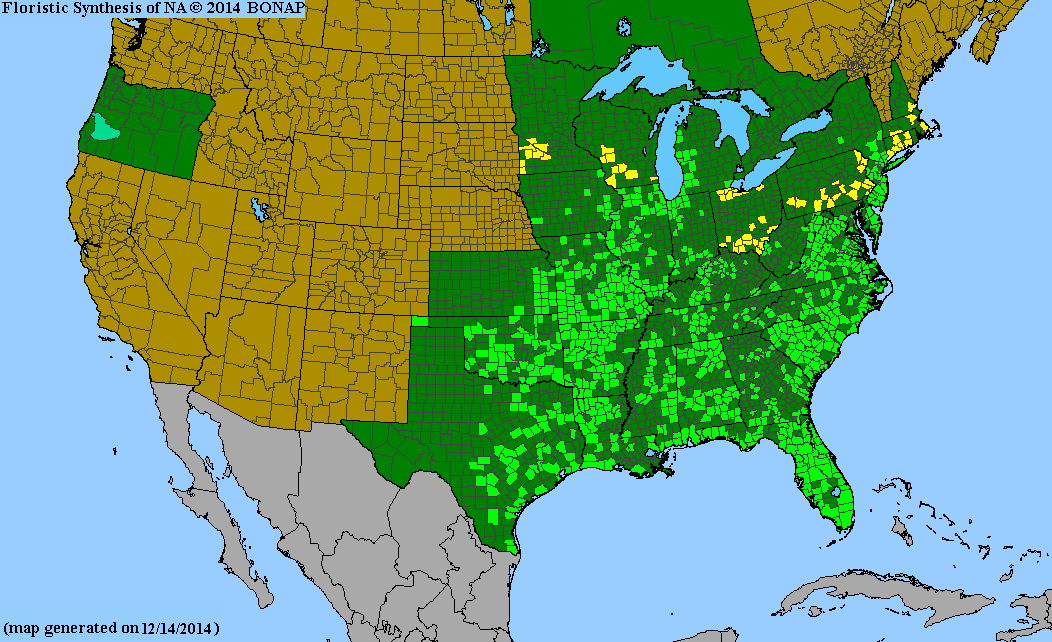
Range map courtesy of the Biota of North America Program (BONAP).
The Eastern Prickly Pear is a wide-ranging cactus found throughout much of the eastern United States. It is rare in many of its northern locations, including Ohio where it is state-listed as Potentially Threatened. One reason is the destruction of proper habitat (like the development of sand terraces). Another reason is the removal of wild plants from a wild population. People like to have these as a yard plant, and some will simply go to a wild population and transfer those plants to their yard, reducing the individuals in that population.

There are records from a total of 19 counties here in Ohio, although only 13 of those counties have records from after 1980. It appears to be disappearing from the southern counties that are away from the Ohio and Scioto Rivers, although the lack of records from the past 35+ years might simply reflect a lack of effort to keep tabs on those populations. You should look for this species in well-drained sandy soils that are exposed to sunlight.

Eastern Prickly Pear Ohio
Of course, it wouldn't be a post about a cactus without talking about their infamous defenses. The Eastern Prickly Pear employs two different types of defense against a would-be herbivore. The first, and most obvious, are spines. These spines are actually modified leaves, although the cells in spines are dead instead of living like a normal leaf. These spines grow out of a dark bump on the cactus called the areole. The other line of defense are glochids. Glochids are tiny hair-like spines that also grow from the areoles. Unlike the spines, these glochids break off very easy and readily irritate the skin. I personally found this out after touching one of the cacti to get a better look. The rest of the day I kept pulling out tiny glochids that had embedded themselves in my hand. You can see these glochids in the photo above; look for the red clusters protruding from the areoles. There are hundreds of glochids in each cluster.

Eastern Prickly Pear Ohio
Cacti, as a whole, are strange. They're plants, but they really don't look or act like other "normal" plants. They are extremely modified and have many adaptations that allow them to live in dry or drought-prone areas. Most species, including the Eastern Prickly Pear, are succulents, meaning they have thick, fleshy pads that are used to store water. Since they lack photosynthetic leaves, all photosynthetic processes occur in the enlarged stem. They also employ a special water-saving process during photosynthesis called Crassulacean acid metabolism, better known as CAM photosynthesis. Those are only a few of the many adaptations. Of course, Ohio isn't quite like the deserts of the Southwest or South America, but the Prickly Pear uses these adaptations not to simply survive in an area, but to exploit a hard to grow in area. As I've previously mentioned, this species prefers sandy soils. This isn't the easiest type of soil to grow in. Any rainfall will simply seep out of the sand instead of remaining easily accessible like most soils. As a result, these soils are very dry. Add in full sunlight, and you have a very hard place for a plant to live in. The Eastern Prickly Pear, with its water-saving adaptations, can easily take advantage of this type of habitat and thrive, instead of facing intense competition in a more forgiving environment.

Eastern Prickly Pear Ohio
If you look at the bottom of this photo, you can see some of the prickly pear individuals nestled among the other plants. The hills in the background are actually in Kentucky. Those hills are the cut banks from the Ohio River. The rest of the ground you see is part of the flat sand terrace.

I'm currently finishing up this summer's lab work. This upcoming Saturday I move back into the dorms at Ohio University and start classes on that Monday. I plan on trying to get out one or two more posts this week since I have a few days of "rest" before dealing with the craziness of moving in and starting classes. Thanks for reading!

Thursday, August 6, 2015

The Showy World of Moths

I ventured out to Buzzard's Roost Nature Preserve in Ross County, Ohio, this past Saturday night. The naturalist for the Ross County Park District, Joe Letsche, was holding an arthropod night there at the park. There were two mothing sheets set up, and some awesome moths visited us over the course of the night. 

Ohio moths
I know when many people think of moths, they think of little brown and gray insects. "Boring." "All the same." Moths like the ones above probably come to mind. As a result, many people dismiss moths altogether. Now I'm biased; I'm interested by all things nature, and I get excited even when I see the most plain brown moth ever. I think that part comes with time. When people get "into" some part of nature, it often stems from seeing something we "-ers" (birders, herpers, mothers, what have you) refer to as a "Spark Species." For example, I became a birder after I spent a summer watching a family of Cooper's Hawks nest and fledge. A Cooper's Hawk was my spark bird. In the case of moths, a Polyphemus Moth I found when I was in elementary school was my spark moth. Normally these spark species are something showy, exciting, and attention-grabbing. They pull you into their world, and eventually you begin loving everything in it whether they are showy or drab. I put together this post filled with the showy, potential spark moths from the other night. If you aren't already interested in the "dark side of Lepidoptera," maybe this might get you to go out and take a look!

Rosy Maple Moth, Dryocampa rubicunda
Showy colors aren't just reserved for the butterfly side of Lepidoptera. Case in point: this guy. This is the Rosy Maple Moth, Dryocampa rubicunda. As the name suggests, the caterpillars of this species feed primarily on maple trees. This is a common moth in Ohio, probably occurring in all counties. The Rosy Maple Moth is in the Royal Moth subfamily (Ceratocampinae), meaning it is related to the Imperial Moth; however, this is one of the smallest species in the Royal Moths, meaning it often gets overlooked. This moth inhabits deciduous forests across the state and flies from April to September (two broods).


Hebrew Moth, Polygrammate hebraeicum
This is the Hebrew Moth, Polygrammate hebraeicum, typically just called the Hebrew in the mothing world. Unlike the Rosy Maple Moth, which dazzles with its colors, the Hebrew dazzles people with its stark and contrasting black-and-white patterning. This moth flies from May to August in Ohio, and seems to be concentrated in the Eastern half of the state.

Ailanthus Webworm Moth, Atteva aurea
My favorite moth of the night was the Ailanthus Webworm Moth, Atteva aurea. I had been wanting to see one of these diminutive moths for years and years, but had never been able to find one. This night there wasn't just one on the sheets, but at least 5! I was incredible ecstatic, to say the least. This is a very interesting moth. Originally it was native to the American tropics, only reaching into the USA in northern Florida. This species feeds on the tropical Paradise Tree and a closely related species found in the rainforests of Central America. Starting in the late 1700's, Americans began using a Chinese species of tree called the Tree-of-Heaven as an ornamental. This species escaped cultivation and spread as an invasive species. The Tree-of-Heaven is related to the Paradise Tree, and it turns out the Ailanthus Webworm Moth can feed on it. As the Tree-of-Heaven spread throughout the Eastern US, the Ailanthus Webworm Moth spread northward from the tropics and Florida all the way up to Canada. As a result, this moth is technically nonnative to Ohio; however, it is important to note that this moth isn't considered an invasive. Why? Since it feeds on the invasive Tree-of-Heaven, it is technically beneficial to have around here. Sadly the Ailanthus Webworm isn't making the biggest impact on the Tree-of-Heaven, which is still a serious issue in the US. Since the Ailanthus Webworm is an insect from the tropics, it doesn't take too well to the colder temperature of the US. As a result, this species actually migrates back south to Florida and the tropics in October (for Ohio) and comes back around March. 

Clymene Moth, Haploa clymene
This is the Clymene Moth, Haploa clymene, which you can see is actually a member of a black metal band. The Clymene Moth is actually a species of Tiger Moth, subfamily Arctiinae. This moth is an easy species to ID, and quite possibly might be mimicking bird droppings as a defense. The Clymene Moth can be found throughout all of Ohio and typically inhabits meadows and fields with forested areas nearby. 

Harnessed Tiger Moth, Apantesis phalerata
Next up is another species of tiger moth. This is the Harnessed Tiger Moth, Apantesis phalerata. This species can be found all throughout Ohio and flies from April well into Autumn (The Moth Photographers Group even has records from December in Ohio). Whenever I go over a species on my blog, I always like to give some cool natural history facts about the species. The problem with many insects, especially moths, is that we often don't know much of anything about their natural history. There are so many species (3,000+ species of moths in Ohio alone) in this region that it's hard for scientists to know even basic facts about most of them. This is one of those species where information is lacking.

Magdalen Underwing, Catocala illecta
Not all moths are obviously showy; sometimes an otherwise "bland" moth is more than meets the eye. This is the Magdalen Underwing, Catocala illecta. The Underwings are a group of moths with camouflaged forewings and brightly colored hindwings. There have been over 60 species of Underwings recorded in Ohio, with some being rare and state-listed. The Magdalen Underwing is one of the more common species. The bright hindwing colorations of the Underwings serve to deter predators. If a predator happens to find a camouflaged Underwing, the Underwing will open its wings and flash the bright colors, momentarily scaring the predator. This will give the moth just enough time to escape.

Imperial Moth, Eacles imperialis
And last but not least, we have the Imperial Moth, Eacles imperialis. This species stands out not only for its colors, but also for its size, with wingspans reaching from 3-7 inches. If you want to learn more about the Imperial Moth, check out my previous post on it!

Hopefully you're leaving this post with a little more interest in moths. Looking for and identifying moths is a fun, and challenging, hobby to get in to. Not only can identification be challenging, but there's so many species in Ohio that you will almost always see a new species every time you go out! Thanks for reading!

Tuesday, August 4, 2015

Imperial Moth

This past Saturday Joe Letsche, the naturalist for the Ross County Park District, held an arthropod night at the Buzzard's Roost Nature Preserve. It was a great gathering of insect-and-arachnid-loving people, with an amazing array of arthropods to boot. There will be several future posts going over some of the goodies from that night, but I want to start with this. In keeping with this year's apparent "really big and awesome moths" theme (see my previous posts on the Cecropia Moth and the Luna Moth), here's the Imperial Moth!

Imperial Moth
This beautiful moth is the Imperial Moth, Eacles imperialis. This species, the Cecropia Moth, and the Luna Moth all belong to the family Saturniidae; however, the Cecropia and Luna belong to the subfamily Saturniinae, better known as the Giant Silk Moths. The Imperial Moth, on the other hand, belongs to the subfamily Ceratocampinae, better known as the Royal Moths. This species ranges throughout the entirety of Ohio, with records from nearly all the counties. It is worth pointing out that although it ranges across Ohio, the Imperial Moth seems focused on the southern and eastern parts of Ohio. It can be found in deciduous, coniferous, and mixed forests. The Imperial Moth's habitat gives us a clue to understanding their strange coloration. Moths are heavily preyed upon by a variety of predators, and as a result most moths have developed some sort of visual defense mechanism. Some use camouflage and look like lichen found on trees or other natural objects. Others mimic wasps, toxic beetles, or even hummingbirds in the case of the Hummingbird Clearwing. How does the Imperial Moth avoid predation? Well, it looks like a dead leaf! During the day this moth sits on the forest floor, pretending to be a leaf until nightfall. If you passed this moth while it happened to be on a pile of yellow and brown leaves (which are especially abundant this time of year), you would never notice it!

Imperial Moth
The Imperial Moth has another thing going for it when it comes to camouflage: variation. There is a huge amount of pattern variation in this species; simply compare this individual with the previous individual pictured above to get an idea! Okay, so imagine you were told to find some camouflaged objects in the forest, and let's say all these objects look exactly the same. It will be hard to find the first few, but eventually you'll begin learning what to look for. Soon you'll start getting faster and faster as your brain recognizes the same patterns over and over. Good for you if you're a predator, bad for you if you're the prey. Now, imagine you are told to find another set of camouflaged objects, but this time all the objects vary slightly in pattern and coloration. You never really develop "eyes" for that object, and you struggle to find it. This time it's bad for the predator, good for the prey. This is exactly how the Imperial Moth excels. Overall, they all look like a dead leaf, but they all look like different dead leaves, just like how all dead leaves vary. Birds and other predators have a very hard time learning to pick them out of all the background noise, resulting in more Imperial Moths surviving to reproduce and passing on their color variations.

Imperial Moth Size
The Imperial Moth is a very impressive moth to see in person. There's variation in wingspan sizes, but they typically reach 3-7 inches. Females, such as the one above, are typically larger than males. The Imperial Moth does come to lights, and we had 3 individuals visit the mothing sheets over the course of the night. In Ohio, these moths begin flying in late June through mid-August.

Imperial Moth
When it comes to these large moths, I really like to try and get a shot of their face. There's something adorable, in my opinion, about these ridiculously-furry moth faces, although I know many probably disagree.

As I said before, I have several posts coming up from this night, so stay tuned! Thanks for reading!