Friday, September 27, 2013

Some Findings at The Ridges

I went on a hike at The Ridges the other day, which you can read about right here, and came across a few interesting creatures and plants.

This is an Eastern Garter Snake, Thamnophis sirtalis sirtalis. He was lucky; I didn't see him at first and almost stepped on him. This garter was really cooperative with me. He let me get within 5 inches of his face to take some close ups before he slithered away into the forest. Eastern Garter snakes are very common snakes and if you pay attention you'll probably notice one sometime while out hiking. This one was a smaller one, only about a foot long, but they can reach up to three feet or more. Soon this one will be grouping up with other garters to hibernate for the winter.

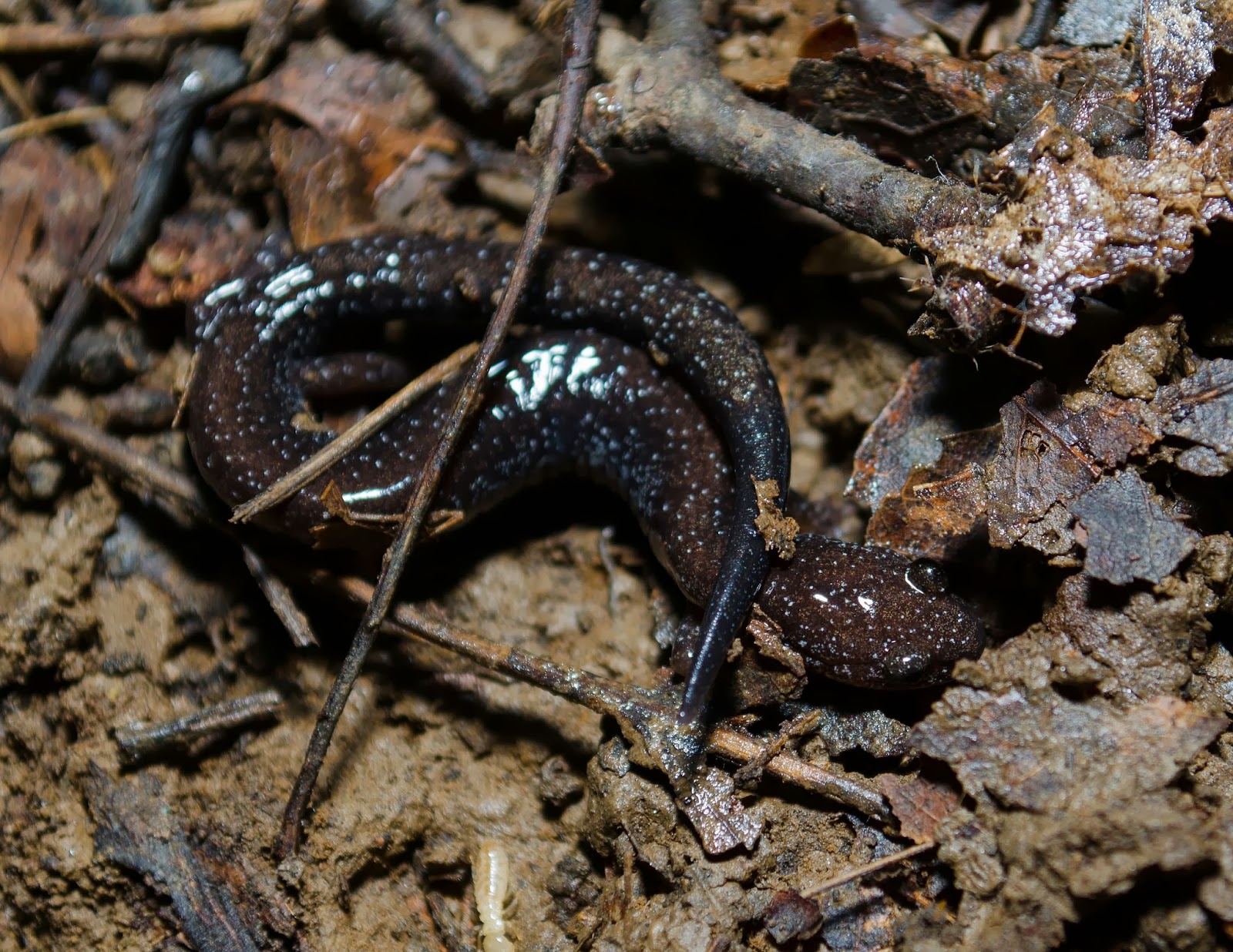
Ah! A salamander! I flipped over a log hoping to find one, and sure enough there was. This is a new species for me - the Northern Ravine Salamander, Plethodon electromorphus. This is a relatively "new" species actually. It was separated from the old "Ravine Salamander," P. richmondi, now known as Southern Ravine Salamander, in the last decade or two. Northern Ravines are different from their Southern Ravine cousins in their protein composition and their distribution. As a result, information on them seems rocky. Most of the studies done in the 1900's at some point may have included mixes of both species, or one, or the other, so info on Northern Ravine Salamanders is lacking, to say the least. Now that they know it's a new species maybe new research will start separating our knowledge of the two.

Here's another salamander I came across. This is a shy Northern Dusky Salamander, Desmognathus fuscus. He was in some exposed rocks along a stream and when I looked at him he promptly pulled himself into a little crevice and tried to hide from me. ODNR says they are the most abundant of our salamanders. In the northern parts of their range, like Ohio, they prefer small streams (Like where this one was found), springs, and seepages. Interestingly, this species has an immovable lower jaw and the only way it can open its mouth is to raise its head.


You've might have seen one of these, if you pay attention to tiny critters. This is a Red Velvet Mite, family Trombidiidae. I'm not sure of the species, but it's most likely either a Trombidium sp. or a Allothrombium sp. Red Velvet Mites are actually arachnids, like spiders. Many species are very small, but this one was a bit larger than the ones I normally run across; still very small, but large enough to catch my eye from a few feet away. They won't hurt you, unless you're a small insect, in which case these predators will probably be going after you.

These are the flowers of the White Snake Root, Ageratina altissima. This is a poisonous herb. It contains the toxin tremetol, which can poison humans through an interestingly process. Cows will sometimes eat this plant, and as a result ingest the toxin. This makes the milk and meat of the cow poisonous. Humans would drink the milk, and if they ingested large enough quantities of the toxin, would consequently get tremetol poisoning. Before we knew snake root was the cause, we used to just call the subsequent poisoning "Milk Sickness." Back in the frontier days, it killed thousands of settlers, many of them in the Ohio River Valley. Abraham Lincoln's mom Nancy Hicks was actually a victim of Milk Sickness. Finally, in 1928, the official link between Milk Sickness and White Snake Root was pinned down.

Alright! That's all I have for this post. Stay tuned for another post really soon over a couple of "fuzzy" caterpillars I found on this trip.


Tuesday, September 24, 2013

Radar Hill and The Ridges

I'm finally back after a few weeks of a hiatus. I moved into Ohio University back in August as a freshmen and only recently brought my camera down. But anyway, I now have material for three posts or more.

This one is on the trail system up at The Ridges in Athens, Athens County, Ohio. Specifically, it's about the Radar Hill trail.

What is The Ridges? Well...

The Ridges Insane Asylum
The Ridges is a large complex owned by Ohio University that is mostly what used to be the Athens Lunatic Asylum. The Athens Lunatic Asylum was opened in 1874 and closed in 1993. This is a nature blog, so I'll only mention this place's history in passing, but if you're interested, SERIOUSLY read up on it. Its history is crazy. Check out Forgotten Ohio's amazing post on it right here! The Wikipedia article is nice too. Nowadays OU utilizes what it can of the buildings. For example, the main part of the hospital - the part in the photo above - is the Kennedy Museum of Art.

Anyway, The Ridges also has a large forested area attached to it with several trails, including a Nature Walk trail, connector trails, the Radar Hill Trail, and more.

The Ridges Hiking
Radar Hill is an incredibly popular destination for OU students and "townies" alike. A short hike of about one mile will take you to the highest point in Athens. The trail starts out in your "typical" southeastern Ohio forest and opens up to a more secondary-growth type of habitat that you can see here. The trail is well-maintained and wide. Radar Hill is that little mound-type hill at the end of the trail in this photo. So, here's how the trail works. If you start at the Hocking River (say if you're a student walking from OU) by Richland Avenue, you follow a brick path up a hill to The Ridges. Then, you climb another hill that takes you to where a water tower is. The path begins by the water tower. You climb up and up until you get on another ridge. You walk along the ridge until you get to the Radar Hill peak, which you also have to climb. It's almost like climbing 4 hills, but it isn't too strenuous, really.

Radar Hill The Ridges
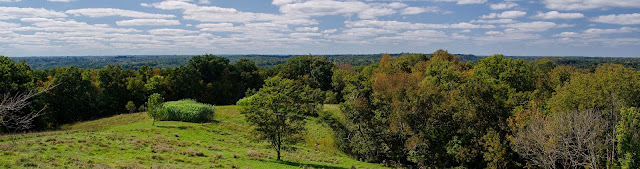
This is the view from atop Radar Hill, looking out the opposite direction the other picture showed. As you can see from the horizon, you can see for miles. Why is it called Radar Hill? Well, in World War II the US Army built a radar station on the hill. OU and the Air Force then took over the radar station and turned it into a defense research facility. Then, NASA contacted OU in the early 60's and had them use the station to help gather info on the moon for the upcoming Apollo missions. By the 70's, the station was abandoned, and now it no longer stands.
Radar Hill The Ridges
Remember, you can always click on the photos in this blog to view a larger version!
Here's the view on the opposite side of the hill. Miles and miles of sight; the rolling Appalachian foothills make up the horizon. As you can see, fall is here, well, at least us birders can see. Fall songbird migration has picked up and is really in full swing. I saw my lifer American Redstart and Blackpoll Warbler at The Ridges a week before these photos were taken. As this photo shows, you can see the trees beginning to change. The temperature has also began cooling (finally!).

Radar Hill Athens
This trail (as far as I am aware) is open all the time, and many people take night hikes. I did one late at night and watched the sun set. As you can see, tt was absolutely spectacular! On the way up, I saw about 15 deer, and these locals seem to have essentially no fear of humans. They just stand there, eating grass, like ten feet from you and don't even bat an eye.

You can also see part of Athens from the peak. This is a zoomed in view to better point it out. At night, it's an amazing view; The light of the town glows in the dark valley as darkness is all around you. If you want better views of town though, check out Witches Hill or Bong Hill, which I will make posts about sometime soon.

That wraps up this post! Keep on the lookout for more posts soon, which will most likely cover salamanders, some caterpillars, nearby Witches and Bong hills, and more! See you soon!

Sunday, August 18, 2013

Some Moths

Moths are really spectacular, but sadly they are many times over-shadowed by the more "flashy" butterflies. While butterflies are nice, moths are so incredibly varied and fascinating that they deserve a closer look.

So let's take a look at some of the moths I've come across recently.

Some moths are quite flashy and in your face. This is one such moth. This is a Pandorus Sphinx, Eumorpha pandorus, (also known as the Pandora Sphinx). These guys are massive; they can have wingspans of 3¼–4½ inches. If you ever come across one, you will definitely notice it. I came across this individual a few years ago on my front porch in the city. Adults fly at dusk from May to October, depending where you are in their range. In Ohio, there's flight data from June through August. The north only has one generation a year. Sphinx moths are always flashy, and this one is one of the flashiest in my opinion.

While there are flashy moths, there are also very plain moths. However, many of these plain moths have a very subtle beauty if a person actually gives them the time of day to look. This is a Common Tan Wave Moth, Pleuroprucha insulsaria. This smaller moth lives throughout Eastern North America and is common in deciduous woods, forest clearings, and field edges. They are nocturnal and attracted to lights, which is where I found this individual by.

This nondescript moth is a Green Cloverworm Moth, Hypena scabra. It's a species found over the majority of Eastern North America, and has even been reported in Great Britain! They're also nocturnal and attracted to light.

This tiny moth is a Sparganothis Fruitworm Moth, Sparganothis sulfureana. When I first saw him, I just thought it was another tiny, drab moth, but then I took a closer look at it. It revealed a intricate cream-and-caramel-coloured moth. Next time you see a tiny moth, take another look; you'll never know what you may see.

This moth stood out because of its color. This is a Spotted Fireworm Moth, Choristoneura parallela. 

Here's another interesting moth. Tiny, but different. This is a Black-shaded Platynota Moth, Platynota flavedana. 


This is a Common Idia, Idia aemula. A pretty common moth, this species is found across most of North America and Eurasia. This individual was quite worn, as you can see!

This one turned out to be the highlight of one mothing (yes, mothing, like birding) night. I'm pretty sure (and others agree) that this is a Detracted Owlet, Lesmone detrahens. It appears to be a very worn individual, making ID a bit harder, but it really matches other photos of Detracted Owlets on BugGuide. Anyway, Detracted Owlets, a southern moth species, are uncommon/rare visitors to Ohio, so this turned out to be a great find!

That's all for this post. Keep on a look out for moths!

Thursday, August 1, 2013

Creatures of the Night

The other night around 10 PM, I headed out to a big security light in my backyard (located in Pickaway County). Insects were flying everywhere, all drawn to the light. Predators, such as spiders, prowled the area looking for an easy meal. Here are a few of the creatures I came across...

This awesome moth was the highlight of the night. This is a Virginia Creeper Sphinx, Darapsa myron. It's also known as the Hog Sphinx. Sphinxes are a type of moth that are very easily identifiable. Most sphinxes have the general body shape as the one above. The Virginia Creeper Sphinx is widespread across the Eastern portion of the US and is quite common.

Here's another beauty of a moth. Many times moths are overlooked; many people go after the more "flashy" butterflies. However, many moths are also flashy. Many have subtle beauties as well if you take the time to actually look at them. This one is a Delicate Cycnia, Cycnia tenera, also known as the Dogbane Tiger Moth. Interestingly, these moths will emit a high pitched clicking sound when bats are nearby. While the exact function is still uncertain, studies have found that bats many times choose to forgo these moths when clicking, so it is thought that the Delicate Cycnia's clicking might actually be disrupting the bat's echolocation, rendering it confused and not wanting to attack.

This is a conehead, as you can see from its cone-shaped head. Species wise, I'm pretty sure it is a Robust Conehead, Neoconocephalus robustus. I'll get into why later. First, this insect was massive; she was nearly the size of 3/4 of my hand or so. You might have heard one during the summer. They have an incredibly loud, constant buzz. Head over to this video to hear a recording of one. I believe this is a Robust Conehead because of its large size, the immaculate tip of its head, and the size of its ovipositor (egg-laying organ that looks like a giant stinger-type thing) which is 1.0-1.2 times the length of its hind femur. Coneheads are part of the katydid family, as you might be able to tell. The camouflage of this girl (which you can tell is a girl due to the presence of the ovipositor) is amazing; if you were by a silent one on a leaf, you would probably never notice it!

My backyard was surprisingly filled with a variety of life; I went out looking for moths and found treefrogs as well! This guy is a treefrog, but the exact species is uncertain. It's either a Gray Treefrog or a Cope's Gray Treefrog. Both species look exactly the same and can only be told apart by song or DNA. This one was silent, so I just have to leave it at some sort of gray treefrog.

Here's a shot of another treefrog that landed by me. Yes, landed. He fell from the sky and landed beside me. I think he was on the top of a shed I was by when he decided he didn't want to be there anymore... Don't worry though, he was fine. Really fascinating creatures up close though. This was actually my first time ever seeing a treefrog, so I was quite happy. Our yard also has a lot of American Toads hopping around, so it's quite the amphibian-hang-out.

There were about ten more species of moths, a few spiders, and other odds and ends that I came across over the night. After I identify some of the other moths, I'll have a post about some of them, so stay tuned you insect-lovers!

This also shows the incredibly variety of nature you probably have in your backyard. If you ever get bored, go outside at night with a flashlight and look for the whole other world that comes alive when the sun goes down!

Sunday, July 28, 2013

Indian Pipe

There's one wildflower I have always been fascinated with but I've only come across once in my life, many years ago in the Hocking Hills.

However, I finally found it again, this time essentially in my backyard. While hiking after the rain at AW Marion State Park, I came across a strange plant known as Monotropa uniflora.

These are the strange plants in question. Monotropa uniflora goes by a few common names. I prefer Indian Pipe, but it is also known as the Corpse Plant or Ghost Plant. You can see why; the deathly-white plant is almost skeletal in appearance. Why is it white? Well, the reason why is something that makes this plant very strange in the plant world. Indian Pipe lacks chlorophyll, the biomolecule that allows most plants to harness energy from the sun. Chlorophyll also gives plants their green hue, and the absence of it in Indian Pipe leaves the plant a ghastly white. Since it lacks one of the most critical ingredients for photosynthesis, Indian Pipe is left to be parasitic to get its energy. Indian Pipe, being a myco-heterotroph, feeds upon certain fungi that are mycorrhizal with trees (that is, the fungi form a mutualistic relationship with the trees). In short, Indian Pipe steals energy from a fungus that is sharing nutrients and energy with a tree. Quite a multi-leveled food chain, isn't it?

Here's a close-up of the flowering end. This specimen was all white, but many times they have a pale-pinkish hue to them, and rarely they even have a deep red hue. Since it isn't dependent on sunlight for photosynthesis, Indian Pipe can thrive in very dark areas, including dense understory areas in forests. This species has been recorded in 59 of the 88 Ohio counties, mostly in the Eastern portion. They're quite small (only a few inches tall), but if you look out for them in nutrient-rich and dense forests you're bound to come across some!

Hargus Lake after some rain.
I highly encourage curious people to go to their local park and explore, explore, explore. You are never quite sure what you'll find. In my case, AW Marion SP is my local park, and I've found many, many interesting things over the years, from a Ross's Goose, to Caribou Lichen, Indian Pipe, Running-Pine, waterfalls, snakes, and more.

I know I haven't been terribly active lately; things have been hectic. Come August 16th, I'll be moving down to Athens, OH, to start college! I'll be majoring in Wildlife and Conservation Sciences, so I'm sure that will lead me to many interesting stories which I can share on here. Have a nice week!