Last week was the end of the salamander field season in Northern Ohio; the high temperatures had driven most of the Plethodontid salamanders completely underground, rendering them nearly impossible to find. With the field season over, the lab-based part of my summer job is about to begin. I have a few days off before I have to head back down to Athens, and I've spent many of those days exploring (surprise surprise). One of the locations I've visited so far is Cedar Bog Nature Preserve in Champaign County, Ohio.
Cedar Bog is indescribable; it is by far one of the most amazing, and unique, places I've been to in Ohio. There are several different types of ecosystems located there, but this post takes place in the scene above. This is a White Cedar swamp. Swamps are essentially a forested wetland, and in this case the dominant tree is the White Cedar, a rare tree in Ohio.
I was walking quietly down the boardwalk when a tiny scurrying noise caught my attention. I assumed it was probably a snake so I began searching intently for it. After a few seconds, I noticed a tiny head staring at me. It was a skink! I froze and hoped that he would possibly come out for a better view...
Sure enough, he did. This is a Five-Lined Skink, Plestiodon fasciatus. This specific individual, with his bright orange head, is a male in breeding colors. You might have heard of this skink by another common name, the Blue-Tailed Skink, which refers to the bright blue tail that the juveniles have. The Five-Lined Skink is the most common of the 5 lizard species we have in Ohio. I've previously covered another Ohio lizard on this blog, the Eastern Fence Lizard, which you can read about here. Although this species is the most common in Ohio, it isn't an easy find by any means. Skinks are incredibly fast (they're some of the fastest lizards out there), and any that might be in the area will simply run quickly away from you if you're not quiet and paying close attention. I would have never seen this guy had I not been looking and listening for anything that might be in the area.
Eventually the curious little skink wandered out onto the boardwalk only a few feet away from me. This was the start of a 10 to 15 minute game of hide-and-seek-with-a-skink. The skink would wander out into the open for a few seconds, then run away and hide. A few seconds later he would reemerge from a new location somewhere within 5 feet of me. This cycle repeated over and over. A ground-dwelling species, this skink knew all the ins-and-outs of his territory and could have easily slipped away never to be seen if he wanted to. It was an interesting encounter to watch unfold; he was obviously interested enough in me to check me out, and also seemed to know that I wasn't an immediate threat to him. He would have been gone had he seen me as a real threat, but instead he kept coming back and watching me.
The Five-Lined Skink probably lives in most, if not all, of the counties in Ohio; however, only about half the counties have official records of this species, which can often be hard to find. Records of this species are conspicuously missing from the central part of Eastern Ohio. This is a common theme with many reptile and amphibian species of Ohio. Counties such as Belmont, Harrison, Jefferson, and others in that immediate area are missing records of many species that are almost certainly there. These counties must not be heavily explored by surveyors. Southern Ohio is still your best bet to see this species, as well as Cedar Bog NP in Western Ohio.
A blog about the natural world around us, whether it be birds, insects, plants, geology, or more!
Friday, June 19, 2015
Five-Lined Skink!
Labels: nature, ohio, photography, parks
Champaign County,
Herpetology,
Herping,
Lizards,
Reptiles
Thursday, June 4, 2015
Northern Parula
This year's Spring migration is all but a memory now, and most species are currently focusing on raising a successful brood. I, however, want to revisit a day during migration for this post. On May 19th I had the chance to visit the famous boardwalk at Magee Marsh along Lake Erie. Sadly, I was a few days late for the Biggest Week in Birding, but Spring migration was still hopping. I saw many warblers and assorted other migrants, but one Northern Parula gave me and a few other birders quite the show. I was fascinated by this Parula and decided to write up a post about the species, so here we go!
The Northern Parula, Setophaga americana, is a small migratory warbler. You might be wondering where in the world the name "Parula" came from. When this species was first classified by Carl Linnaeus in 1758, Linnaeus considered it to be related to the tits of the Old World. The name for this genus was Parus, and that was slightly changed to Parula for the common name of this species. However, the Northern Parula isn't a tit, and is instead a new world warbler. Like other neotropical warblers, the Parula spends half the year in more southerly climes and the other half in more northerly climes to breed. During Spring (April-May in Ohio), this species migrates from parts of Central America and the West Indies to the Eastern United States and Eastern Canada. It then spends the next few months trying to find a mate and raising a new generation before migrating back south to overwinter.
Where can you find this species in Ohio? Well, it depends on when you're looking. They can essentially be found anywhere across Ohio during migration, especially in the southern portion of Ohio and along the Lake Erie coast. It's a little harder to find this species during the Summer. They breed in the Allegheny Plateau region of Southern and Eastern Ohio, becoming scarcer the farther North you travel. The Northern Parula breeds in well-established forests here in Ohio. The older forests of Southern Ohio typically hold a good number of individuals. You can always find some in the Hocking Hills region, as well as Adams County. If you're looking for one though, good luck! The Northern Parula is a tree-top gleaner, meaning it feeds on insects that live on the branches in the canopy. Parulas are also roughly the same size as a chickadee. Spotting this tiny bird when it's 80 feet up in the leaves is definitely a frustratingly hard thing to accomplish. To help know when there's a Northern Parula near you, learn their song! It's a fairly easy song to learn, and you will find ten times more individuals this way than you would by just scanning the trees in hope for one. To listen to some examples of their songs, go to this link and look on the bottom right for "Songs and Calls."
At Magee Marsh during Spring migration, things are a little different. Tree-top gleaners, such as the Northern Parula, might be only 5 feet off the ground. On top of that, the warblers are so focused on getting enough food to make it across Lake Erie that they essentially ignore all the people around. That means there might be a warbler only an arm's length away and right at eye level. Regardless of how cheesy it sounds, I can only describe Magee Marsh as a magical place, and birders who have made the trip know exactly what I'm talking about. This Northern Parula was no exception, foraging right at eye level only about 5 feet away. In the photo above you can see him checking out a leaf for a possible tasty arthropod morsel.
And turns out there was indeed a tasty arthropod about! He quickly pulled a tiny green caterpillar off the leaf, which you can see in his beak above. As always, you can click on the photo to get a bigger version. While the Northern Parula eats a wide variety of arthropods, their favorites are caterpillars and spiders.
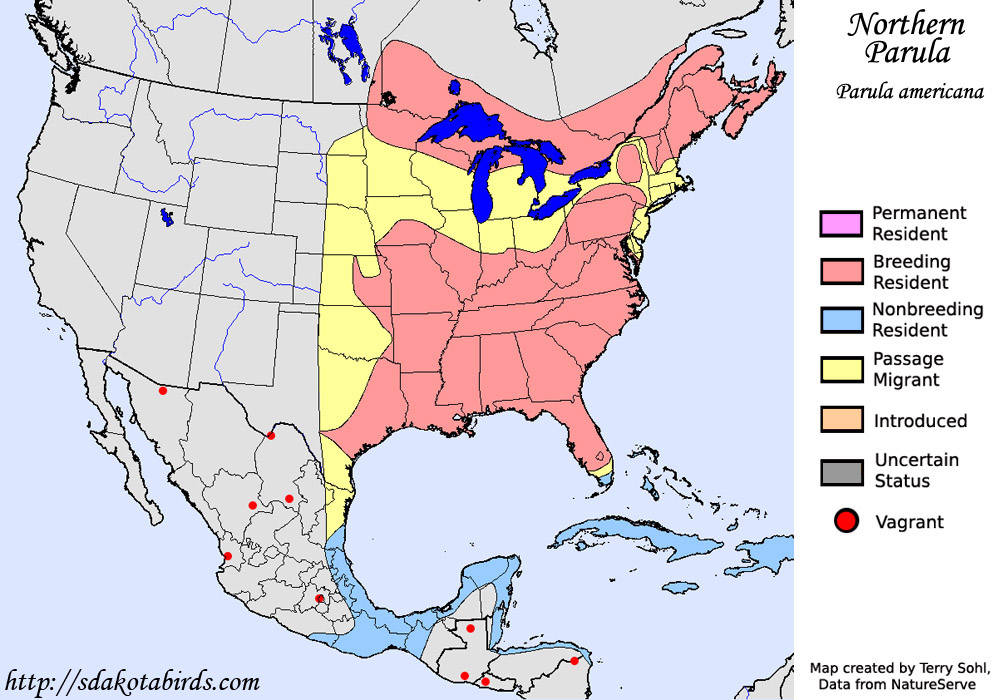
If you look at a range map, like this one here, you might notice something strange. The Northern Parula nests in southeast Canada and the southeast US, but there's a noticeable gap where they don't breed. This gap separates the species into a northern and a southern breeding population. The gap is probably due to a combination of two main factors that I'll discuss below.
The Northern Parula loves to make nests out of tree lichen. In the south they use Spanish Moss, which is actually a lichen, while in the north they utilize Usnea sp. lichens, commonly known as the Beard Lichens. Is there abundant tree lichen in the gap? Turns out there isn't, but that wasn't always the case. Lichen is very sensitive to air quality, and if you look at the gap you can see that it matches up nicely with big metropolitan areas where air pollution was, and still is, an issue. The Parula more than likely nested in the gap in the past before industrialization, but the air pollution the cities brought killed off the tree lichen species they would utilize. With the disappearance of appropriate nesting material, the Parulas were simply forced to leave that area; however, there is another factor to consider. Parulas favor complex forests where there is a variety in tree height, plant species, and so on. The area that the gap is in was a victim of deforestation, and as a result there is now a very homogenous forest instead of a complex heterogeneous forest. The homogenous, young forests of the area coupled with the lack of tree lichens is probably the true cause of the gap, not just one or the other. Once again, this is another example of human-caused problems. Hopefully the air quality will get better in the gap over the upcoming decades and the Northern Parula will once again return to the area to nest.
Where can you find this species in Ohio? Well, it depends on when you're looking. They can essentially be found anywhere across Ohio during migration, especially in the southern portion of Ohio and along the Lake Erie coast. It's a little harder to find this species during the Summer. They breed in the Allegheny Plateau region of Southern and Eastern Ohio, becoming scarcer the farther North you travel. The Northern Parula breeds in well-established forests here in Ohio. The older forests of Southern Ohio typically hold a good number of individuals. You can always find some in the Hocking Hills region, as well as Adams County. If you're looking for one though, good luck! The Northern Parula is a tree-top gleaner, meaning it feeds on insects that live on the branches in the canopy. Parulas are also roughly the same size as a chickadee. Spotting this tiny bird when it's 80 feet up in the leaves is definitely a frustratingly hard thing to accomplish. To help know when there's a Northern Parula near you, learn their song! It's a fairly easy song to learn, and you will find ten times more individuals this way than you would by just scanning the trees in hope for one. To listen to some examples of their songs, go to this link and look on the bottom right for "Songs and Calls."
At Magee Marsh during Spring migration, things are a little different. Tree-top gleaners, such as the Northern Parula, might be only 5 feet off the ground. On top of that, the warblers are so focused on getting enough food to make it across Lake Erie that they essentially ignore all the people around. That means there might be a warbler only an arm's length away and right at eye level. Regardless of how cheesy it sounds, I can only describe Magee Marsh as a magical place, and birders who have made the trip know exactly what I'm talking about. This Northern Parula was no exception, foraging right at eye level only about 5 feet away. In the photo above you can see him checking out a leaf for a possible tasty arthropod morsel.
And turns out there was indeed a tasty arthropod about! He quickly pulled a tiny green caterpillar off the leaf, which you can see in his beak above. As always, you can click on the photo to get a bigger version. While the Northern Parula eats a wide variety of arthropods, their favorites are caterpillars and spiders.
![]() |
| Another caterpillar victory! |
The Northern Parula loves to make nests out of tree lichen. In the south they use Spanish Moss, which is actually a lichen, while in the north they utilize Usnea sp. lichens, commonly known as the Beard Lichens. Is there abundant tree lichen in the gap? Turns out there isn't, but that wasn't always the case. Lichen is very sensitive to air quality, and if you look at the gap you can see that it matches up nicely with big metropolitan areas where air pollution was, and still is, an issue. The Parula more than likely nested in the gap in the past before industrialization, but the air pollution the cities brought killed off the tree lichen species they would utilize. With the disappearance of appropriate nesting material, the Parulas were simply forced to leave that area; however, there is another factor to consider. Parulas favor complex forests where there is a variety in tree height, plant species, and so on. The area that the gap is in was a victim of deforestation, and as a result there is now a very homogenous forest instead of a complex heterogeneous forest. The homogenous, young forests of the area coupled with the lack of tree lichens is probably the true cause of the gap, not just one or the other. Once again, this is another example of human-caused problems. Hopefully the air quality will get better in the gap over the upcoming decades and the Northern Parula will once again return to the area to nest.
Labels: nature, ohio, photography, parks
Birding,
Birds,
Species Account
Location:
Magee Marsh, Carroll, OH 43449, USA
Friday, May 29, 2015
Cecropia Moth
The Cecropia Moth (pronounced "say-crow-peeah"), Hyalophora cecropia, is a member of the moth family Saturniidae, also known as the giant silk moths. I was absolutely ecstatic that I had found this species, a lifer for me, only two weeks after finding yet another giant silk moth lifer, the Luna Moth. Interestingly, both the Cecropia Moth and the Luna Moths were found hanging on small herbaceous plants on very windy days. This could possibly be explained as a simple coincidence, but I hypothesize that these large moths were simply taking refuge in low-lying parts of the forest, as they would be most protected from the wind in those locations.
The Cecropia Moth is an incredibly massive moth. In fact, this is the largest regularly-occurring moth species in Ohio! They can reach wingspans of 6 to 8 inches, but are typically between 4 and 6 inches. This individual was pushing the upper limits, and probably had around a 6 inch wingspan. The Cecropia can be found all throughout Ohio, typically in places where a forest meets a large open space such as an old field or meadow. Like the Luna Moth (as well as all other giant silk moths), the adult Cecropia Moth lacks any sort of mouth, rendering it incapable of eating. As a result, the adult moth only lives for about a week; its sole goal during that extremely short period is to find a mate and reproduce. This species has only one generation in Ohio, and you can find them from May to July.
Very fuzzy, isn't he? And yes, this individual is a male. Cecropia Moths can be easily sexed by paying attention to their antennae. Males, such as this one, have very feathery antennae, while the antennae of a female are much less feathery and bushy. The male's feathery antennae are incredibly sensitive and are used for sensing out a prospective female's pheromones. During mating time, which is between 3 and 4 AM, the females will release pheromones into the air. Males can pick up these pheromones with their antennae from up to a mile away, but many males will travel up 7 miles in order to find a female.
In a few weeks I'll be moving back down to Athens County. I hope to get a mothing setup and begin mothing somewhat regularly. If you like moths, stay tuned for more!
Labels: nature, ohio, photography, parks
Insects,
Lepidoptera,
Moths
Tuesday, May 19, 2015
Melanistic Garter Snake
For half of this summer, I'll be living up in Northern Ohio helping with some salamander research as a field assistant. It's only been 2 weeks so far, but we've found so many interesting and wonderful things. The best find of last week came from one of the field sites on South Bass Island in Lake Erie.
Olivia Brooks, who is the one behind the nature-oriented Twitter account Wild Earth, is the other field assistant. We're always on the lookout for snakes, and while in the middle of trying to find salamanders, Olivia yelled "snake!" We ran toward Olivia and were met by a very young Eastern Garter Snake. I've covered Eastern Garter Snakes before, and you might notice that this one doesn't really look like a garter at all. The coloration is all wrong, right? Garter snakes aren't black?!
This is indeed an Eastern Garter Snake, Thamnophis sirtalis sirtalis, but it is an individual with melanism. Melanism is essentially the opposite of albinism. While albinism is the absence of melanin (a dark colored pigment found in skin), melanism is the overabundance of melanin, leading to an individual with an abnormal amount of black coloration. Melanistic Eastern Garter Snakes can be found along the Western Basin of Lake Erie and on some of the Lake Erie Islands. Some populations can be up to 50% melanistic in this area, meaning there will be a mixture of normal-looking and melanistic individuals within one area.
The photo above shows what a normal Eastern Garter Snake looks like. This normal-colored individual was found at the same exact location on South Bass Island as the melanistic individual we found. I have no clue as to what the exact ratio between the two types is, but it would be very interesting to do a survey and get an estimate!
So why is there such a high concentration of melanistic garters in Northwest Ohio? Mutations that lead to melanism can arise randomly in any animal that has melanin; however, mutations that cause melanism and albinism are very rare. This leads to sporadic occurrences of the color abnormality that randomly occur across multiple populations. For a trait like melanism to "build up" in a population, there must be something else going on. More specifically, being melanistic must benefit the individual in some way. If the trait was bad for the individual, it would quickly be selected out of the population. If it had a neutral effect, individuals with the trait would only exist in very small numbers. Adaptive melanism can be adaptive for many different reasons. For example, in Black Panthers, which are actually just melanistic Jaguars, melanism leads to better camouflage as these predators hunt in the dark of night. In the Eastern Garter Snake, being melanistic makes it easier for an individual to warm up when basking in the Sun. The color black absorbs all the wavelengths of the white light of the Sun, resulting in the black individual gaining relatively more heat energy than the predominantly brown individuals. Snakes are ectotherms ("cold-blooded"). This means that they do not hold a constant internal temperature like we do, but instead rely on the ambient heat of the environment to regulate their internal temperature. For a snake to be able to hunt successfully, their body temperature must reach a certain threshold. By being able to reach that threshold quicker and easier, melanistic garter snakes have an advantage in being able to find and eat more food than the normal individuals, who have to wait longer for their temperature to reach that threshold.
Olivia Brooks, who is the one behind the nature-oriented Twitter account Wild Earth, is the other field assistant. We're always on the lookout for snakes, and while in the middle of trying to find salamanders, Olivia yelled "snake!" We ran toward Olivia and were met by a very young Eastern Garter Snake. I've covered Eastern Garter Snakes before, and you might notice that this one doesn't really look like a garter at all. The coloration is all wrong, right? Garter snakes aren't black?!
This is indeed an Eastern Garter Snake, Thamnophis sirtalis sirtalis, but it is an individual with melanism. Melanism is essentially the opposite of albinism. While albinism is the absence of melanin (a dark colored pigment found in skin), melanism is the overabundance of melanin, leading to an individual with an abnormal amount of black coloration. Melanistic Eastern Garter Snakes can be found along the Western Basin of Lake Erie and on some of the Lake Erie Islands. Some populations can be up to 50% melanistic in this area, meaning there will be a mixture of normal-looking and melanistic individuals within one area.
The photo above shows what a normal Eastern Garter Snake looks like. This normal-colored individual was found at the same exact location on South Bass Island as the melanistic individual we found. I have no clue as to what the exact ratio between the two types is, but it would be very interesting to do a survey and get an estimate!
So why is there such a high concentration of melanistic garters in Northwest Ohio? Mutations that lead to melanism can arise randomly in any animal that has melanin; however, mutations that cause melanism and albinism are very rare. This leads to sporadic occurrences of the color abnormality that randomly occur across multiple populations. For a trait like melanism to "build up" in a population, there must be something else going on. More specifically, being melanistic must benefit the individual in some way. If the trait was bad for the individual, it would quickly be selected out of the population. If it had a neutral effect, individuals with the trait would only exist in very small numbers. Adaptive melanism can be adaptive for many different reasons. For example, in Black Panthers, which are actually just melanistic Jaguars, melanism leads to better camouflage as these predators hunt in the dark of night. In the Eastern Garter Snake, being melanistic makes it easier for an individual to warm up when basking in the Sun. The color black absorbs all the wavelengths of the white light of the Sun, resulting in the black individual gaining relatively more heat energy than the predominantly brown individuals. Snakes are ectotherms ("cold-blooded"). This means that they do not hold a constant internal temperature like we do, but instead rely on the ambient heat of the environment to regulate their internal temperature. For a snake to be able to hunt successfully, their body temperature must reach a certain threshold. By being able to reach that threshold quicker and easier, melanistic garter snakes have an advantage in being able to find and eat more food than the normal individuals, who have to wait longer for their temperature to reach that threshold.
Labels: nature, ohio, photography, parks
Herpetology,
Herping,
Snakes
Location:
South Bass Island, Put-in-Bay, OH, USA
Sunday, May 17, 2015
Luna Moth
Last week I was walking along a path at Old Woman Creek National Estuarine Research Reserve in Erie County, Ohio. Suddenly, something on a Mayapple caught my eye...
I quickly stopped and took a closer look. Much to my surprise, the object that caught my eye was a Luna Moth, a lifer for me! I then noticed that not only was there one Luna Moth, but a few inches away there was also a second one. I have been wanting to see this beautiful species for years, and I was ecstatic that I finally had the chance!
The Luna Moth, Actias luna, is a very large moth. In fact, this species is one of the largest moths in North America. Its wingspan is 4.5 inches on average, making this species an incredibly impressive sight. The Luna Moth is found in the deciduous forests east of the Great Plains, and in Ohio they can generally be found from May through October. The Luna Moth can have 1, 2, or 3 generations a year depending on where you are within their range. Ohio falls in the 2 generation range, which means these individuals are part of the first generation for the year. While the Luna Moth can be found in every county in Ohio, they are hard to find and sadly on the decline. If a Luna Moth is hanging from a leaf, their camouflage makes them very hard to spot. Most people see Luna Moths when they are perched on a wall or other surface that makes their bright green coloration stand out. It's been even harder to find them recently due to a decline over the past several years. This decline is especially pronounced near cities and large towns, but the exact cause, or causes, remain unknown.
The adult Luna Moth has a very short life. The only goal for an adult is to find a mate and reproduce. While this is the same goal across all species, the Luna Moth life cycle is missing essentially anything it doesn't need to achieve that goal. Upon metamorphosing, the adult moths lack a way to feed. As a result, they only live for about seven days before starving to death. That single week is spent looking for a mate, and then waiting for death. Since they cannot eat, the moths need a large storage of fat to live off of. If you look at the photo above, you can see how large the abdomen (about the size of a big thumb). This is due to all the fat the individual accumulated in the caterpillar stage in order to last through the adult stage.
Luna Moths are hard to find since they are so short-lived, but even if you've never seen one in person, you probably recognize them. They're a commonly represented moth in our lives. Commercials, cartoons, magazines, and more all utilize Luna Moths for advertisement or plot devices. Moths, in general, are an overlooked group of animals, but it is impossibly hard to overlook a Luna Moth, and so they pop up a lot in pop-culture. There's nothing quite like seeing one in person though, so keep an eye out the next time you take a hike through a forest. You never know what you might find.
![]() |
| Can you find both Luna Moths? |
The Luna Moth, Actias luna, is a very large moth. In fact, this species is one of the largest moths in North America. Its wingspan is 4.5 inches on average, making this species an incredibly impressive sight. The Luna Moth is found in the deciduous forests east of the Great Plains, and in Ohio they can generally be found from May through October. The Luna Moth can have 1, 2, or 3 generations a year depending on where you are within their range. Ohio falls in the 2 generation range, which means these individuals are part of the first generation for the year. While the Luna Moth can be found in every county in Ohio, they are hard to find and sadly on the decline. If a Luna Moth is hanging from a leaf, their camouflage makes them very hard to spot. Most people see Luna Moths when they are perched on a wall or other surface that makes their bright green coloration stand out. It's been even harder to find them recently due to a decline over the past several years. This decline is especially pronounced near cities and large towns, but the exact cause, or causes, remain unknown.
The adult Luna Moth has a very short life. The only goal for an adult is to find a mate and reproduce. While this is the same goal across all species, the Luna Moth life cycle is missing essentially anything it doesn't need to achieve that goal. Upon metamorphosing, the adult moths lack a way to feed. As a result, they only live for about seven days before starving to death. That single week is spent looking for a mate, and then waiting for death. Since they cannot eat, the moths need a large storage of fat to live off of. If you look at the photo above, you can see how large the abdomen (about the size of a big thumb). This is due to all the fat the individual accumulated in the caterpillar stage in order to last through the adult stage.
![]() |
| Who can't love a cute face like this? |
Labels: nature, ohio, photography, parks
Insects,
Lepidoptera,
Moths
Subscribe to:
Posts (Atom)