Thursday, August 24, 2017

Wayne National Forest Internship

Wayne National Forest Headquarters
This summer I had the opportunity to intern at Wayne National Forest, Ohio's only national forest. This internship was focused on wildlife biology, and was part of a larger joint venture between Ohio University and the United States Forest Service out of Wayne National Forest. The main project that I worked on was an environmental impact assessment for a proposed mountain bike trail system.

Beginning in early May, I and another wildlife intern from Ohio University were tasked with surveying the wildlife along an approximate 30 mile section of the proposed trail route. We found many interesting animals and plants over the course of the summer, including discovering two new populations of a state-endangered dragonfly and documenting the first-ever Brown Creeper breeding attempt in the southeastern portion of Ohio.

In addition to assisting with the wildlife portion of the environmental impact assessment, I was given the opportunity to do some guest blogging about my internship experience on the Ohio University College of Arts and Sciences Forum. I wanted to share the four posts that I wrote for the Arts and Sciences Forum on my personal blog for anyone that was interested in reading them. Simply click on the links on the titles of the posts below.

Blue Corporal Dragonfly Ohio
First Post: Working on the Wayne | ‘I Wanted to Get My Boots Dirty’

This first post gives an introduction to the project I worked on, and goes over a few of the initial findings of note.


Northern Metalmark
Second Post: Working on the Wayne | Awesome Arthropods Abound

Arthropods are cool, and I saw many an awesome arthropod this summer. This post explores a few of the stand-out species, including the Camouflaged Looper, Luna Moth, and the rare Northern Metalmark (pictured above).

Copperhead Ohio
Third Post: Working on the Wayne | Snazzy Snakes

What's cooler than arthropods? Snakes. This post goes over a few of the common snakes of southeastern Ohio, and attempts to dispel some of the common misconceptions about them.

Brown Creeper on Nest
Fourth Post: Working on the Wayne | An Ending Note

In my final post, I summarize the findings of the wildlife surveys, talk about the potential impacts of the trail, and offer a few musings on the importance of hands-on experiences in the field in addition to a classroom education.

Kyle Brooks
Your blogger in his surveying gear. Yes, I had to wear a hard hat.
This internship was an amazing experience. Not only did I see amazing wildlife and plants, but I also learned a lot (which is really the main goal for any internship). The biggest takeaway for me, however, was that there is always something new to discover if you just take a walk in the woods and keep your eyes open. You never know what you might come across.

As for now, I am in the midst of searching for another job. Wish me luck, and thanks for reading!

Tuesday, August 22, 2017

Day Tripping to Adams County

If you have ever spent time with me, you probably know that I love Adams County in southern Ohio. Adams County has some of the most fantastic and unique nature in the state of Ohio. Last week I traveled to Adams County with two fellow naturalists from Ohio UniversityOlivia Brooks and Alayna Tokash—in order to do some botanizing, herping, and birding.

Lynx Prairie Preserve
Out of the several places we traveled to, the favorite was Lynx Prairie. Lynx Prairie is a public preserve that is owned by The Nature Conservancy, and is a location I've written about extensively on this blog. To get a general overview about the nature and history of this famous preserve, check out this link: Lynx Prairie Posts. Lynx Prairie is a system of 10 xeric short grass prairies that are of varying sizes. There is a whole host of interesting and rare species that call these "pocket prairies" home, and so I wanted to share a few of the highlights from my most recent trip!

Slender Ladies'-Tresses Spiranthes lacera Ohio
I'll begin with this inconspicuous flower. This is Slender Ladies'-Tresses (Spiranthes lacera). The ladies'-tresses is a group of orchids with a white inflorescence that typically inhabit prairies or prairie-like habitats. There are 9 species that can be found in Ohio, with 3 of those species being state-listed. The Slender Ladies'-Tresses is one of the more common of the Spiranthes species in Ohio.

Spiranthes lacera Ohio
The ladies'-tresses can be a difficult group to identify down to species. To identify a ladies'-tresses, you should first see if the flowers are arranged in a single-spiral (such as the Slender Ladies'-Tresses), or a double spiral (like the Great Plains Ladies'-Tresses). After that, you have to carefully inspect the flowers. There are several single-spiral species that can be found in Adams County, but the flowers of each species differ slightly. The Slender Ladies'-Tresses has a characteristic green labellum (or lip), which can be seen above. If you want to read about some of the other species of ladies'-tresses that can be found in the prairies in Adams County, check out my previous post: Spiranthes Orchids at Blue Jay Barrens.

False Aloe Manfreda virginica Ohio
The most exciting plant find of the day—and a lifer for yours truly—was the unassuming succulent pictured above. This is False Aloe (Manfreda virginica). Although common in the southern US, False Aloe is extremely rare in Ohio, where it can currently only be found in Adams and Highland Counties. False Aloe has an extremely interesting history in this part of the state. False Aloe thrives in dry prairie openings, which is currently a rare habitat in Ohio. But between 8,000 and 4,000 years ago, the world entered a very warm period called the Hypsithermal. Ohio became very dry and hot, resulting in the prairies of the west extending into Ohio. False Aloe—a plant of the south-central part of the United Statesis thought to have invaded northward into these new Ohio prairies during this time, where it thrived. 

When this hot, dry period ended around 4,000 years ago, the forests began to recolonize Ohio. False Aloe found itself suddenly restricted to the dry limestone barrens of southwest Ohio, which were already thousands of years old. Originally kept open during the last ice age by megafauna like the Mastodon, these barrens were now being kept open as a result of fires set by the early Native Americans in the region. False Aloe became the dominant plant in some of these limestone barrens, and one European settler from the early 1800's even made reference to an "agave desert" in the Adams County region. Once the European settlers killed and pushed the Native Americans out of this region, the human-set fires in the prairies and forests of this region ceased and became a thing of the past.

As the 1900's approached, the people living in this region allowed the forestwhich had been all but clearcut in the mid 1800'sto come back. The remaining limestone barrens of Adams County that had not been developed or otherwise destroyed began experiencing the effects of natural succession. Red Cedars and Tuliptreeswhich had previously been kept at bay by the fires the Native Americans had set for thousands of yearsbegan pushing their way into the barrens. As many of these barrens became forested, the False Aloe found itself dying out in Ohio. Nowadays this species is found in only a few of the protected barrens which are managed with prescribed burns. Sadly, a recent study found that many of the remaining populations of False Aloe in Adams County are reproductively  isolated and inbred. This will only lead to a further decrease in numbers over the next century, as the seeds of inbred False Aloe tend not to thrive. At its current state, the future of the False Aloe in Ohio seems rather grim...

Eastern Fence Lizard Ohio
Moving aside from the doom and gloom to something more upbeat, here is a recently-hatched Eastern Fence Lizard (Sceloporus undulatus) that Alayna found hiding under a loose rock. Learning that Ohio has lizards may come as a surprise to many, but Ohio is indeed home to 5 species (Eastern Fence Lizard, Common Five-Lined Skink, Broad-Headed Skink, Little Brown Skink, and the non-native Common Wall Lizard). The Eastern Fence Lizard belongs to the genus Sceloporus, which are collectively known as the "spiny lizards." The Eastern Fence Lizard is the only spiny lizard that can be found in Ohio, where it inhabits the southern and southeastern portions of the state.

Baby Eastern Fence Lizard
Alayna Tokash (Master's student in Ecology and Evolutionary Biology at Ohio University) studies the tiny Eastern Fence Lizard as it perches on Olivia Brooks's (Undergraduate majoring in Wildlife and Conservation Biology at Ohio University) thumb.
Eastern Fence Lizards begin mating as early as late April here in Ohio, and the first round of eggs begin hatching in June. The individual we found probably hatched out in either June or July. Although Eastern Fence Lizards can live 3-4+ years, most don't make it past their first year due to depredation or other such life-ending circumstances. Hopefully this individual makes it past the initial first year, as chances of survivorship greatly increases in year two. If you want to see what a grown-up Eastern Fence Lizard looks like, take a peek back at my previous "Eastern Fence Lizards" post.

Baby Common Five-Lined Skink
Only an hour later, I came across another baby lizard that was hanging out in a patch of forest between two of the pocket prairies. This is a recently-hatched Common Five-Lined Skink (Plestiodon fasciatus). The Five-Lined Skink is the most widespread and common lizard in Ohio, but isn't commonly seen due to its secretive nature. Five-Lined Skinks can be incredibly skittish, and they will often dart up a tree, under a log, or under the leaf litter upon seeing a human or other potential threat approach. The Five-Lined Skink, along with most other species of lizards, has another line of defense in addition to great evasion skills. The Five-Lined Skink is able to detach its tail in times of danger. If a predator gets too close, or if a predator grabs onto the skink's tail, the skink is able to willingly detach its tail at one of the several breakage points along the tail. 

When the tail becomes detached, it begins to wildly thrash about, which—if all goes according to plan—will surprise and distract the predator, giving enough time for the skink to run away. The Five-Lined Skink that I caught had already used this defense earlier in the summer, as can be told by the healing stub of a tail. Amazingly, Five-Lined Skinks, and other tail-dropping lizards, are able to regrow their tail over time. The catch: they aren't able to regrow the bones in the tail, and are only able to grow a rod of cartilage that takes the place of the bones.

Common Five-Lined Skink Ohio
Lynx Prairie is a great location for Five-Lined Skinks. The Five-Lined Skink exploits edge habitats, which are areas where two different types of habitats meet. They prefer edge habitats in which a forest meets some sort of disturbed open habitat, especially if such an area offers plenty of rock and log objects to bask on and to hide underneath. There are copious amounts of edge habitat at Lynx Prairie, offering plenty of appropriate areas for Five-Lined Skinks to inhabit.

Long-Tailed Salamander Ohio
One of the most unexpected finds at Lynx occurred when Alayna flipped a small piece of wood. Underneath this tiny piece of wood were two Long-Tailed Salamanders (Eurycea longicauda). The Long-Tailed Salamander was something of a nemesis species of mine for the longest time. They can be found throughout Ohio, except for the northwest quarter of the state. They can be relatively common in near streams in moist forests, but they tend to hide pretty well under rocks and logs, and in crevices in the ground. Despite looking for them for several years, the Long-Tailed Salamander evaded me—until this year, that is. This summer I've seen several Long-Tailed Salamanders, with these being number 3 and 4. As their name implies, the Long-Tailed Salamander has an abnormally long tail when compared to other Plethodontid (lungless) salamanders. In fact, a Long-Tailed Salamander's tail makes up approximately ~60% of its entire body length.

Visiting Lynx Prairie always makes for a fantastic day. However, this trip decided to give me two rather unpleasant surprises. Somehow while in the cedar barrens, I managed to pick up dozens and dozens of tick nymphs. In fact, I ended up pulling 87 tick nymphs off my body that day, and also got 40+ chigger bites as well. I guess that's the price you have to pay to see neat things?

Thursday, June 29, 2017

The Ethics of Photographing Wildlife and Rare Species

With good cameras now cheaper than ever, many people are becoming hobbyist photographers. Unfortunately, this has resulted in an increase of rather unethical, dangerous, and harmful behavior "for the sake of the shot." Oftentimes this sort of behavior stems from photographers not knowing the proper ethical guidelines for nature photography; other times it is simply due to photographers not caring.

Recently I've been seeing a lot of concerning photos being posted on Facebook, blogs, and other corners of the internet. I want to briefly go over what is "good" photographer etiquette, especially with regard to photographing rare plant or animal species, and wildlife photography in general. Not following such ethical guidelines puts wildlife, plants, and sensitive areas at risk.

Wildlife Photography Ethics

Guidelines for Ethical Wildlife Photography:


1. The welfare of the animal is more important than your photo.
People will often do horrible things for amazing photos. Take owl photography, for example. Last year in the Cleveland area there was a famous Eastern Screech Owl that roosted in the cavity of a dead tree. People reported photographers shaking and pounding on the tree in order to get the Screech Owl to stick his head out of the cavity, just so the photographer could get a photo. Don't be that person, ever. When photographing wildlife, the ultimate goal should be to actively minimize your impact on the animal's well-being. If you cannot minimize the impact to an acceptable level, then you should not try taking the photos.

Ethics of Photographing Owls
A heavily-cropped photo of a Short-Eared Owl in Central Ohio. I was far enough away to where the owl was exhibiting normal hunting behavior.
2. Keep an appropriate distance away from the animal. If the animal appears stressed or tries to escape from you, you're too close. 
This happens a lot with rare birds. Photographers will try to approach a rare birdsay, for example, a Snowy Owlto get the closest and most-detailed photo they can get. The problem is, they will oftentimes get too close, scare the bird, and the now-stressed bird will then be forced to escape the threat. This sort of stress is completely unnecessary. Another problem occurs when photographers get too close to an animal, which then prompts an attack. Take the bison of Yellowstone National Park: Every year tourists will get too close to one of the park's bison in an attempt to get a good photo. This leads to several tourists being attacked by scared bison, who view the tourists as potential threats. Learn the signs of stress in animals, and always watch for those signs. If an animal stops doing what it was doing, looks at you, tries to walk away, or begins some kind of warning signal to you (like a White-Tailed Deer stomping their hoof), move away that instant. You are too close, and you need to back away and leave the animal alone.

3. Never disturb nests or animals with young.
There was a well known Great Horned Owl nest in Columbus several years ago. The same pair nested year after year in this one specific tree. Birders would go and view the nest from a safe distant each year, watching the pair raise generation after generation of new owls. One year, someone put a ladder up to the nest in order to get close photos of the owl nestlings. The Great Horned Owls stopped nesting at that location after that. Taking photos of nestlings or animals caring for their young is perfectly fine, as long as you are doing so at a safe distance. 

Frog Riding Beetle Staged
4. When viewing photos from wildlife photographers, ask yourself if it looks like the photo was taken ethically.
This last point is a bit different from the previous points, but is still important. When viewing photos from other people, ask yourself whether it looks like the photographer followed ethical guidelines. Unethical wildlife photography is a vicious circle. Good wildlife photography is difficult. Good, and ethical, wildlife photography is even harder. Sadly, this means that people take the easy way out by taking photos using harmful techniques. When these types of photos become famous, it normalizes the techniques used. Take the various famous and viral photos of frogs riding beetles, or "dancing," or otherwise doing seemingly entertaining things. These photos were not taken naturally, but instead were staged in ways that often resulted in injured, or dead, animals. For example, let's look at this viral photo of a tree frog riding a beetle. The frog's hand is twisted in an unnatural manner, and was probably tied up using fishing line, which was then edited out of the photo. The frog has his mouth open, which frogs do not do unless they are highly stressed. Finally, this is a situation which would never happen in real life. A frog simply would not get on top of a beetle in a position like this, which means the frog is most likely either tied or glued down to the beetle. To read more about such inhumane techniques, check these following links: Example, Example 2, Example 3. When these types of photos go viral, it encourages other photographers to utilize similar techniques. Don't feed bad behavior and help these types of photos go viral, as that only contributes to the continued use of such detrimental techniques.

Guidelines for Ethical Photography of Rare Species:


Ethics of Rare Species Photography
The Eastern Spadefoot, an Ohio state endangered species. This was taken at an undisclosed location in Athens County, Ohio.
1. Do not disclose where you took the photo or where you found the species.
This is one of the most important rules in this entire post. When dealing with either a federally-listed or state-listed species, you should never publicly share the location. Why? Because people might go out to this area and harass the species, kill the species, or steal the species. This problem can be broken down into two groups: The unintentional sharing of locations, and the intentional sharing of locations.

Geo-tagged photos (where the exact GPS coordinates are embedded in a photo's metadata) are being used for poachers to track down and hunt endangered animals, like rhinos. In this case of unintentional sharing, try to ensure that you remove location metadata from a photo before sharing it. Intentionally sharing the location of an endangered species to someone who asks (or just posting it without being asked) can also lead to people then going out to poach that species for the pet trade or other nefarious reasons. Take, for example, the poachers in Arizona finding out where Twin-Spotted Rattlesnakes are by being friendly with those who mean well. Basically, if it's rare, never give a more detailed location than county, and you should not give a more detailed location than region or section of the state when dealing with some of the more at-risk or really endangered species. It's important to remember that although you may be well-meaning, not everyone else is. Don't put the species at more risk than it already is.

Ethical Wildlife Photography
3. Do not publish a photo with you holding or otherwise manipulating a state or federally listed animal.
In the vast majority of cases, it is illegal to touch or hold any protected animal without the appropriate permits. Take for example the photo above. I'm holding a Kirtland's Snake, a threatened species in the state of Ohio. Under normal circumstances, I should have never picked this snake up, and I definitely should have never posted a photo of me holding it. I took this photo, however, when I was out with a wildlife biologist who was assisting with a research project on this species. There were permits involved, allowing those with permission to safely handle this species. If I had just stumbled across this snake on my own, I would have only taken photos of it in situ, meaning I would not have touched or otherwise moved the snake from the position I originally found it in.

4. Never pick or remove part of a state or federally listed plant.
This should be obvious, but it needs to be emphasized. Don't pick the flower of a rare species, or try to dig a plant up to transplant it in your garden. I see posts on Facebook groups all too often asking how to best transplant a wild plant they found. In most cases, this will simply lead to the person killing the plant on accident. Leave the plants alone. If you really want a specific plant for your garden, buy ethically-sourced seeds. 

General Outdoor Ethics:

Practice Leave No Trace principles. 
Leave no Trace is a series of guidelines that attempt to minimize human impact when recreating in natural areas. There are seven main LNT principles: Plan ahead, travel and camp on durable surfaces, properly dispose of waste, leave what you find, minimize campfire impacts, respect wildlife, and be considerate of other visitors. To learn more about each principle, please visit the Leave No Trace website.

Parting Thoughts


Photographing wildlife and ethics
The next time you're out photographing wildlife, make sure you take a step back and look at the situation. Don't just think about how to properly take the photo, or how awesome the photo is going to be; ask yourself if you're taking the photo in a manner that minimizes your impact on the animal. When you get home and you excitedly go to share the photo on Facebook or Twitter or what have you, make sure you ask yourself "What details should I add? What details should I leave out? Is this photo okay for me to post?" You might have good intentions, but the welfare of the species in question is more important than likes, shares, or whatever. Try to ensure that you don't harm the future of the plant or animal.

Tuesday, June 27, 2017

Mothing at Clear Creek: The Showy

On the night of June 17th, I traveled to Clear Creek Metro Park in Fairfield County, Ohio, to participate in a moth night. I talked about some of the drab and subtle moths of the night in my previous post, but now I want to take a moment to highlight some of the showy species.

 Mothing in Ohio
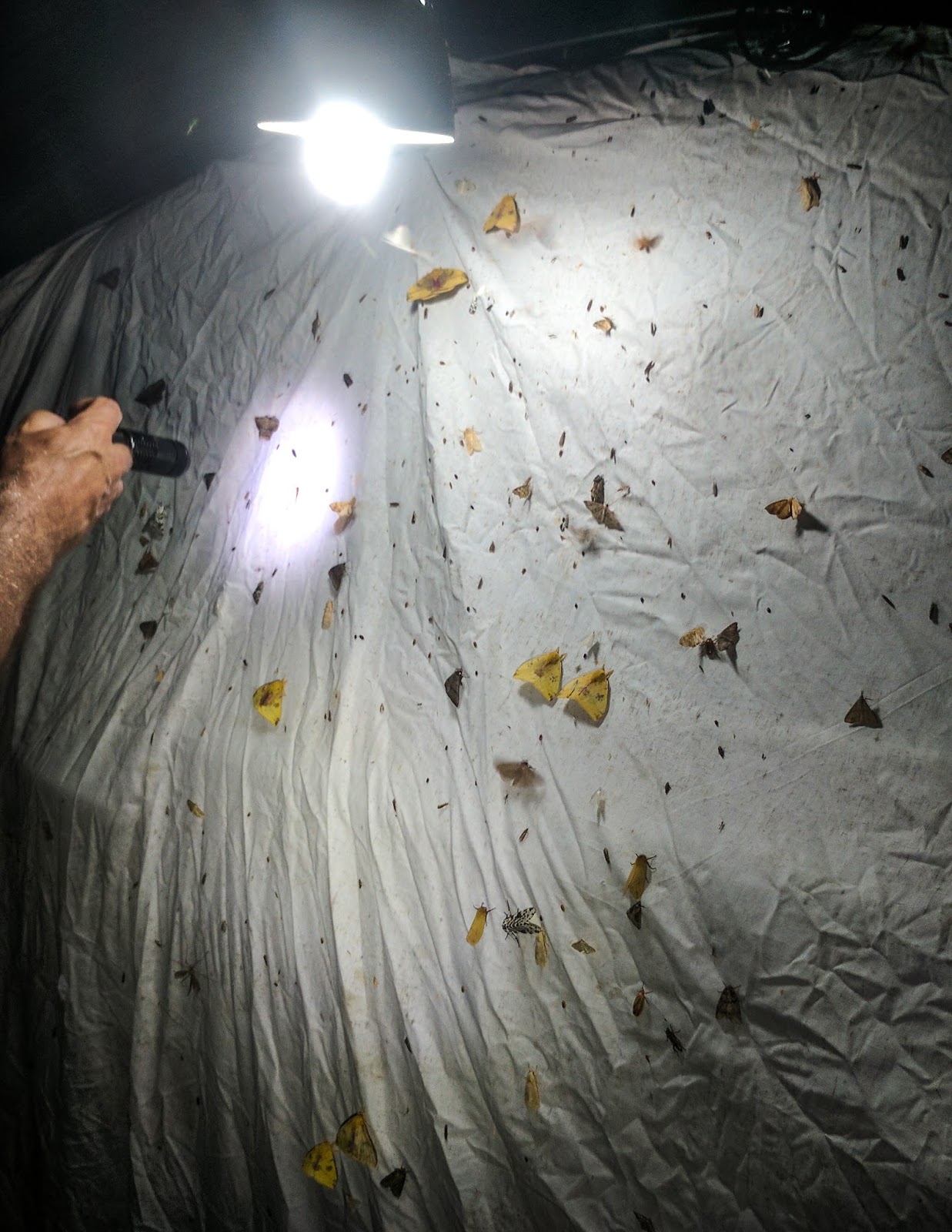
Weather plays an important part when it comes to mothing. As a general rule, moths like warm and dark nights. The darker and warmer the night, the more moths you will see. Luckily, the night was not only in the mid 70's, but was also pitch black. No Moon was out, and clouds covered the sky. The amount of moths flying and visiting the mothing sheets was incredible, as the photo above shows.

Io Moth (Automeris io) Ohio
I'll begin with the Io Moth (Automeris io). The Io Moth is a stunning species in the Saturniidae family, the same family the contains other knockout species like the Luna Moth, Cecropia Moth, and the Imperial Moth. The Io Moth is a relatively common moth across the entirety of Ohio, and over a dozen visited the sheets during the course of the night. As you have probably noticed, the wings of the Io Moth have two large eye spots. These eye spots serve to ward off predators. The Io Moth typically sits with its wings closed. If a potential predators comes near, the Io Moth will open its wings and flash its eye spots. If everything goes according to plan, the surprised predator should back off, giving the Io Moth time to escape.


Painted Lichen Moth (Hypoprepia fucosa) Ohio
Moths have a diverse array of anti-predator defense mechanisms, and not all are based on appearances. Take the Painted Lichen Moth (Hypoprepia fucosa), for example. This species, along with many other related tiger moths (subfamily Arctiinae), has another line of defense. When the Painted Lichen Moth flies at night, they are at risk of being eaten by various bat species. The Painted Lichen Moth is semi-toxic though, and relatively unpalatable to bats. The problem is, bats won't be able to see the red-orange-black warning coloration of the moth at night. So how does the moth let bats know not to try to eat it? They click! When a bat is in the area making its own clicking noises for echolocation, the Painted Lichen Moth will hear the bat and begin clicking in defense. This lets the bat know that this moth isn't a good meal, and the bat will hopefully leave the moth alone.

Orange-Headed Epicallima (Epicallima argenticinctella) Ohio
This tiny moth is the Orange-Headed Epicallima (Epicallima argenticinctella). This species inhabits deciduous forests, where the caterpillars feed on elm trees. The Orange-Headed Epicallima is what is commonly known as a micro-moth. "Micro-moth" is general name given to tiny moths. There is no strict definition of a micro-moth, but most people seem to consider moths that are 1/2 inch long or smaller as a micro-moth. Identifying micro-moths is oftentimes a difficult process, but the Orange-Headed Epicallima is one of the more easily-identifiable species.

Labyrinth Moth (Phaecasiophora niveiguttana) Ohio
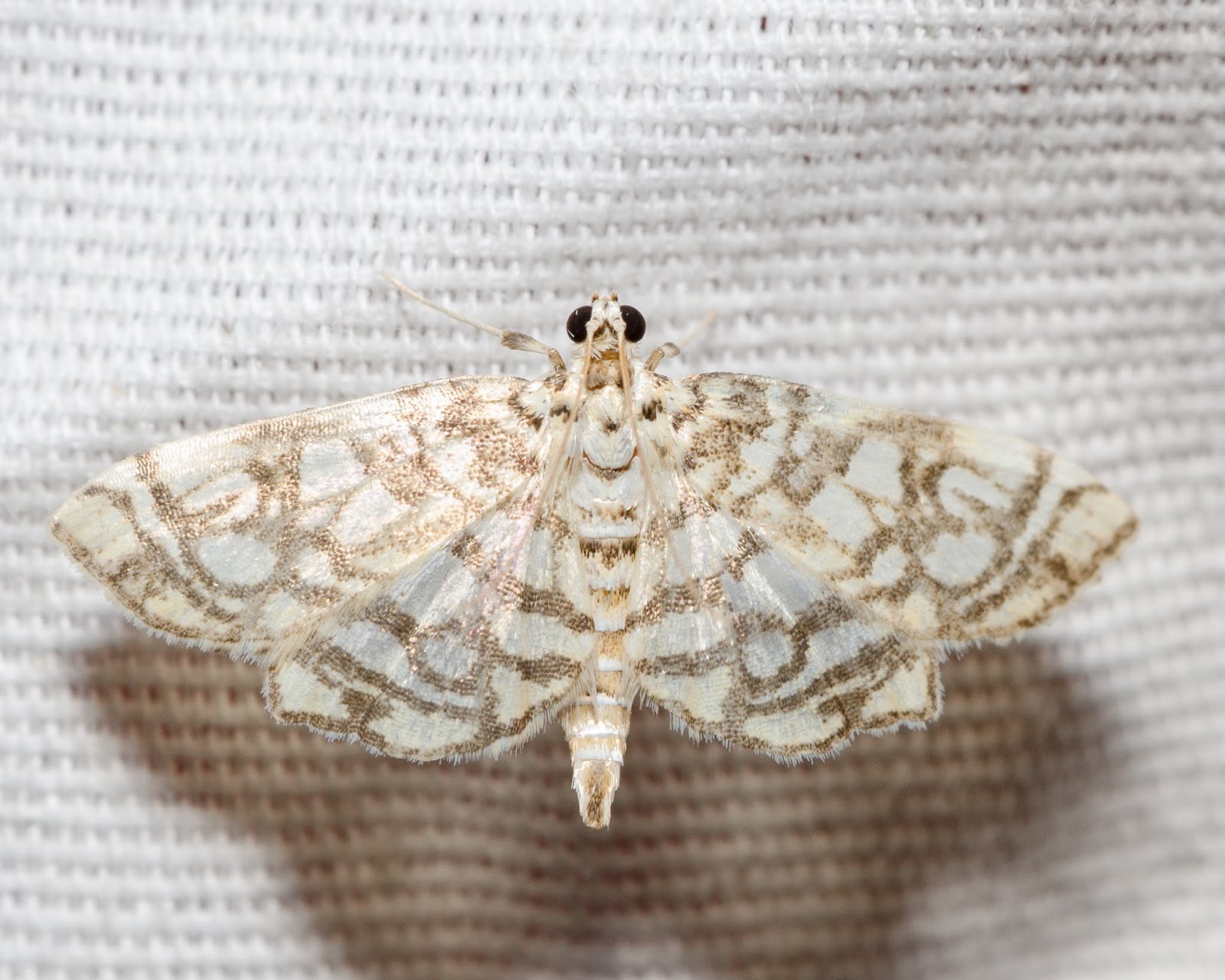
Another showy micro-moth of the night was the Labyrinth Moth (Phaecasiophora niveiguttana). The caterpillars of this species feed on the mid-story tree species Sassafras and Witch Hazel. This moth gave me quite the headache, and this frustration underscores a problem with arthropod field guides. I must have flipped through the Peterson Field Guide to Moths of Northeastern North America a good 5-7 times while trying to identify this moth, but I simply couldn't find it. I posted a photo of it on the Facebook group Mothing Ohio to see if someone could help. Within a few minutes a member ID'ed it for me, and I soon realized why I couldn't find it in the guide—it wasn't in there! When it comes to arthropods, there are tens of thousands of species. There are over 11,000 species of moths alone in North America! A field guide can not simply contain every single species with numbers like these, even if that guide only focuses on one group of arthropods in one section of the continent like the Peterson Guide does. Choices have to be made on what to include and what to exclude, and the authors of the Peterson Field Guide to Moths only included "1,500 of the most common or most eye-catching moths in" Northeastern North America. Luckily, the internet fills in these field guide gaps, and Facebook groups or sites like BugGuide will help you out!

Giant Leopard Moth (Hypercompe scribonia) Ohio
When I was a young kid, this was the first moth that I learned the name of. This is the Giant Leopard Moth (Hypercompe scribonia). The Giant Leopard Moth, along with the Polyphemus Moth, were my two "spark moths." A spark animal is the colloquial term for a species that inspires a curiosity or admiration of a given group of animals in a person. The individual pictured above is actually a female Giant Leopard Moth, as can be told by the loss of wing scales on the ends of the wings. When Giant Leopard Moths mate, the male and female will stay attached for 24 or more hours. During this long-lasting session of mating, the male will position his wings over the female's. This results in the male accidentally rubbing off the female's wing scales, leading to an appearance like this.

The Neighbor (Haploa contigua) Ohio
Staying with black and white moths for a moment, here's The Neighbor (Haploa contigua). Moths have the best names, don't they? The Neighbor belongs to a group of tiger moths in the genus Haploa, which are often referred to as the haploa moths. haploa moths all have various black lines set against white wings, and identification involves carefully studying the patterns of those black lines. To see the diversity of wing patterns in the haploa moths, check out this BugGuide link.

Beautiful Wood Nymph (Eudryas grata) Ohio
This is the Beautiful Wood Nymph (Eudryas grata). The Beautiful Wood Nymph is just one of several moth species which are hypothesized to be mimicking bird droppings. Imagine you're a small predator making your way through the forest in search of a meal. If this moth was just sitting on a leaf out in the open, you would probably be quick to dismiss it as some unsavory bird feces. You would move on in search of some actual tasty food, and the Beautiful Wood Nymph would live another day.

Dark-Banded Geometer (Ecliptopera atricolorata)
This stunning moth is the Dark-Banded Geometer (Ecliptopera atricolorata). For many, this was moth highlight of the night. This is another relatively uncommon species that is missing from the Peterson Field Guide to Moths. Typically when I write a post like this, I try to find at least one neat fact to share for each species. The problem is, I can barely find any information on this species. I did, however, find a quote about this moth from the famous Lepidopterist and naturalist William Jacob Holland in his 1903 book entitled The Moth Book. Holland writes that the Dark-Banded Geometer is "One of the most beautiful of the geometrid moths found in the Atlantic States." There you have it: the Dark-Banded Geometer, always a show stopper.

Polyphemus Moth (Antheraea polyphemus) Ohio
I'll end with the very last moth of the night. This gigantic beauty is the Polyphemus Moth (Antheraea polyphemus). Due to Columbus Metro Park rules, the moth night had to officially end at midnight. The night, however, did not end there. After shutting down the mothing sheets, many of the moth-ers traveled down the road to a gas station that straddles the intersection of Clear Creek Road and US Route 33. Why travel to a gas station, you might ask? Well, there are bright lights, and these lights attract moths. We might not have been able to moth in Clear Creek Metro Park at that point, but we could still moth at a gas station! And yes, I realize how absolutely ridiculous this must sound to those of you not into moths. As I mentioned earlier in this post, the Polyphemus was one of my spark moths, and you can probably see why. This thing is huge. Just to give you an idea of size, my hand is about 8 inches long. This Polyphemus moth has about a 6 inch wingspan, making it one of the largest moth species in Ohio. It's hard not to stop and take a closer look at this moth, even for those who might hate insects.

- - -

That wraps up my two-part series on some of the moths of Clear Creek Metro Park. Once again, the first part can be found at this link: Mothing at Clear Creek: The Subtle. Thanks for reading!

Saturday, June 24, 2017

Mothing at Clear Creek: The Subtle

Last weekend I had the pleasure of attending a moth night at Clear Creek Metro Park. The attendees saw a lot of moths over the course of the night, and I wanted to highlight a few species in particular. I'll be doing so in two posts; this post will focus on some of the more drab and subtle moth species of the night, while the next post will focus on the more showy and colorful moth species of the night!

EDIT: Click on this link to see the second post covering the showy moths of the night.

Mothing in Ohio


Moth nights are fun. The activity of mothing—a hobby involving the pursuit of moth diversity—centers primarily around moth sheets, like the ones pictured above. Moth sheets in themselves are nothing special; they're just plain white bed sheets. The magic lies in the lighting. Although normal household lights will attract moths here and there, you really need to use one of two types of special lights to really attract the moths. UV lights and mercury vapor lights are the weapon of choice here, with mercury vapor lights being the best of the best. This moth night at Clear Creek consisted of 4 mothing sheets set up throughout one section of the park. Several dozens of various moth species visited each sheet over the night, so let's jump right into some of the more drab and subtle species of the night!

Common Lytrosis (Lytrosis unitaria)
First up is the Common Lytrosis (Lytrosis unitaria). The Common Lytrosis is a rather large moth, coming in with around a 3 inch wingspan. I think this is a perfect species to start out with. If it were to fly by you, you might simply dismiss it as a big brown moth. But upon closer inspection, you would see all the minute and intricate details present in the wings. We humans tend to like the showy, eye-grabbing things in life, and we often skip over things that don't instantly grab our attention. But if you start taking a closer look at those "boring" things, you will soon find that they aren't so boring after all.

Barred Granite (Speranza subcessaria)
Mothing is like looking at abstract art. With abstract art, the appeal lies not within some straightforward meaning that the elements of the artwork create, but instead lies within the elements of the artwork themselvesthe colors and the contrast, the changing patterns across the canvas, the lines that take you on a journey through the artwork. The appeal of mothing, at least in my opinion, is the same. It's just fun to look closely at each species and see how all the colors, patterns, and lines interact with each other, and how that changes from species to species. This moth is called the Barred Granite (Speranza subcessaria), and its dark patches set among a pale gray background is a great example of contrasting elements.

Hemlock Angle (Macaria fissinotata)
One of the most enjoyable parts of mothing lies in the process of identification. This is the Hemlock Angle (Macaria fissinotata). At first glance, it looks almost identical to the previous Barred Granite, but closer inspection reveals differences in patterning. When I go mothing, I take photos of everything I see. I then spend the next week or so trying to identify each species from the comfort of my home. I use the Peterson Field Guide to Moths of Northeastern North America for this part. Identifying moths can be super frustrating, but in a fun way. Identifying these drab moths involves a lot of flipping from page to page through the Peterson Guide. Over and over. Again and again. Eventually you find the species you're looking for (but not always). As the name of this species implies, the larvae feed on Eastern Hemlock and occasionally Basalm Fir. Clear Creek Metro Park has a big population of Eastern Hemlocks, so it's no surprise that the Hemlock Angle is there!

Pale Metanema (Metanema inatomaria)
When I first saw this moth, I thought it was some species of emerald (subfamily Geometrinae), but it's actually the Pale Metanema (Metanema inatomaria) in the subfamily Ennomina. The caterpillar of the Pale Metanema uses various poplar species, and occasionally willows, as a host.

Bog Lygropia (Lygropia rivulalis)
This is a Bog Lygropia (Lygropia rivulalis). When it comes to most moths, we really don't know much information about their natural history. With most species, we at least know what types of plants the caterpillars feed on. With the Bog Lygropia, we don't even know that. In fact, from what I can tell we don't even know what the caterpillar looks like! There's so much fundamental information we're missing when it comes to the dark side of Lepidoptera.

The Beggar (Eubaphe mendica)
This is The Beggar (Eubaphe mendica), a rather common sight at mothing sheets. The common names of moths are strange. For decades, there were no common names. When people began "getting into" moths, those who made guides decided that they needed common names in addition to the scientific names. To solve this problem, they simply began making names up! Some common names were based off the scientific names. For example, the Bog Lygropia is called such because its scientific name is Lygropia rivulalis and it prefers wet and boggy areas. Other names are not as straightforward, and The Beggar is one such example. No one is exactly sure why it's call that, but the speculation is that whoever named it thought the dark patches on the wings looked like the holes in a stereotypical beggar's clothes.

Adult Woolly Bear
Next up is the Isabella Tiger Moth, which you probably better know as the Woolly Bear (Pyrrharctia isabella). A single individual visited the mothing sheet that night, and it happened to be a very worn individual that had lost a lot of its patterning. Luckily, there isn't much else that looks like an adult Isabella Tiger Moth. If you've ever wondered what the Woolly Bear turns into after metamorphosis, now you know! Side note: If you want to learn about some more "fuzzy" caterpillars, check out my previous post "Caterpillars of the Fuzzy Variety."

Arched Hooktip (Drepana arcuata)
I'll end this post with the Arched Hooktip (Drepana arcuata). The adults are your typical moth; the caterpillars, however, are unique. During the Arched Hooktip's caterpillar stage, the caterpillars like to be with other caterpillars of the same species. How do they find other caterpillars? They drum! One caterpillar will roll a leaf up, tighten it down with silk, and then crawl inside this new home. Once inside, the caterpillar will begin making vibrations by dragging parts of its anal segments against the leaf, drumming with its mouthparts, and performing a series of other actions. The resulting vibrations are a signal to any nearby Arched Hooktip caterpillars to come over and hang out in the new leaf shelter and eat together. This communicative behavior is super interesting, and very unique among the moths (at least from what we currently know). If you want to read more, here is a link to the original study: Invitation by vibration: recruitment to feeding shelters in social caterpillars

That's it for this post! I'll have the next post covering some of the showy moths up in a few days. Thanks for reading!

EDIT: Click on this link to see the second post covering the showy moths of the night.